What the Loom Could Not Count
Story
WHAT THE LOOM COULD NOT COUNT
The last bell had not yet sounded in Threadhall, but the loom hall was already gathering the particular silence of a place where everyone had been told that tomorrow would be different.
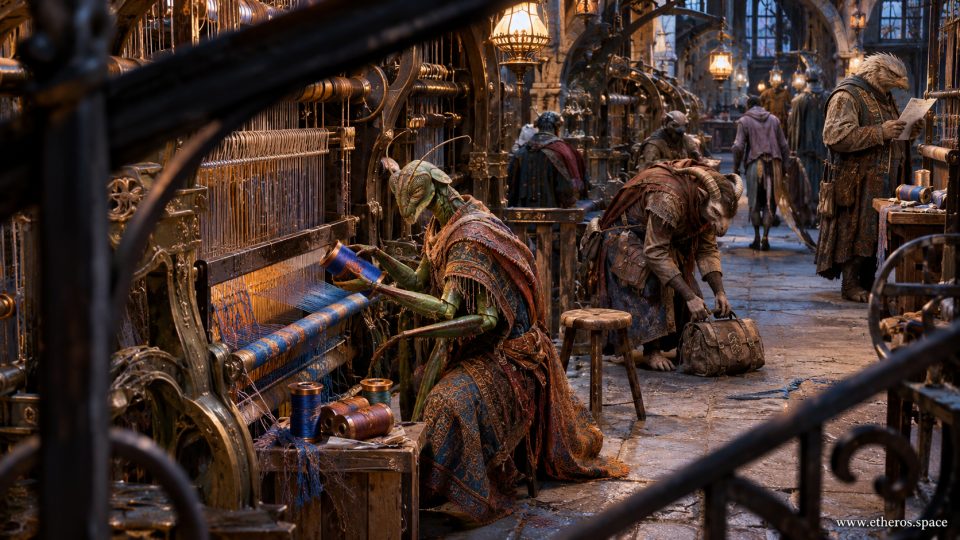
In the first aisle a mantis-faced weaver sat close to a broad machine, green forearms crossing above a cylinder of blue yarn. Her name was Veyra. The shawl around her shoulders had been repaired so many times that the repairs had become a history of their own: orange edging from her mother's house, a narrow violet strip from a winter apprenticeship, and a patch made by someone who would not now answer her letters. The blue thread pulled taut between her fingers and the loom. It was ordinary material, except that she knew when it was about to snap from a tremor too small for any measuring needle.
The factory had once worked in three separate halls. Now, beyond Veyra, self-tensioning frames turned under a common drive. They were faster, and often safer, and no honest person could deny that they had made heavy cloth affordable to families who had spent generations sewing worn blankets together. But the council had begun to assign each loom a new crew, and each person a new station, and the numbers on the page seemed to have forgotten what was carried inside a pair of hands.
Bren, the horned porter, bent beside a satchel in the aisle. It was not full enough for a journey, only heavy enough to make its owner feel he had packed something. He had been told that cart hauling would be consolidated with the new winding line. He was not yet dismissed; neither was he promised a place. He had spent the afternoon walking between offices because everyone was waiting for someone else's signature.
At the far side of the hall, a feather-headed clerk named Halen studied a sheet held close to the lamplight. From Veyra's stool he looked like another ordinary reader of factory accounts. She knew him as the person who checked damaged cloth against the receiving ledgers. He was not responsible for the new arrangement, yet people had begun to fall quiet when he walked past. He disliked that silence more than their accusations.
'If the new frame can do everything,' Bren said without looking up, 'why are you still winding the old spindle?'
Veyra passed the thread between her fingers. 'Because this one does not yet know where to stop.'
She drew out a span of blue fabric and exposed a subtle unevenness near its edge. A child wearing a soft-feathered collar would never notice it until the seam pressed against the throat. The new tensioning frame had kept its measure perfectly; it had also kept the mistake perfectly. A living hand could feel the difference in resistance where the yarn crossed a hidden knot. A machine could be taught the same warning, perhaps, but only if someone bothered to describe it.
Bren placed the satchel upright, where it stood like a patient animal. 'You cannot train a frame with a sad story.'
'No,' Veyra said. 'But you can train it with a true one.'
Halen came over carrying the ledger. On the open page were spaces for the mass of cloth, the hours of fuel, the number of completed lengths, and the cost of replacing an operator. There was no space for a sore neck, for a child missing school because her mother's shift moved across the valley, or for the bent finger of an elder who could teach every apprentice what a flawed thread felt like. Veyra did not ask him to abandon the accounting. She asked him to add a column.
'For what?' he said.
'For what the account cannot presently see.'
The three listened to the machinery. Behind them, another worker crossed the long aisle with a bundle of cloth; the overhead lights trembled in their housings; the hollow body of the building took the regular pressure of its moving frames. Nothing was collapsing. Neither was anything settled.
They began with one blue length. Halen wrote down its measurement and the defect the machine had overlooked. Bren marked which delivery route could supply the next testing shift without keeping a driver awake all night. Veyra described the hands needed to inspect the cloth, then stopped herself and replaced *hands* with *skills*. Threadhall employed many kinds of bodies. Some held three shuttles at once; some saw better in dusk than under a high lamp; some needed a lower seat or a slower foot control. The old roster had accommodated these differences imperfectly. A new one could either learn from those failures or erase the people who had lived with them.
Their first proposal was small: the new frames would continue operating, but no worker would be reassigned permanently until the crews had tested each design for the bodies who would wear it. Apprentices and experienced weavers would make those tests together. The council would have to answer questions about travel, income, and training in public rather than behind the locked doors of its upper office. The promise was not a victory. It was a way for an argument to become work.
When the bell finally rang, some of the looms stopped and others continued to turn. The cold blue light of evening seeped through the tall windows. Bren shouldered his satchel but did not leave. Halen folded the page and returned to his ledger. Veyra drew out one more span of blue thread and laid her fingertips against its surface.
She could not tell whether Threadhall would employ her in another season. She knew only that tomorrow, when the engines started, there would be a new column on the page, and that for one evening three people had refused to pretend it had always been there.