The Names Beneath the Sapling
Story
THE NAMES BENEATH THE SAPLING
In Merrowroot, the paths of the remembrance garden were repaired more often than the houses. It stood on dry ground beneath a lattice of old stone arches, between a low ridge of terraces and the thickened roots through which Etheros slowly tended its own soil. No one called it a cemetery. Some of the people honored there had left no bodies; others had shed wings, shells, or entire forms in the ordinary course of long lives. The garden kept what their neighbors could still care for.
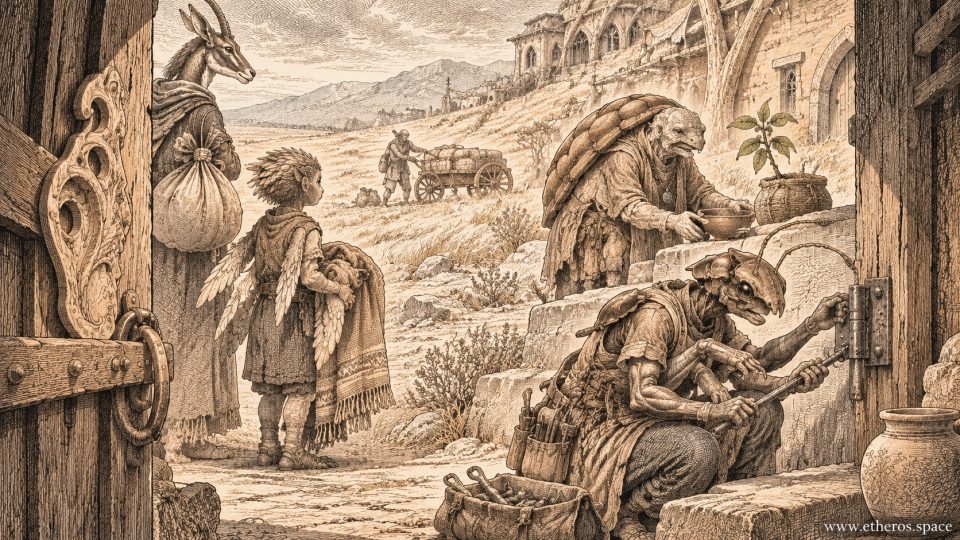
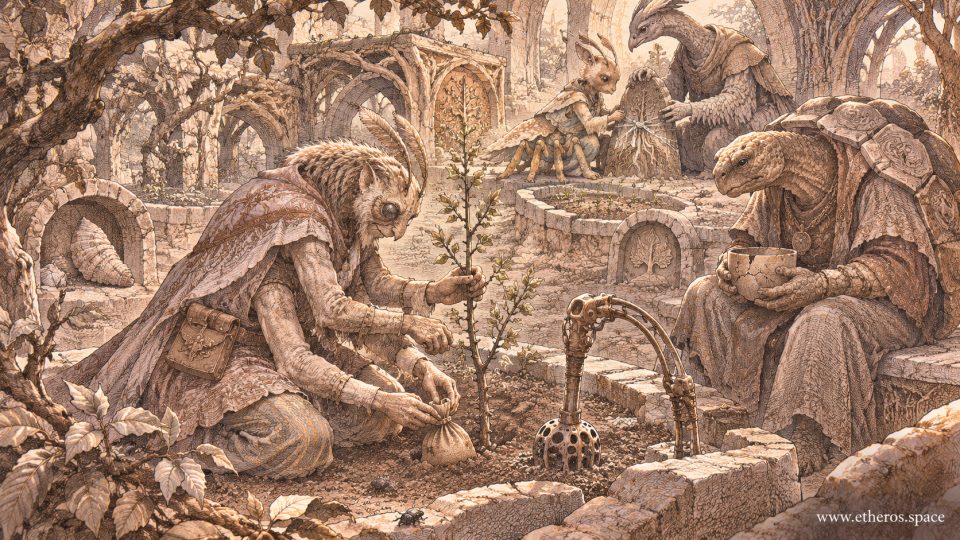
By the time morning reached the engraved paving, Iven Rhul had found a place for the young thornroot. He knelt in the soft earth, his mothlike face lowered to the leaves and his four working hands occupied with two tasks: steadying the sapling and settling a small cloth packet into the soil. His outer cloak had caught the dust of the upper path. A brass-root fitting rose out of the planted bed beside him, its perforated bulb half buried and its slender arched stem leading beneath the stones. It was a modest part of the garden's living system, not a miracle that exempted anyone from weeding, tending, or paying attention.
Across the bed sat Mora Hesk, whose broad shell had acquired more repaired ridges than its owner cared to count. She held a cracked ceramic bowl in both hands. A lesser potter might have declared it unusable, but it had spent twenty-three growing seasons holding seeds from the western ledges, and she had insisted on bringing it again. The bowl was empty now. That was not a symbol arranged for the ceremony; its last seeds were already in Iven's packet.
Behind them, at a higher root marker, Tiri struggled with a narrow tie. The child's long ears were alert, while the several small, sure-footed limbs underneath were packed tightly against the stone edge. Esh Var, an avian guardian with the patience of someone accustomed to untangling other people's work, bent forward to show how the ribbon should sit so that it would not constrict the living wood as it thickened. Neither watched the older two. In the garden, remembering was generally a series of small repairs made by people absorbed in what was directly in front of them.
The young thornroot was for Thaen, Mora's brother. He had spent his working years clearing the low root-channels when the dry season hardened their mouths with grit. For much of that time the work had appeared in no public record. A channel might flow for a season, a building might remain upright, and those in the higher galleries would thank the soil itself. Mora knew that the planet was alive and worked continuously to maintain its forms. She also knew which arthritic hands had cleaned the narrow openings when the living tendons could not flex far enough.
A clerk had offered to cut the simple trade mark of a maintenance worker into Thaen's stone. Mora refused it. The mark would have placed him among the official guilds to which he had never been admitted. Instead she requested the smallest unmarked stone, and asked that the tree be allowed to grow where the roots of the old arch could shelter it. Iven considered the request too quiet. A future visitor, he worried, would find another anonymous planting and know nothing of the person who had kept this part of the city alive.
They had disagreed for three mornings. No one had won. That was why Iven had brought a seedling rather than a chisel.
"Then remember what he actually did," Mora said, as Iven adjusted the packet. She did not mean that he should abandon the name. She meant that the channel alongside the bed needed cleaning before the next dustfall. A family might honor someone by carving a history no one could verify, or it might undertake one practical task that the person had once performed. The choice was not entirely fair: memory should not depend upon a surviving relative's ability to work. Iven told her so, and she nodded. They would need both a place for the forgotten names and neighbors willing to tend it after their own families had moved on.
The shell-backed elder lifted the empty bowl as if to offer it, then set it on the stone beside her. Iven did not plant the bowl. It could carry seeds again next season, or be lent to a family who had arrived with no keepsake at all. Nearby, the child's ribbon finally lay flat against the marker. Tiri drew back one careful limb to see whether it would hold. Esh did not praise the knot immediately. They waited together for the breeze to test it.
Above the memorial beds, stone ribs arched into a thinning canopy. In the gaps were rooms with small windows, the traces of older paths, and leaves opening toward the light. The garden belonged to a city, not to a single family. It contained monuments to celebrated builders and nameless ridges planted by people who could offer only a seed. No one had resolved how all its histories would be recorded, whether the city would fund the neglected channels next year, or which accounts of old lives were entirely true.
When the breeze came, the new ribbon moved but did not tighten. Tiri smiled without turning toward anyone. Iven pressed the soil once more around the thornroot, careful to leave its branching base room to swell. Mora watched the small leaves trembling in the same air and made no request for a grander inscription. Across Etheros, the planet continued the immense work of sustaining itself. In this little garden, four of its inhabitants attended to the part within reach.