The Path That Had to Hear Both Sides
Story
THE PATH THAT HAD TO HEAR BOTH SIDES
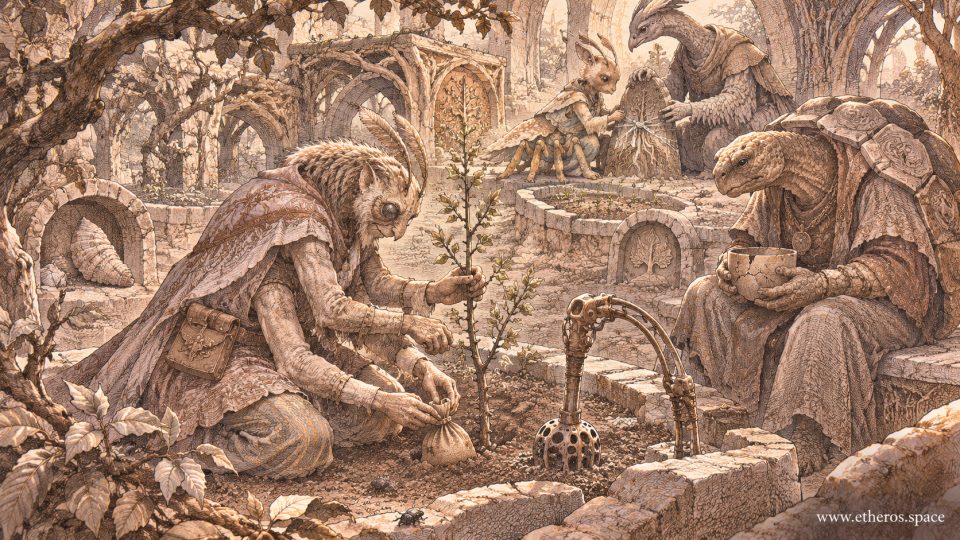
On the Serev saltpan, the most serious disagreements were not shouted. Sound carried strangely over the chalk-white crust. Two people could raise their voices at opposite ends of the basin and spend an entire day mistaking echoes for answers. So the traveling folk had developed a quieter custom: before anyone drew a boundary, they placed the stones on the ground and listened.
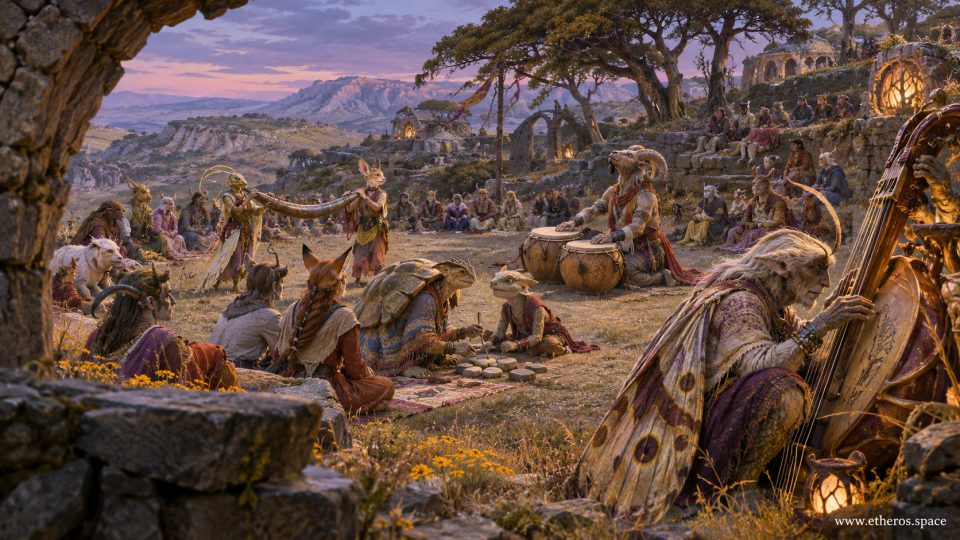
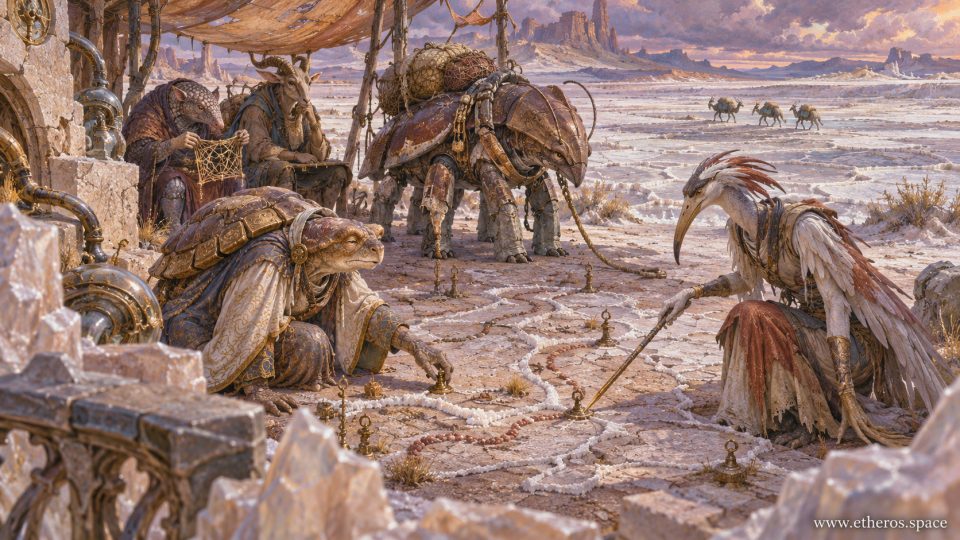
The council that morning was little more than a patched canvas roof beside the abandoned mineral weighhouse. Under it, Peth, a pangolin-faced cordmaker, held a web of dyed measuring threads between the claws of his work-worn hands. Beside him, the horned elder Drun Kel examined a narrow ledger across his knees. Neither looked toward the others; both were watching the pattern that had taken three journeys to assemble.
In front of the awning, Hessa Vurn knelt slowly with her heavy, weather-polished shell tilting toward the earth. Her blue and ochre sleeves dragged across the salt. She set one small brass peg between two pale ridges and looked up at the traveler opposite her. Her name meant Patient Stone in an old dialect, but lately patience had been a task that cost her a great deal.
Iru Vesh, an avian wayfinder whose white and russet crest had faded from a season of dust, held a long reed staff close to the ground. Its tip touched the newest line of salt grains. Between them lay a map made on the actual surface it represented: bright crust for the firm crossings, reddish pebbles for the sheltered hollows, and tiny bronze stakes for places where a heavily burdened animal might safely rest.
Behind them, Sarekh, an enormous plated pack-beast, stood under a netted load and breathed with the deliberate rhythm of a creature conserving its strength. Three smaller cargo animals had already taken the eastern track toward the distant bluffs. Their silhouettes were scarcely larger than seeds against the immense flats. Nobody asked Sarekh to wait for the council's decision. The rope in its halter was slack, and the beast could shift to the shelter of the canvas whenever it wished.
For generations the residents of Serev had kept the old north causeway open to caravans. They received salt-cloth, timber and grain in return. But the pale ground had changed. A section once firm enough for loaded animals now gave a soft, hollow note beneath the hoof. Hessa's community insisted that the western detour should become the only permitted passage. Iru's caravan families objected. The detour meant an additional day with little shade, and their smallest beasts could not carry provisions for a day they had not planned.
Peth had made two maps, and both were honest. His threads revealed where the bedrock lay near the surface. The ledger revealed how much time each route demanded. The trouble was that the drawings answered different questions. A path could be physically passable and still be impossible for the family responsible for walking it.
Drun Kel wanted the council to sign one permanent rule before the afternoon winds rose. He had reason: an inconsistent crossing put settlements on both sides at risk. Yet Iru objected to a rule that could be changed only by those who lived near the meeting place. She pointed, not angrily, to the distant caravan. None of those drivers had a seat under the roof. Their absence could not be treated as consent.
Hessa examined the thin red line of stones, then noticed that its southern end crossed a low, unmarked basin. She pressed her fingers to the crust. Small indentations formed under the pressure and did not vanish. Beneath that patch lived the dry-season burrowers whose tunnels allowed the salt flats to breathe after the rare rains. No creature could see them from here. They had neither a vote nor a voice, but their work kept the causeway from becoming a dead sheet of mineral.
For a while the gathering was silent except for the soft clink of Sarekh's harness. The map had been made for travelers, but the ground itself belonged to more lives than a traveler could count. Iru quietly moved her staff back from the basin. Hessa, in turn, lifted the brass peg that had closed the eastern path. It was not an agreement, only the removal of two certainties that had become too convenient.
They made a smaller decision. Through the next two wind cycles, light caravans could use the older route under a shared guide, while the heavier loads took the northern ridge at cooler hours. Peth would mark the hollow places openly, and one resident from Serev and one traveler would inspect them together. Drun Kel left two spaces blank in the ledger, reserved for accounts from the drivers already beyond the flats. They would decide the lasting rule only after hearing those witnesses.
The canvas shuddered. Hessa replaced the markers along the edge of the map. Iru leaned back upon her heels and studied it with her, neither triumphant. Their agreement would cost labor and might have to change. But no one had been declared wrong merely for standing on the other side of a line.
When the first crosswind came, it passed over the little brass pegs and made the loose measuring cords tremble. Beyond the shelter, the three cargo animals moved slowly toward the far mesas, following a route that had not yet acquired its final name. Their footprints began to fill with dust. For one morning, that uncertainty was not a failure of the council. It was proof that the path was still listening.