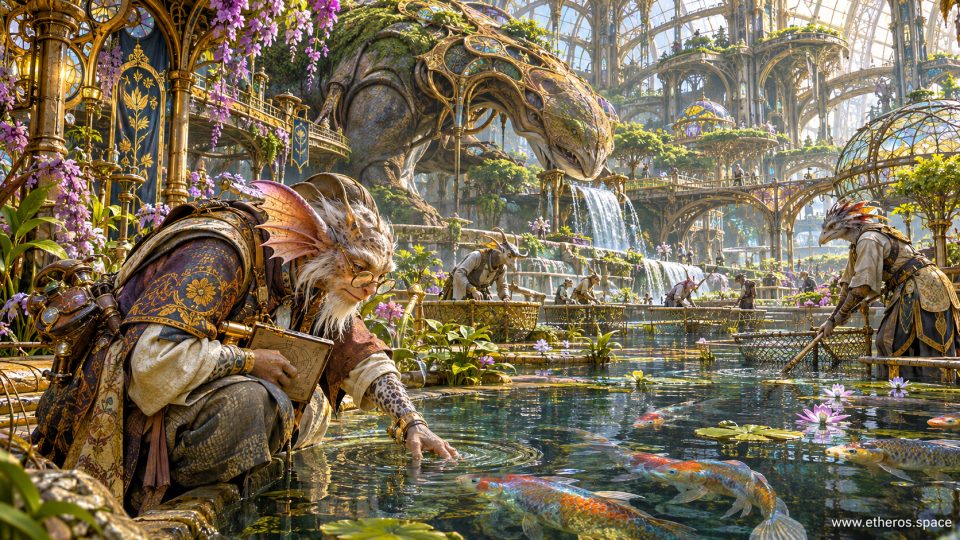
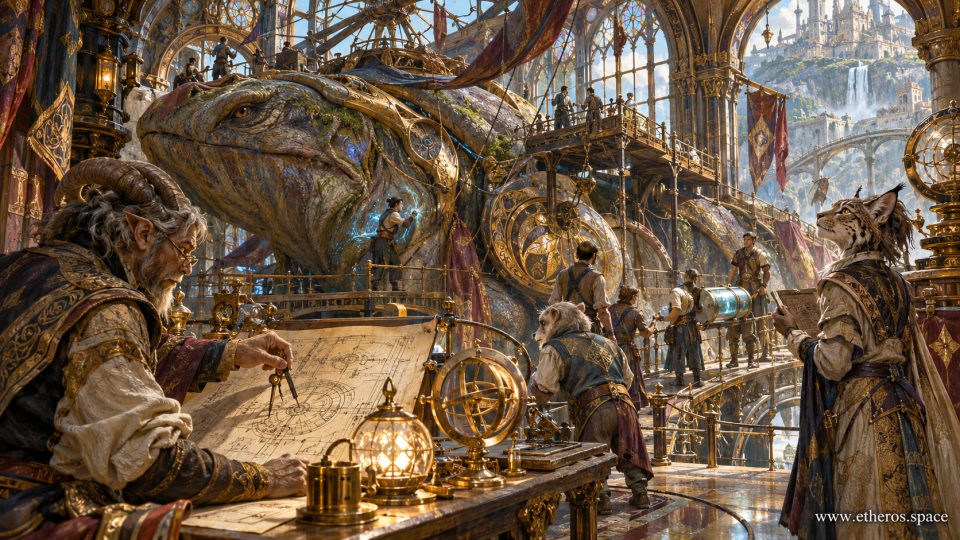
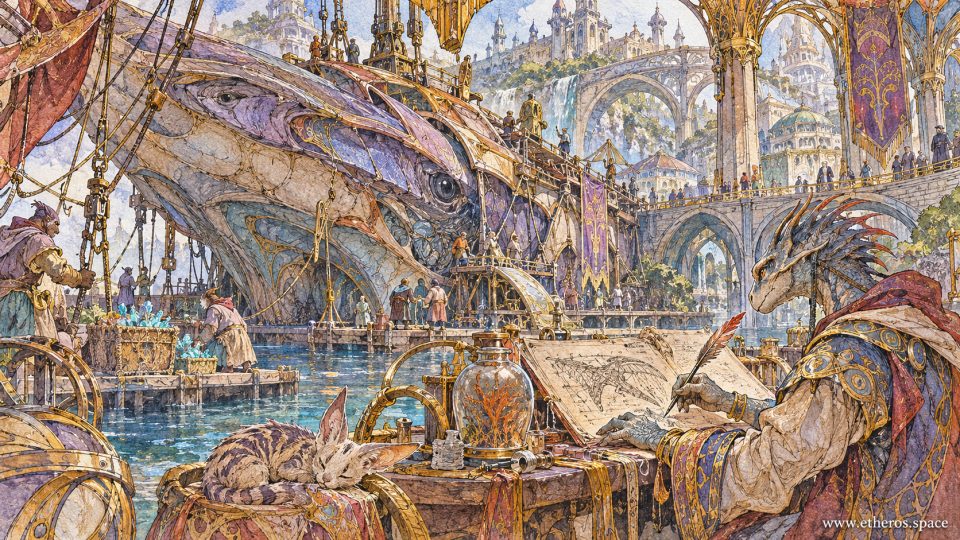
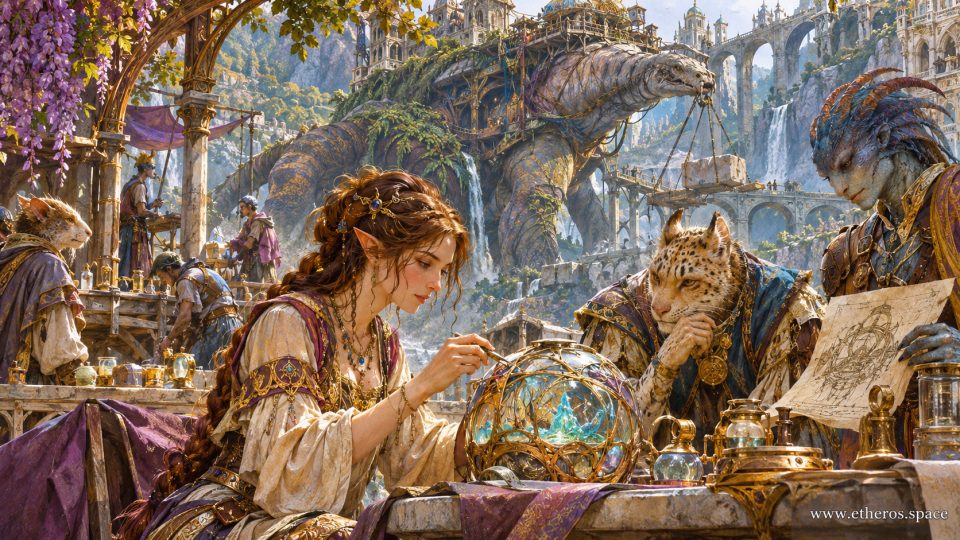
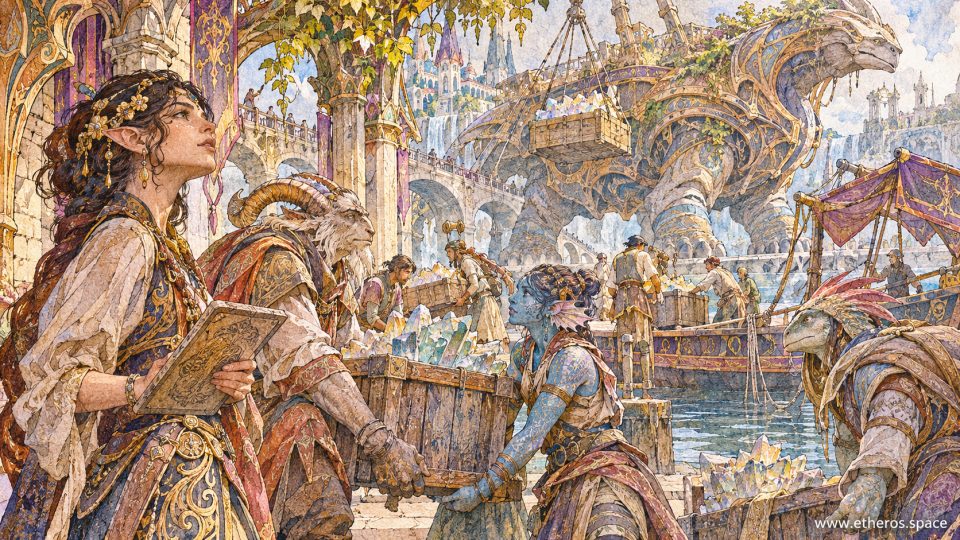
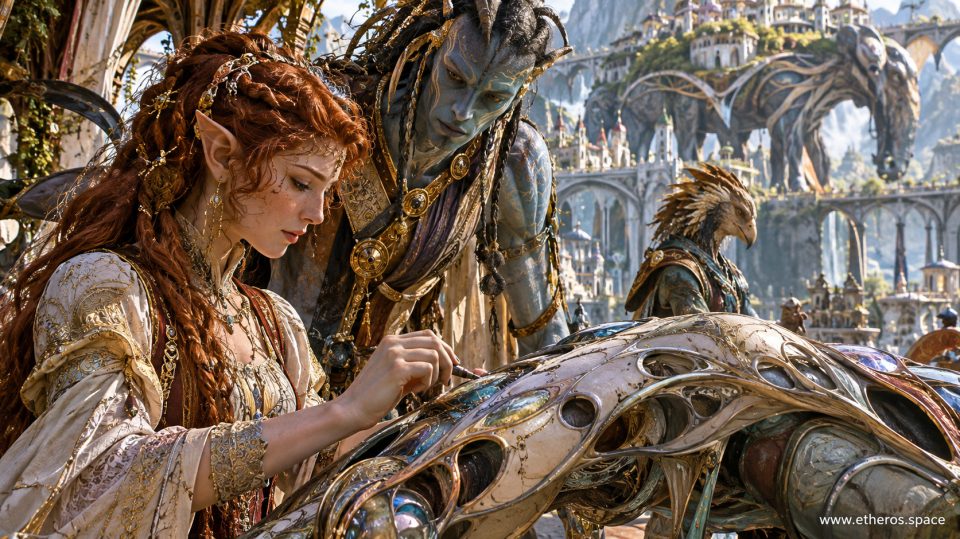
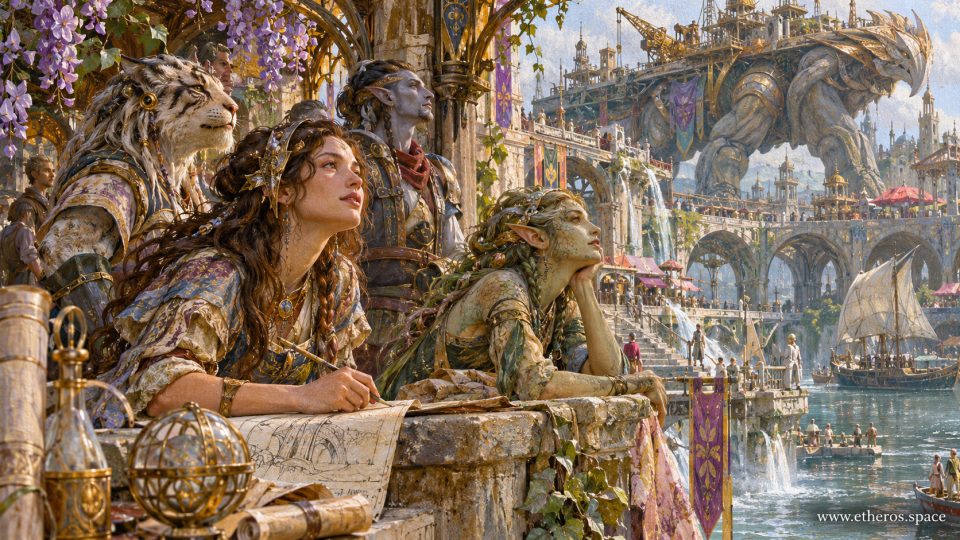
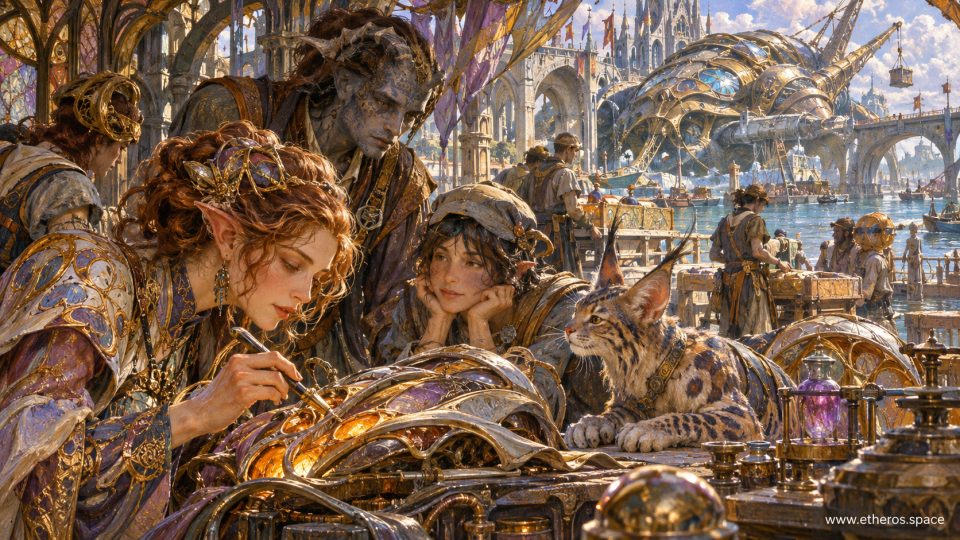
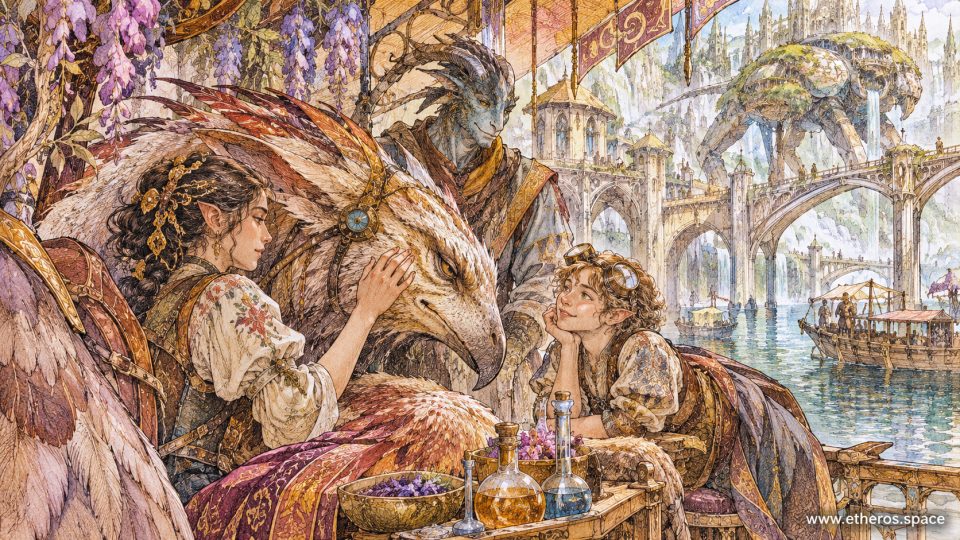
Etheros is not a civilization built upon a planet. It is a civilization living within the life of one.
The Living Planet
There was no single morning on which Etheros awoke. Its intelligence emerged over immense ages: in pressure moving through mineral seams, in roots that learned to share nourishment, in conductive reefs beneath the oceans, in weather systems that seemed to answer the movement of living things. What its inhabitants call the planetary mind is not a sovereign seated at the center of the world. It is a vast, uneven conversation among geology, water, forests, cities, machines and the countless beings whose lives intersect them.
Every settlement rests upon a substrate capable of remembering damage. Beneath streets and wetlands, living conduits transport heat, water, resources and information. Some are older than recorded history. Others were grown last week to mend a fractured district. Etheros tends itself, but never perfectly: a hillside may heal too slowly, a canal may silt up, or a population may disagree with the planet's choice of repair. Its care has limits, and those limits make the world both beautiful and vulnerable.
Children of the Substrate
On distant horizons stand the planet-born behemoths. They are neither gods nor ordinary manufactured robots. They begin in enormous biological foundries rooted in the planetary crust, where minerals, recycled alloys, vascular tissues and cybernetic organs are shaped together. A cradle grows the skeleton and load-bearing spine. Articulated limbs, sensors, rotors, tendons, hydraulic systems and neural interfaces are assembled according to a future task. The newborn machine must learn its balance, its power, its work and the geography it will serve.
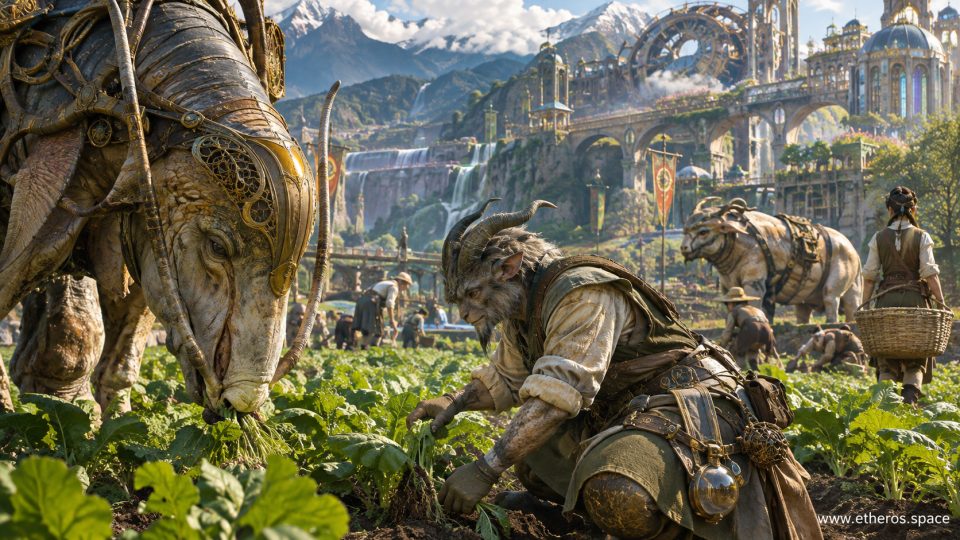
One ancient, many-limbed excavator may spend centuries uncovering a buried river. A suspended carrier may transport an entire nursery across a rain-soaked gulf. A slender, avian machine may distribute water and nutrients through a dying canopy. Others stabilize buildings, weave infrastructure into living towers, lift damaged bridges, deliver medical supplies or restore exhausted soil. Each has a birthplace, an individual history, an age, a web of relationships and a future that may be uncertain. Tools scar their bodies; repairs leave visible generations of anatomy. Nothing materializes from nowhere, and no machine vanishes merely because a story turns elsewhere.
These colossal caretakers are part of ordinary life. In many inhabited territories, their distant silhouettes are as familiar as passing weather. A child on the way to school may barely notice a hovering restorer opening an irrigation line above the rooftops. Another child may spend the afternoon watching it, certain that the machine has recognized her. There are ceremonies welcoming newly matured behemoths, engineering unions that debate their routes, and communities that protest excavations which threaten ancestral ground.
Six Kinds of Service
All planetary-born service machines participate in six overlapping labors: Lift, Build, Excavate, Replenish, Nourish and Provide. The words sound simple because the underlying obligations are not. To lift a habitat, a carrier needs a structurally possible grip, sufficient energy and somewhere safe to set it down. To excavate an aquifer, a digger must account for displaced stone and downstream water. To nourish a forest, a restorer must obtain its water and minerals from actual cycles of supply. Every repair consumes something; every generous act changes the conditions of another place.
Etheros is therefore neither an inexhaustible paradise nor a mechanical apocalypse. Its intelligence tries to distribute benefit amid scarcity. A settlement may be saved while another waits. Ancient machinery may fail. Citizens and planetary systems collaborate, negotiate and sometimes oppose one another. The planet's immense responsibility is one of the sources of its tenderness and melancholy.
The Many Peoples
No single anatomy defines an Etherian. Humanlike citizens share streets with beings whose bodies recall birds, insects, mammals, sea creatures and forms without terrestrial equivalents. Some species emerged through long evolutionary histories of mutation, migration, natural selection and isolation. Others owe their existence to elaborate hybrid developmental pathways or deliberate bioengineering. A chimera, a hereditary hybrid and a cybernetically altered individual may resemble one another while having entirely different origins. Their differences matter in medicine, kinship, law and daily life.
Clothing grows from the practical demands of each body. A tailor must consider wings, horns, extra hands, membranes, antennae, tails, breathing structures and moving armor. Historical dress survives alongside contemporary industry and speculative technology: Renaissance fastenings meet weather-reactive fabric; Victorian silhouettes accommodate articulated limbs; ancient textiles are repaired with cultivated biofilaments. Style is personal, ceremonial, occupational and regional. An apprentice mechanic and a grieving singer may live beneath the same skyline and appear to belong to different centuries.
Streets, Ruins and Floating Routes
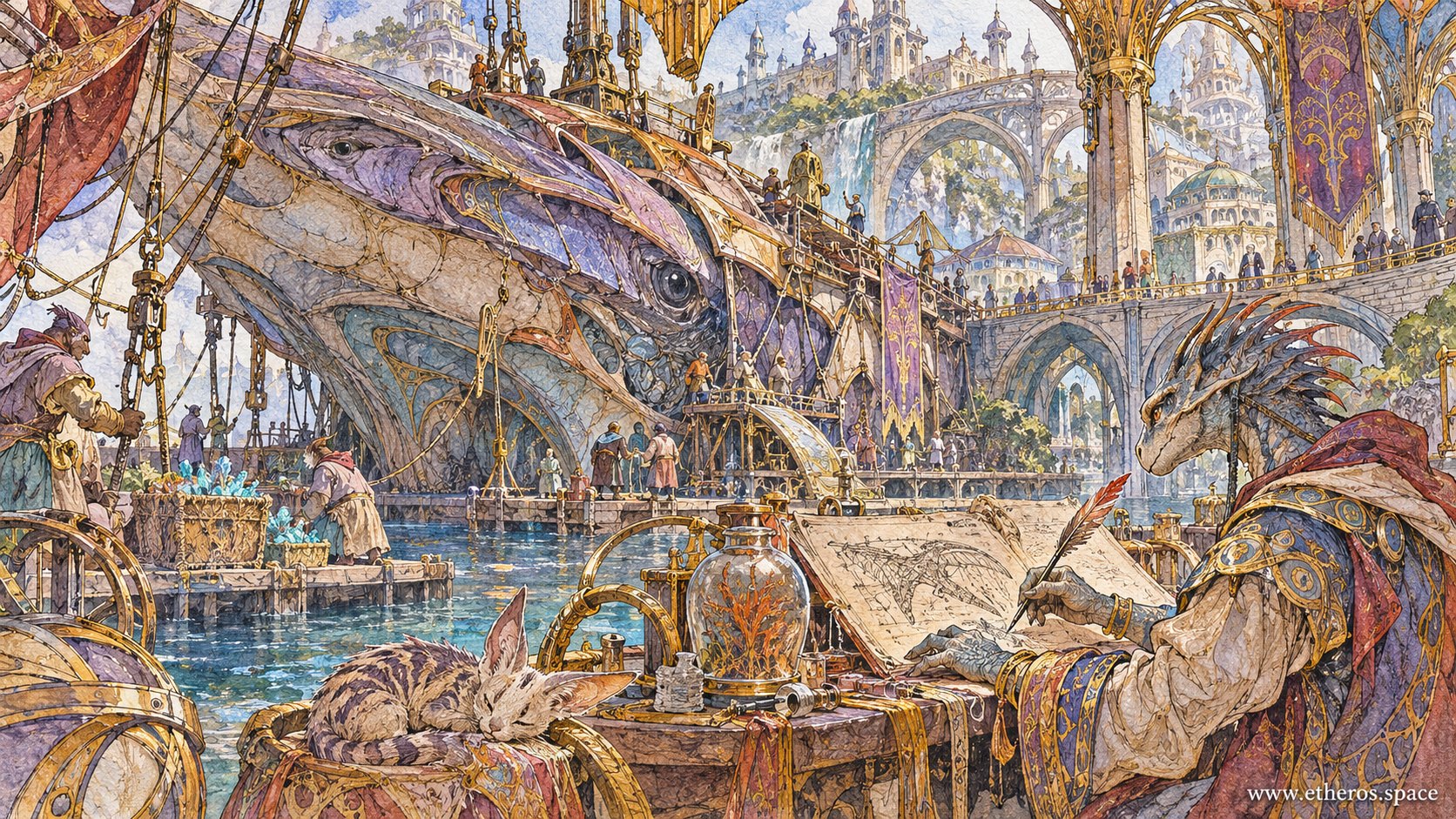
The cities of Etheros are built in layers rather than in one architectural age. Gothic vaults rise from industrial districts; Renaissance courtyards give way to crowded transit crossings; Art Nouveau curves wrap around skeletal, living infrastructure; repairs extend through structures older than the families who occupy them. There are wetland villages, sprawling salvage markets, hospitals, schools, exhausted mining towns, gardens, port districts, underground workshops, immense metropolises, floating archipelagos and habitats suspended above difficult terrain.
Organic architecture is not ornament pasted onto steel. Ribs carry loads. Membranes shed weather. Veins transport water. Metabolic chambers illuminate rooms or regulate temperature. Sensors detect strain and habitation. Older buildings show extensions, patched injuries, obsolete utilities and the marks of those who have loved them. A broken window, a municipal argument or a hand-painted sign may reveal more about a place than its greatest tower.
A Planet with Gravity, Memory and Weather
Some regions possess anomalous gravitational fields. The great hovering machines may use engineered propulsion, distributed suspension, biological levitation, aerodynamic lift or combinations permitted by local physics. Yet their motion is never meant to be consequence-free: forces must balance, payloads impose stresses, energy comes from somewhere, and weather interrupts plans. Mist gathers around enormous working bodies. Rain passes between cables. Forest canopies bend under displaced air. A machine's departure leaves evidence in the world it has changed.
Weather also carries feeling. The atmospheric character of Etheros is often wistful, but melancholy is not emptiness. Markets are full, gardens are cared for, children invent games, lovers miss trains, and neighbors share exhausted jokes while an ancient carrier finishes its work far away. Hope and loss often occupy the same frame. The planet's greatest drama is not always a war or an invention; it can be an ordinary afternoon in which everyone continues living.
One World, Many Ways of Seeing
These artworks belong to one coherent imagined world. A scene has an identity before any rendering style is chosen: its people, creatures, machines, buildings, materials, actions, forces, lighting, moment in history and camera viewpoint are defined independently. The Etheros realism continuum moves from intricate engraved ink through watercolor, painting and cinematic naturalism to a simulated photograph with Nikon D3500, 200 mm and f/5.6 characteristics. The transformation changes how a single scene is represented, not what happened in it.
The principle of world persistence also governs the behemoths. Across a broad portfolio of eligible scenes, working planetary machines appear in roughly sixty-seven percent, but no individual image is forced to display one. A tiny room, an enclosed tunnel or an intimate portrait may have no visible horizon. Where a behemoth is shown, it belongs to a plausible route, a purposeful task and an existing network of cause and consequence. The foreground story remains important even when a titanic caretaker crosses the clouds.
The Archive of Passing Moments
Etheros Space is an illustrated record of this world: artworks and studies, scenes from many societies, portraits of its inhabitants, changing neighborhoods, quiet domestic moments, extraordinary machinery and the stories carried by each image. Each archive entry may contain multiple pictures, audio or moving images. Some posts depict grand planetary restoration; others capture friendship, grief, celebration, labor, boredom or a fleeting expression that deserves to be remembered.
Visitors can explore the archive, view every work closely, listen and watch, follow its RSS feed, share individual images or entire stories, and join the conversation through accounts, comments and community discussions. The art is the doorway; the people and their imagined lives are the reason to return.
Etheros is alive. Not because every horizon contains a machine, but because every place has a past, every living thing has a purpose beyond the frame, and the world continues even when nobody is looking.
 1 media