The Ledger of Blue Light — The Last Cargo at Ravel Quay
Story
At Ravel Quay, the cargo did not arrive when the bells rang. It arrived when the city was ready to bear its weight.
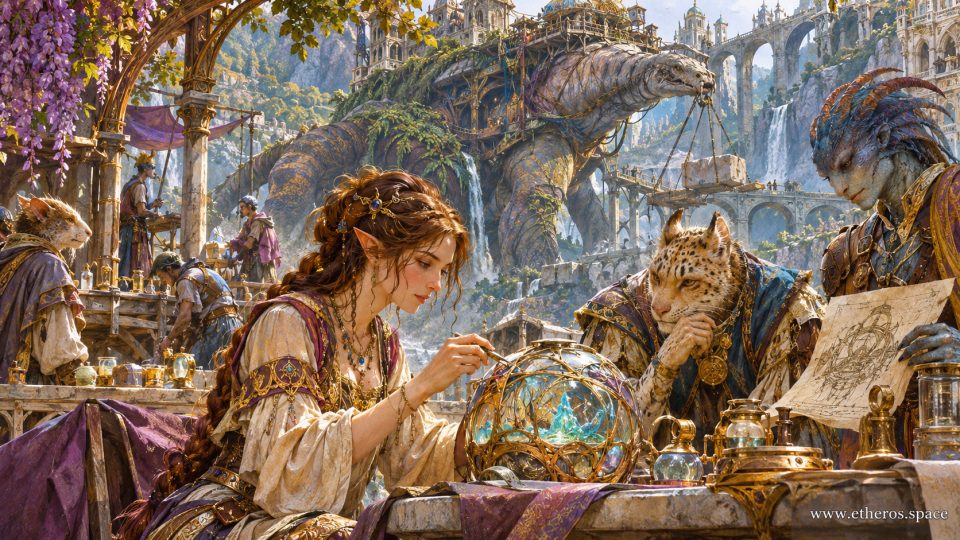
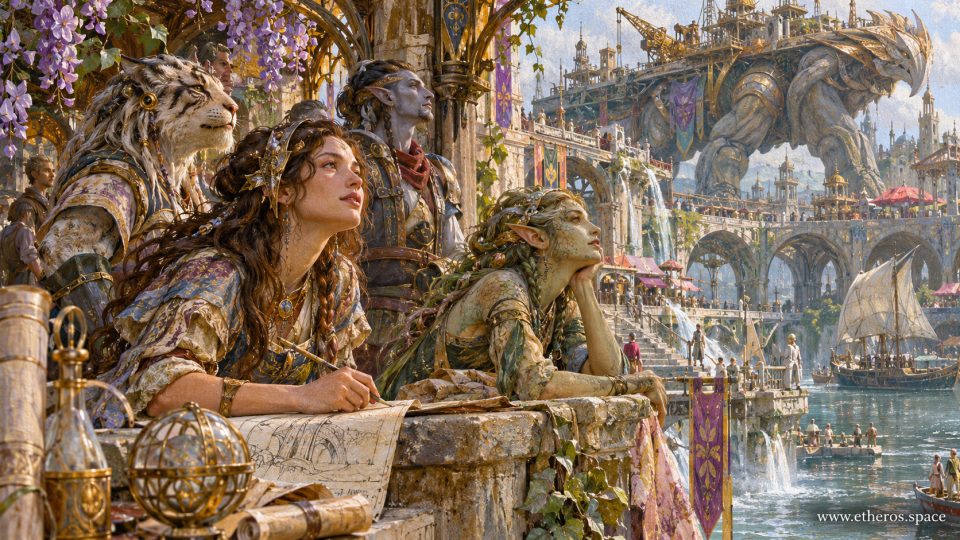
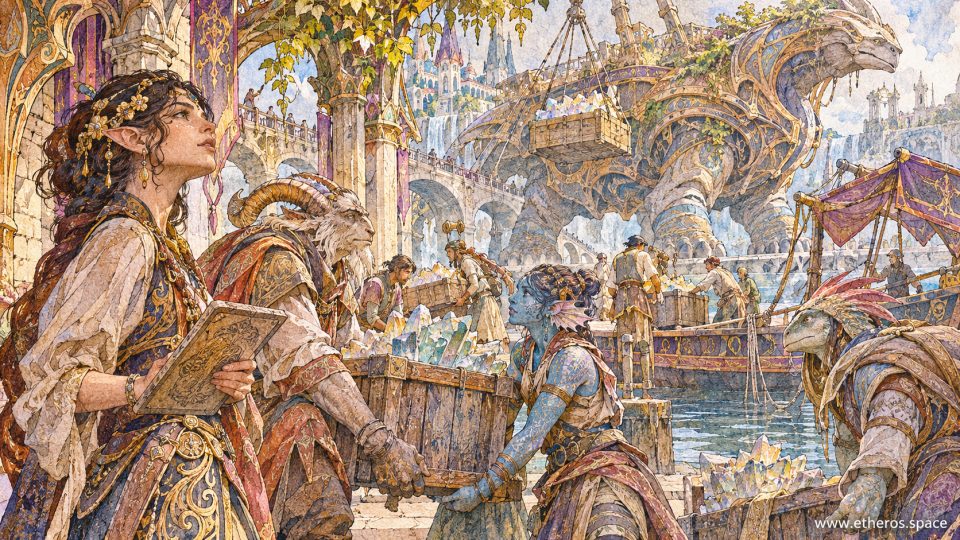
The woman with the gilded ledger was called Tessa Vael, a keeper of measures in the old canal quarter. She stood beneath the violet banners of the upper arcade, where the stone arches were threaded with living roots and every balustrade had been worn smooth by generations of hands. She could have counted the morning’s cargo from her desk. Instead she came to the wharf, because her father had taught her that a number written indoors was only a promise. A number witnessed at the water was a responsibility.
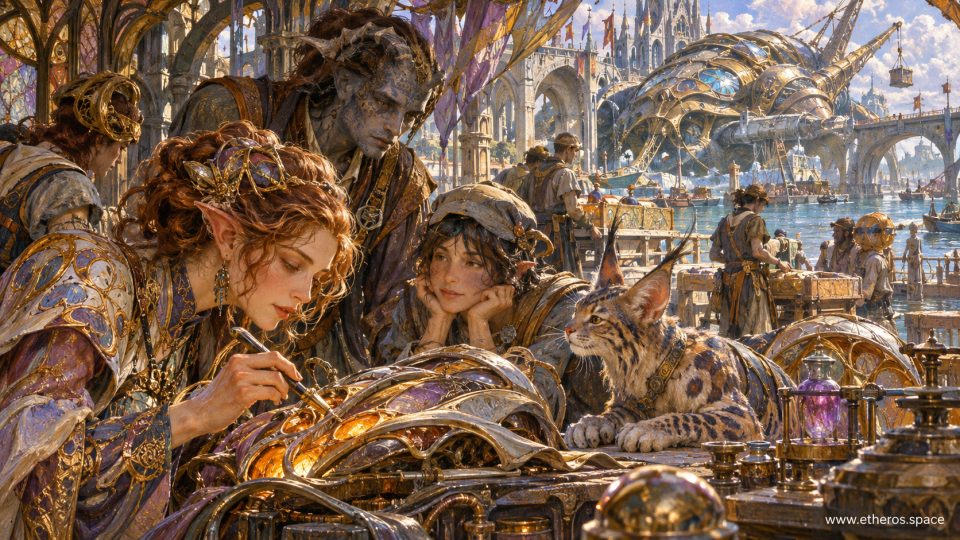
In the crate before her lay a cluster of blue and amber lumenstones, each held in an elastic bed of woven reed and oxidized copper. They were neither jewels nor ordinary fuel. Beneath their crystalline shells, cultured filaments stored heat gathered from the river’s falling water and released it slowly into the cold-tide dwellings across the estuary. One cracked stone would not explode. It would simply go dark, taking an entire household’s evening warmth with it. That was why Tessa examined the cordage before she touched her stylus.
Orum, the ram-horned stevedore beside her, had known this wharf since the year the lower piers were flooded. His red mantle carried the stains of salt, resin, and brass polish; its embroidery recorded the crews he had lost and the bridges they had rebuilt. He kept one broad hand on the crate, not because he doubted the rigging but because Nessa was beneath its leading edge. Her skin was blue with the fine reflective patterns of her saltwater kin, and her wrists were banded with work-braces fitted to her different joints. She could read temperature through the palms of her hands. A sudden tremor in the crystals meant a hidden fissure, long before an instrument would have registered it.
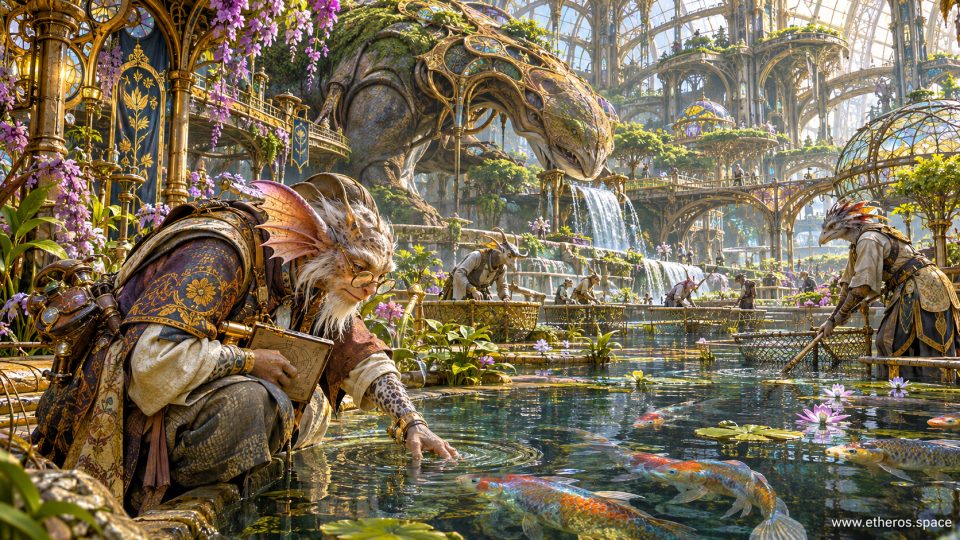
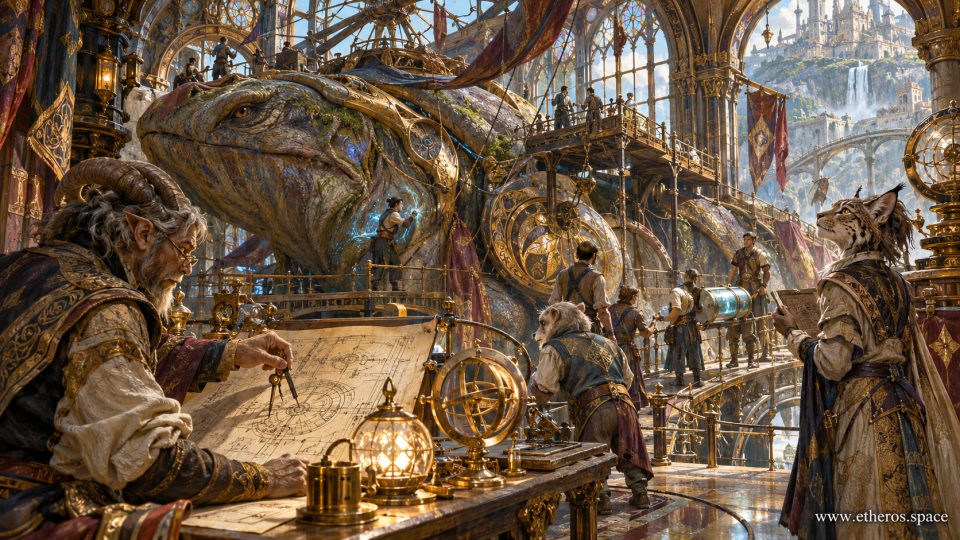
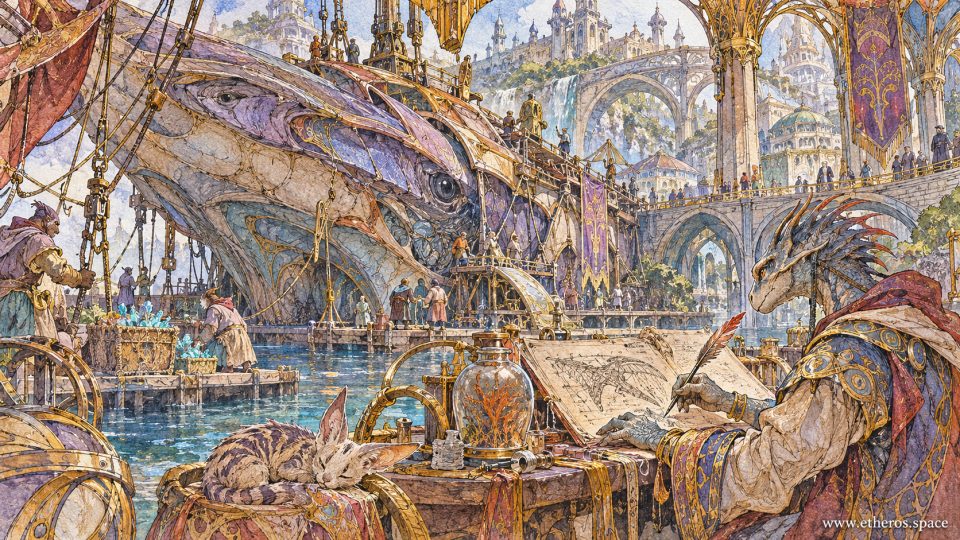
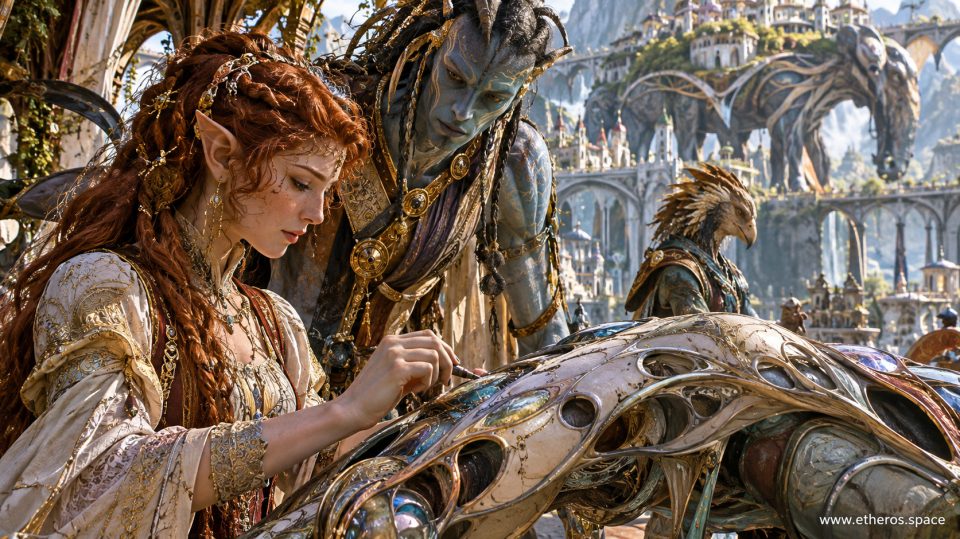
Across the water, the great carrier Calder lowered its armored neck between the spans. From the shore it resembled a moving cathedral: a living vertebral column enclosed by vaulted ribs, mineral plates and gold-rimmed service decks. It was neither worshipped nor commanded like a beast of burden. The city maintained its vascular pumps and fed its microbial gardens; in return it lifted what bridges could not safely carry. Today it held a timber freight basket in tension from its back-mounted cradle while its great feet distributed the reaction forces into the bedrock beneath the canal. The small operators on the upper walkways signaled with polished reflectors. Calder answered by easing its hydraulic tendons one careful measure at a time.
The basket descended. A barge rocked under the line. Ropes tightened, and the people on the far platform bent in unison, pulling the load toward the landing. Nobody in the crowd could hear the child crying aboard the painted boat near the right bank; the noise of water over the distant falls swallowed almost everything. Yet Thyrr, the crested traveler waiting with a shallow tray of spare crystals, turned his narrow head toward that sound. He had once made the crossing with a sick daughter and remembered the little terror of watching the city pass by while every familiar shore disappeared.
Tessa marked the first count. Orum touched her sleeve. Nessa had stopped the crate.
One of the blue stones was singing through her fingertips: a thin vibration, so faint that only her people could detect it. It had not fractured, but the binding threads around its core had loosened in the damp. Orum braced the box while Nessa slid a glass reed beneath the stone and eased the pressure away. Tessa opened the little ledger again, crossed out the cargo number and wrote a smaller one. Better eight warm rooms than nine with a failed furnace, she thought, and then she felt ashamed of the arithmetic. There was no comfort in deciding which room must wait.
Thyrr came forward with a single reserve stone resting in his tray. He had been paid to deliver it to the southern embankment, to a guild rich enough to keep extra light in locked cupboards. He looked at the workers, then at the distant boats, and set the reserve stone beside the damaged one. He asked for no receipt. Tessa offered one anyway. There were gifts that should remain private, she believed, and gifts that deserved to become public evidence of how a city survived.
High above them Calder lifted its chin against the load. Its immense body blocked a moment of pale afternoon from the quay, and the goldwork along the arches went dim. Then the basket settled, the ropes slackened, and a brief radiance from the opened crate washed over the faces gathered at the water. The old man smiled. Nessa felt the vibration cease. Tessa wrote the final count in her careful hand.
No bell announced what had happened. The barge pushed on, the great carrier resumed its work, and the city went about the business of keeping itself alive. But that night, beyond the last bridge, nine windows would glow instead of eight. Somewhere a family would eat in warmth and never know the names of the people who had given it to them. Ravel Quay had always worked that way: with bridges that carried more than stone, and ledgers that remembered what the bells could not.