The Featherwrights of Veyl Quay — A Quiet Return
Story
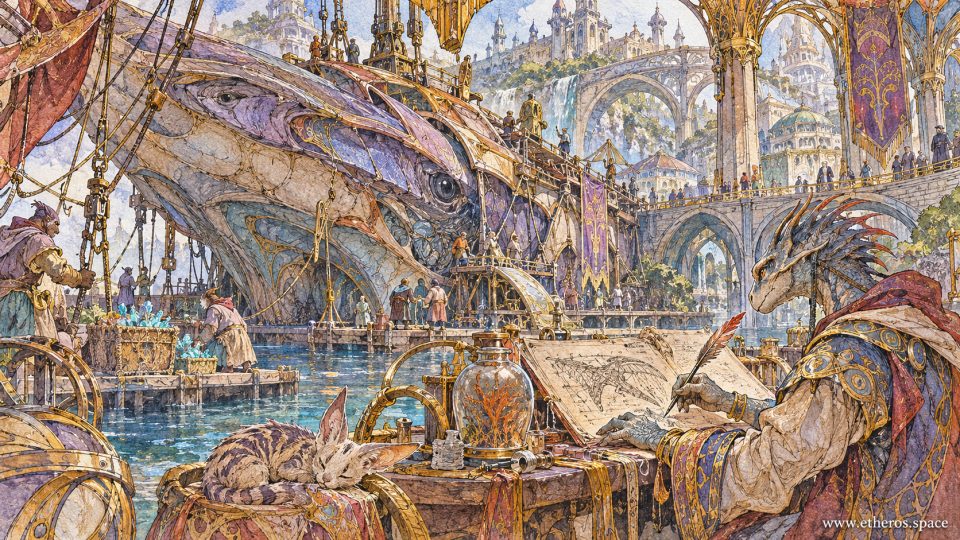
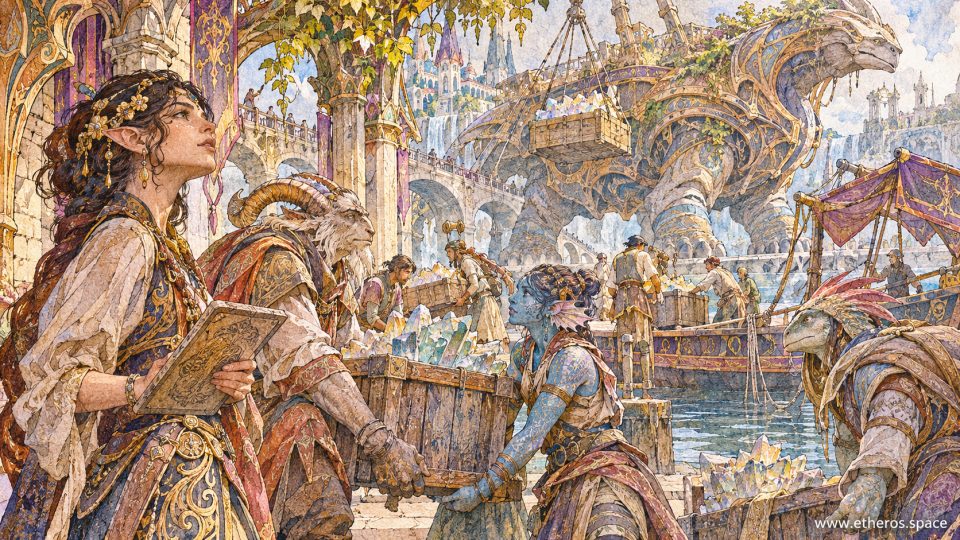
The water at Veyl Quay never lies entirely still. Even on windless days it shivers beneath the arched bridges as the city's living water-carrier passes its weight from one enormous foot to the next. On this clear afternoon its filtration terraces are bright with wet moss, its siphon throat releases a white ribbon into the lower canal, and boatmen steer between the reflected pillars as they have done for nine generations.
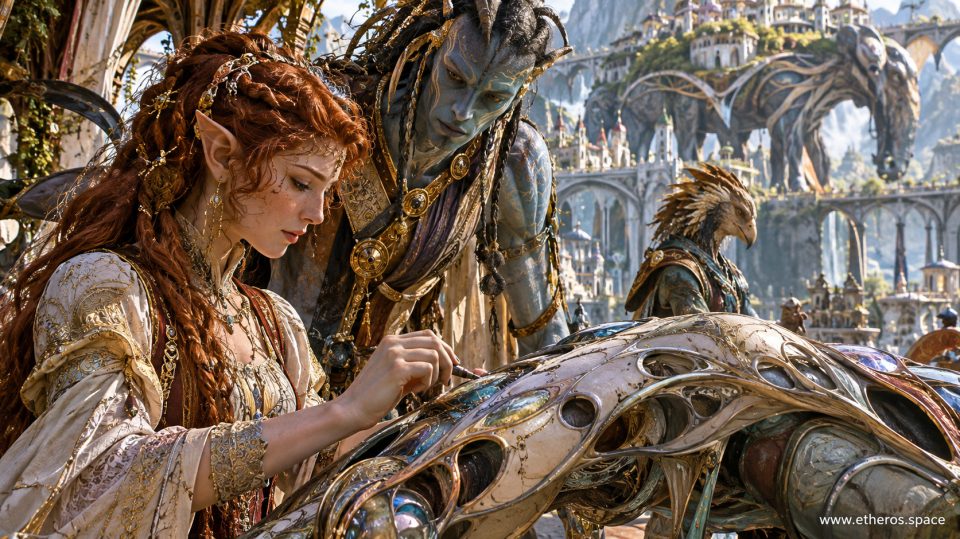
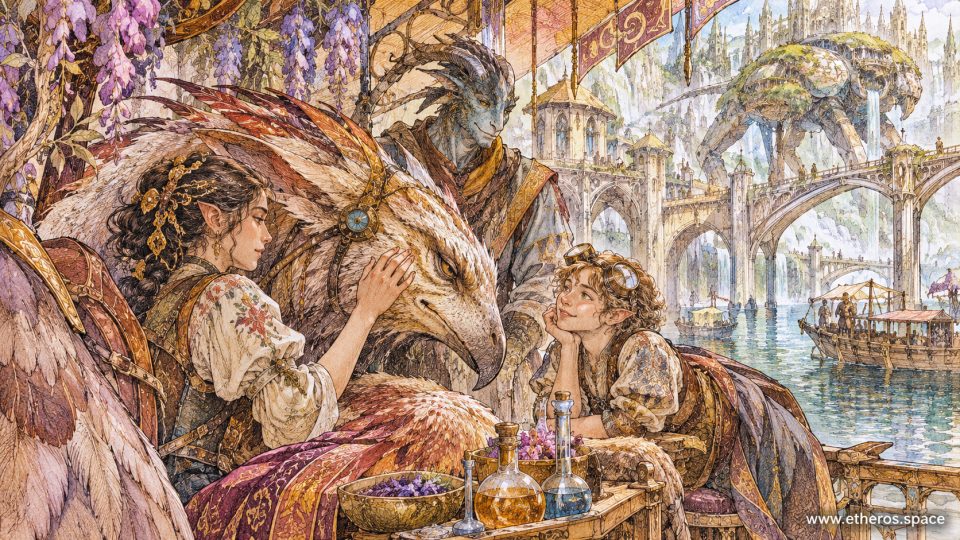
Under a canopy hung with lavender drooping blossoms, Maera Dovenn holds her hand against the brow of a feathered sky-hauler called Thistlewake. The bird's broad head is nearly as long as her torso. Its beak is scarred from breaking the shells of high-cliff crustaceans; its russet flight feathers carry the pale salt of the outer estuary. An articulated gold-and-brass cheek harness rests behind its eye, lined with soft leather where the skin moves. The harness is not a restraint. It transmits the animal's tiny changes of jaw pressure to the saddle's balance vanes, so a rider knows when a storm has frightened it before its wings begin to shake.
Today Thistlewake has come home without its usual convoy. Three mornings ago a sudden crosscurrent seized the cargo flock at the mouth of the river. Maera's older brother had guided the other animals to safety, but Thistlewake stayed above the shoals until the last rescue basket reached shore. The bird returned with salt-cracked feathers and a trembling wing. No wound could be seen from the quay, yet it had refused food and kept its eye half closed. Maera knows that expression; it is the look of a creature still hearing the storm inside its bones.
Serrin, the tall blue-gray Veyran standing behind the bird, watches without reaching for it. His scaled brow and swept-back horns are wet with the light of the harbor. He once fitted load-bearing tendons to aerial freight saddles for the upper districts, work that demanded an intimate understanding of the forces passing through living muscle. Then an experimental coupling failed and a fledgling fell. The fledgling survived, but Serrin left the upper platforms and apprenticed himself to the quay's featherwrights. He has never learned to speak easily about the accident. What he can do, now, is wait: quietly, patiently, until an injured animal chooses to trust his hand.
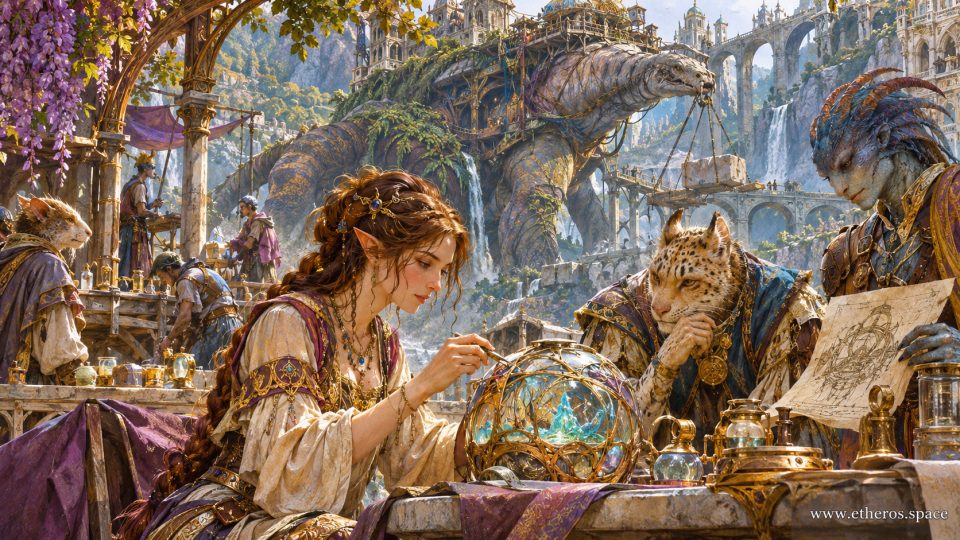
Across the small wooden table, young Ilen rests her chin on her palm. She wears the brass goggles of a canal apprentice though she has not yet passed her first waterworks examination. The amber and blue bottles before her contain feather oil and a dilute mineral rinse, mixed under Maera's supervision. The violet petals in the shallow bowl are not medicine; they are a familiar scent from the cliff meadows where Thistlewake hatched. Ilen had collected them at dawn in the rain, careful not to strip a whole flowering vine. Even apprentices must know which comforts can be gathered without impoverishing the next nesting season.
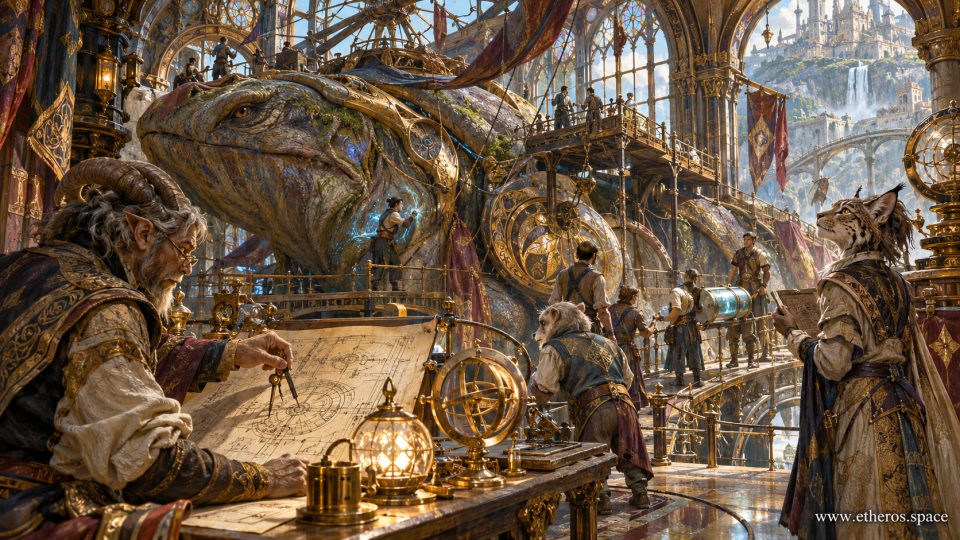
The city's great service-walker moves beyond the quay's railings, carrying tiers of inhabited filtration gardens upon its arched shell. Its feet distribute their mass through broad compliant pads; the older bridges were never built to bear such a load, so it follows the stone foundations of the original riverbed. Water taken through reed-root intakes is lifted by slow vascular pumps, cleaned across living membranes, and returned through the gleaming throat to boats, kitchens and the low districts. The people on the bridges are not spectators to a miracle. They are inspectors, ropekeepers, algae farmers and children taking the short way home. When the machine pauses, a hundred small tasks pause with it.
Maera runs her fingers against Thistlewake's crown, tracing the direction of the feathers instead of forcing them flat. Beneath her palm the animal's breathing deepens. Serrin leans forward a fraction, ready to loosen the upper harness ring if its neck stiffens. Ilen sees the bird open its eye and almost calls out, but remembers that startling a frightened flier can set healing back a day. She does not move. For a moment the three of them share the difficult work of doing nothing too quickly.
Farther out, a boat nudges a mooring beneath the cream-colored arches. Somewhere beyond the tall pale towers a bell answers another bell. The city keeps trading, watering, carrying and growing, indifferent to this small pause beneath the hanging flowers. Yet Ilen will remember this more clearly than any of her examinations: Maera's steady hand, Serrin's unsaid apology, the old bird's feathered weight, the gold harness gleaming where it bends, and the precise instant Thistlewake allowed itself to rest.
By evening they may lift the wing, test each flight tendon, and decide whether the animal can return to the sky. That answer is not contained in the sunlight or the bright bottles, and no one at the table pretends otherwise. For now there is breath. There is fresh water below, a dependable machine still tending the city, and three people who have agreed that getting home is only the beginning of being cared for.