The Note That Had Room for Everyone
Story
THE NOTE THAT HAD ROOM FOR EVERYONE
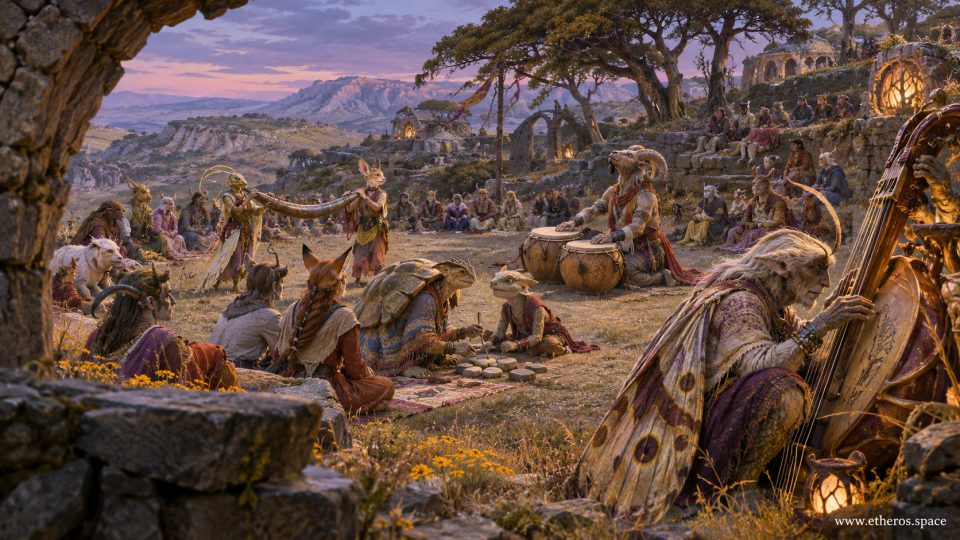
At the first violet hour of the dry season, the plateau of Echolorn gathered a little music and held it against the approaching dark. From beneath a weathered stone arch, the listeners could see the low dwelling-lights kindling in the far hills. The trees on the terrace leaned away from the wind. Their roots held the old steps together, and the steps held the people: horned folk, scaled folk, feathered and furred families, some arrived from days of travel, some from houses scarcely a stone's throw away.
There was no raised stage. A ram-horned drummer named Varruk knelt on the bare ground with two hide-headed drums before him. On the opposite side of the circle, a narrow-faced, long-eared musician called Teth and a tall antenna-crested player called Ossa took opposite ends of a curved sounding horn. Between them the tube sagged gently under its own weight, and its bindings were worn where years of hands had kept it together. Beneath the near arch, half in shadow, an aging, white-maned musician named Soren Ill played the tall string-frame with one patient hand. His moth-patterned cloak was patched at the shoulder and falling open at the knee. He had played on this terrace when the smallest trees were still saplings.
The music had a name in one village and another name two ridges away. People in Echolorn called it the Returning Measure. Farther west, where the stony passes swallowed a voice before it reached a neighbor, they called the same passage the Long Listening. No one could agree whether these were the same song. The older performers remembered different endings. Some insisted there had never been an ending at all.
The argument had begun that afternoon. A visiting registrar wanted the gathering to choose one formal sequence of beats and preserve it in the valley's memory stones. That would make the tradition easier to teach, and safer from the changes carried by people who moved away and returned. Varruk had almost agreed. He had buried a brother who knew the old bass rhythm, and sometimes woke afraid that the sound had gone with him. But Teth's family had lived beyond the ridge, where the air was thin and the long horn required a slower breath. To call their version an error felt to Teth like being asked to leave the family's dead outside the circle.
No registrar stood in the picture of the evening. The disagreement was in the air nevertheless: in the long breath held before the horn began, in the faint impatience of the drummer's hands, in the way Soren listened before touching the next string.
At the center of the near circle, an old shell-backed neighbor named Dema had arranged six small stones on a mat. The child across from Dema, little Kiva, watched the players and placed a hand over the lightest stone. Kiva had been learning the rhythm in secret. Their family could no longer afford lessons with a traveling guild, and the old terrace sounded different from the enclosed practice rooms where the guild kept its instruments. A stone struck here came back from the cliffs a heartbeat later. Kiva kept mistaking that returning sound for another player's answer.
Dema did not correct them at once. The elder's hands were broad and uneven from years of carrying field tools. With one finger Dema tapped the nearest stone, then waited until the echo arrived. Kiva tried again: a quick touch, a pause, and then a second touch that met the reflected note as it faded. The pattern was not written anywhere. It was the plateau itself becoming one more member of the ensemble.
Soren heard the new interval. He could not see every stone from the arch, but he could see Dema bend closer and Kiva's shoulders rise with surprise. He altered one string just enough to leave a hollow space beneath the child's answer. Varruk, who had been preparing a familiar flourish, let his palms rest on the two drumheads and gave the silence one full measure. Across the clearing Teth and Ossa breathed together, neither leading, and the curved horn answered with a sound too rough to be called perfect and too alive to be called wrong.
The audience did not suddenly become a single people. There were arguments waiting in the houses above; there would be unpaid passage debts, rival claims to pasture, old grief between kin who now sat within the same circle. Some listeners knew a different tempo and kept it quietly against their knees. Others had never heard this tune before. But for the length of the new phrase, nobody needed to surrender a home rhythm in order to be heard.
Varruk would later ask Dema to teach the six-stone response to his young apprentice. Teth would carry the altered phrase west, where it would change again in colder air. Soren would not be able to tell whether the missing note had been found or invented. The question could remain open. A living tradition, he thought, was not a vessel that held one sound forever. It was a place with enough room for a sound to return differently and still be welcomed.
By full dark, the old steps had warmed beneath dozens of feet. Far away the inhabited hills were still lit. The earth under Echolorn had not ceased doing its slower, less audible work, carrying roots between stones and holding the weight of every body that had gathered there. The last note traveled into the dry valley, and for a moment, before the distant cliffs returned it, everybody listened.