The Boundary That Learned to Bend
Story
THE BOUNDARY THAT LEARNED TO BEND
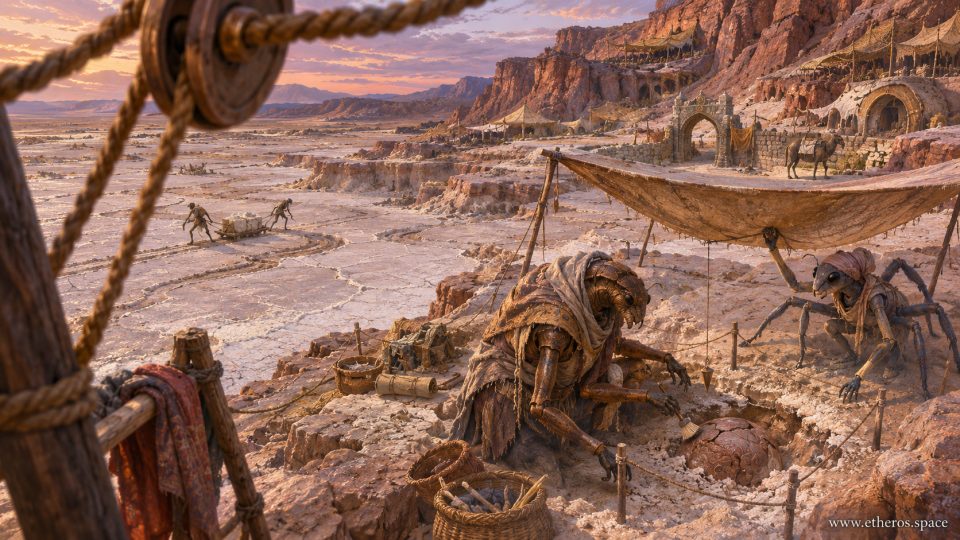
The old playing field at Saffronstep was not round. Its northern edge followed the abandoned arch-road; its southern edge stopped where the dry grass gave way to loose ochre soil. From the field's low side, beyond the tips of brittle grass, a spectator could see every flaw in the ground and none of the importance anyone else had assigned to it. The grandstands were only stepped stone, canvas and shade. On certain afternoons those were enough to bring half the neighborhood outdoors.
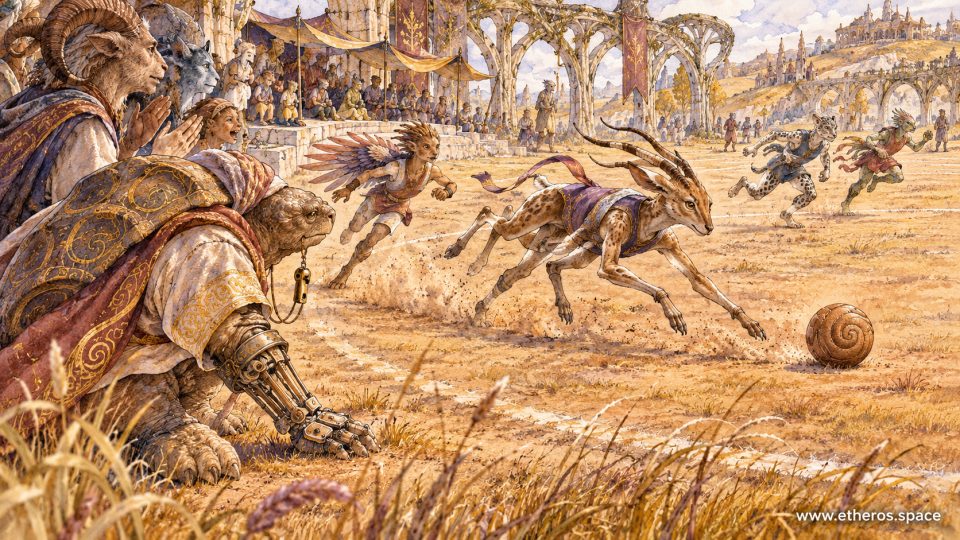
The ball was rolling toward the boundary, gathering dust in its carved spiral as it went. It was made of layered corkwood with an outer braid of dried tendon fiber, heavier than it looked and light enough for small competitors to send racing over the hardpan. It could not fly by itself. Every turn of that spiral had to be earned by contact with the earth.
Lessa Vey, the spotted plains-runner in a violet sash, lowered her chest and stretched her long forelimbs toward it. The extraordinary length of those limbs gave her a reach that would be an advantage on flat stone. Here it meant something less predictable: the ball had begun to skip toward an uneven seam of packed earth. A feather-crested runner named Jori was a stride behind, their narrow feet throwing dust into the thin afternoon light. Farther across the ground, Kima, a young mottled cat-kin sprinter, and a green-scaled athlete called Dess were trying to close the angle rather than win a race they could no longer catch in a straight line.
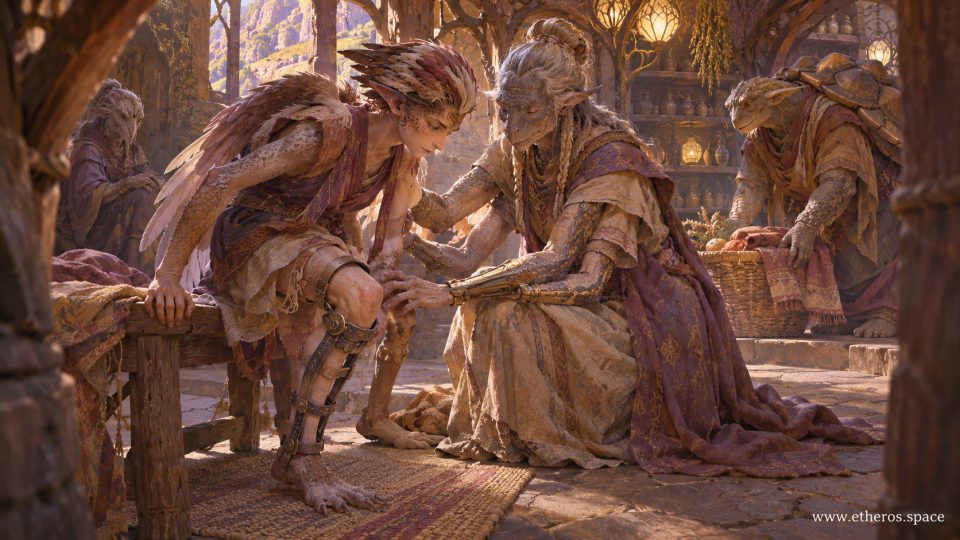
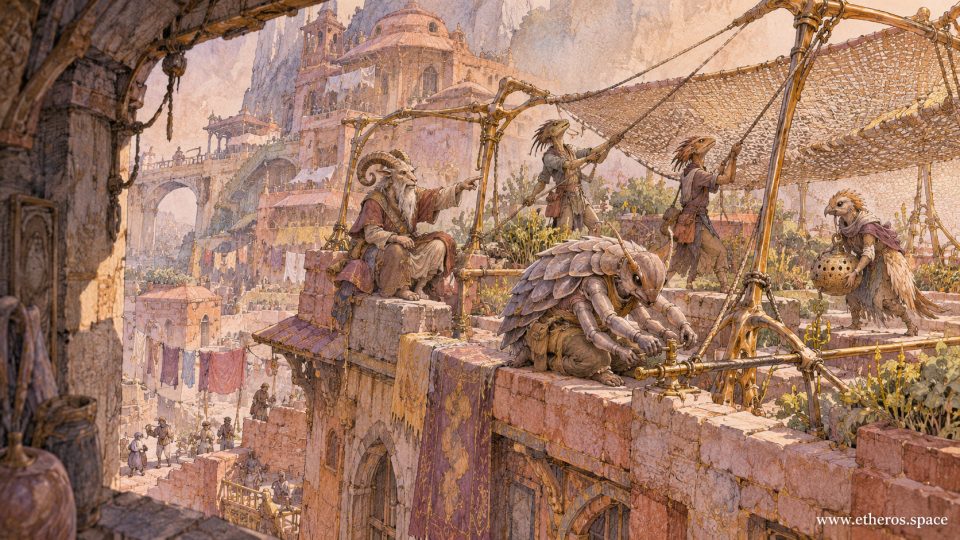
Under the near awning, the retired groundskeeper Tovel Brann rested one broad claw on the turf. His shell was scored with the marks of old repairs, and the fitted brass at his wrist carried the weight of his right forearm through a set of worn articulated plates. Behind him, an elder with curling horns applauded with a loudness usually reserved for the first harvest. Tovel himself was quiet. He was watching not the fastest runner but the margin between the moving ball and the field's chalkless edge.
The game was called coilball, but that name had once meant a dozen slightly different games. In the east hills, four-legged players stopped the spiral with a forepaw. In the dry towns, upright runners favored a hand. Young winged players were instructed to tuck their feathers close, on the theory that the game should be settled on the ground. When visiting teams began to compete, the council had tried to simplify the disagreements into one rule: only a single forelimb could make the last legal touch.
That rule had been written by people who all had nearly the same number of limbs.
Jori had questioned it at the morning meeting. What counted as a forelimb for a person whose wings were part of their upper body, and who could keep their balance only by spreading them? The ward officials had heard a familiar request for special treatment. The players heard something else: a request to be judged for the move they made rather than the body with which they arrived. Tovel had said little, except that the field had survived many revisions to its boundaries and would probably survive one more.
Now the disagreement had become physical. Lessa reached for the ball, but her longer arms crossed the worn boundary almost before her feet did. Jori opened their feathers for balance without lifting from the ground. Kima planted a foot where the dust was strongest and tried to redirect the play toward the center. At the far end a child in the shade jumped up, certain that someone had won. The people beside the child knew better: no one had touched the ball yet.
Tovel held his breath, not because the outcome would decide a season, but because the next few seconds might decide whether the council could see its mistake without somebody first being hurt by it. An old injury had taught him that rigid metal could support a joint only if it yielded at the proper point. The same lesson, he thought, might apply to a law.
Lessa's paw came down just short. The spinning ball struck a pebble, swerved, and continued rolling within the worn margin. Jori called a warning and pivoted, wings open for balance. The others changed course. In the stand, the horned elder clapped again, even though there was still no goal. The clapping spread, then thinned into laughter when the ball seemed determined to escape everybody.
They would argue about the scoring after the dust settled. That was the council's habit, and an imperfect one. Tovel had already decided what he would say. No rule should pretend that different bodies were identical; neither should it make a person's difference a reason to exclude them. The task was to protect the game, its players and the common ground on which they met. There was room, he believed, to do all three if the town was willing to listen longer than it shouted.
For the moment the ball kept turning. There were no officials standing on a dais, no speeches, only children calling, spectators leaning forward and the sudden blur of four very different runners crossing a dry field together. The city beyond them continued its work in the afternoon sun. And near the rough grass, one old groundskeeper watched the line that everyone had agreed to draw, wondering which parts of it still deserved to remain.