The Fruit with Two Names
Story
THE FRUIT WITH TWO NAMES
At the old Meridian Swap, where a pale bridge crossed over the crowded lane without ever reaching the sunlit booths beneath it, a child decided that an unfamiliar fruit should have an unfamiliar name.
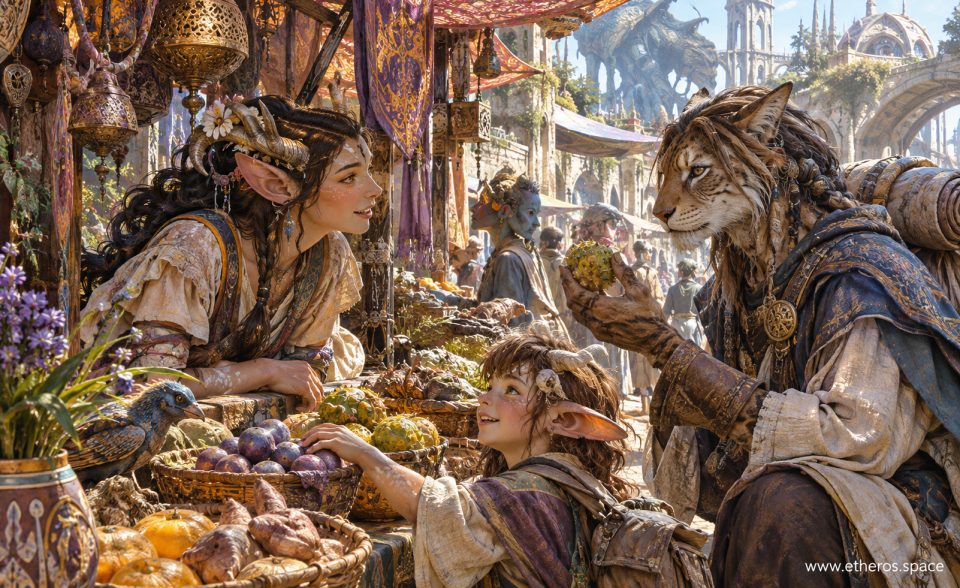
The thing was the color of a young gold beetle, round enough to fit between two palms and stippled with small stiff knobs. A striped traveler held it delicately in his broad hand, turning it in the light. Across the stall, the seller leaned forward on her elbows, her dark braid falling beside a spray of white blossoms woven into her hair. Her little horns caught the afternoon's brass-colored gleam. Between them, a child had already reached into a basket of purple plums; a blue-grey bird perched quietly at the left corner of the counter, indifferent to the negotiations of larger creatures.
The child's name, in this account, is Miri. She called the spined fruit a sunwhistle because the first time she had seen one cut open, the rind gave a soft, squeaky crack. The seller, Ilyra, called it a thorn-pear. The traveler insisted, in his soft growling trade dialect, that its name was varesh. None of the three names was a lie. That was what made the afternoon difficult.
Varesh were carried down from the dry rim villages in cloth-lined packs. A good one was fragrant at the stem, unbruised around the knobs and slightly heavy for its size. The traveler, Varrin, had walked enough ridgeline stairs to know the difference between a fruit that would last another week and one that ought to be shared before sundown. He was not a grand merchant. Most of the weight behind him was food for his household, and the remainder was what could be sold to pay for the next crossing.
Ilyra, whose family had held a small produce stall in the Meridian quarter for two generations, knew how to count the value of any fruit the city recognized. She did not know what the visiting porter would accept for a varesh. A dealer in a nearby lane had offered her an absurd price for the whole bundle, intending to sell each piece behind glass as a curiosity. A few wealthy kitchens would then learn the name while the households who carried it here could no longer afford to taste it.
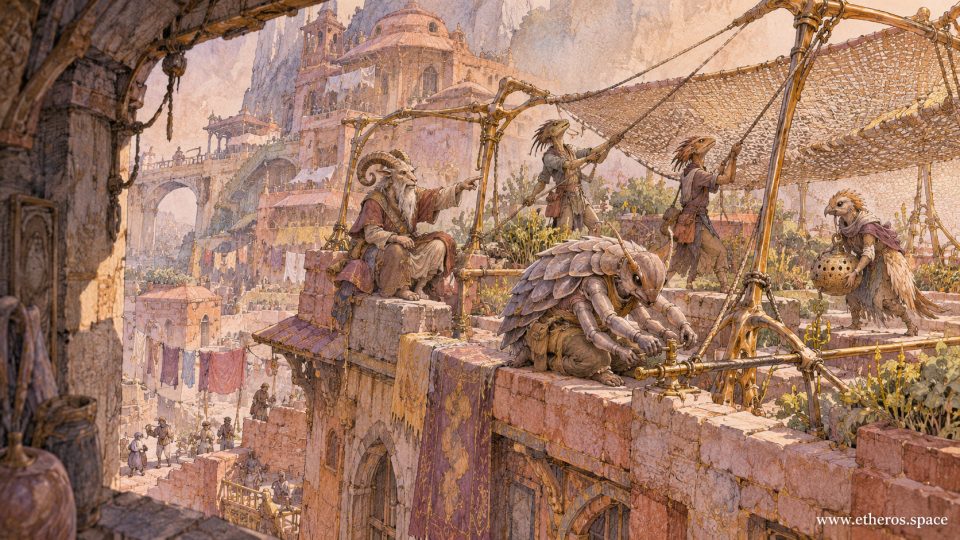
That price had been on Ilyra's mind when Varrin arrived. It was on his mind too, although neither wished to admit it. Beneath the hanging lamps and patterned canopy they considered one another with the caution of strangers trying not to insult each other. Behind them another transaction went on, and beyond the bridge a gigantic segmented shape could be glimpsed among rooftops and towers. From the stall nobody could tell whether it was moving, waiting, or working. The city was full of such partially understood presences. Nobody stopped selling fruit to explain them.
Miri had no interest in a dealer's cleverness. She asked whether varesh tasted like plum, since plums were under her hand. Varrin smiled with half his striped muzzle and shook his head. 'A plum tells you at once whether it is sweet,' he said. 'This makes you earn the answer.' The child's eyes widened. She set the plum down without being told.
The traveler showed them the narrow brown spot beneath the stem. A varesh must be pressed there gently, never cut straight across its seed chambers. The flesh would part along natural seams; the soft inner pith could then be drawn free without spoiling the seeds. Those could be dried and planted, but only in the loose stone beds of a rim-climate garden. To grow them in the damp soil of the lower quarter, he said, would be to lose both the seeds and the hope invested in them.
Ilyra repeated the method and asked him to demonstrate on the smallest fruit. He hesitated. It was the first one he had planned to sell. He had been thinking of the price of travel, the seam of a worn boot, and a brother who needed a new carrying sling. Then Miri, who had been listening with astonishing attention, offered the purple plum she had chosen. It was no proper payment, and Varrin said so. She offered it anyway.
They ate the plum together before the varesh was opened. Its tart juice made Varrin close one eye. He laughed, an unexpectedly small sound from such a large traveler. The seller laughed as well. Miri was pleased that the exchange had begun with something everyone could pronounce.
The opened varesh proved delicate and fragrant, less like an orchard fruit than a warm spice flower. Ilyra did not invent a city price for it that day. Instead she purchased two for her stall, helped Varrin arrange a direct sale of the rest to several neighboring households, and left enough aside for him to carry home. She agreed to put both names on her next verbal call to passersby: thorn-pear for those who knew the city, varesh for those who knew the rim. Miri was granted sunwhistle only within the family, which she accepted with obvious reluctance.
That evening, when the lamps began to outshine the street, Ilyra placed the saved seeds in a dry ceramic cup. They were not proof of a harvest to come. Perhaps the new beds would fail. Perhaps the traveler would never return. The giant shape beyond the rooftops remained an unanswered silhouette. None of that spoiled what had happened at the counter: a visiting stranger had been treated as someone who knew a thing worth teaching, a child had brought the two sides together without understanding commerce, and a familiar stall had made room for a third name.
By dusk the bird had shifted to the other side of the basket. The market continued, loudly and without ceremony. Varrin took the road toward the northern steps carrying fewer fruits, a fairer payment, and an invitation to return when the next dry season came. Miri rehearsed the foreign word beneath her breath all the way home, careful with its final sound. She wanted to be able to greet him properly if he did.