The Floor That Asked a Question
Story
THE FLOOR THAT ASKED A QUESTION
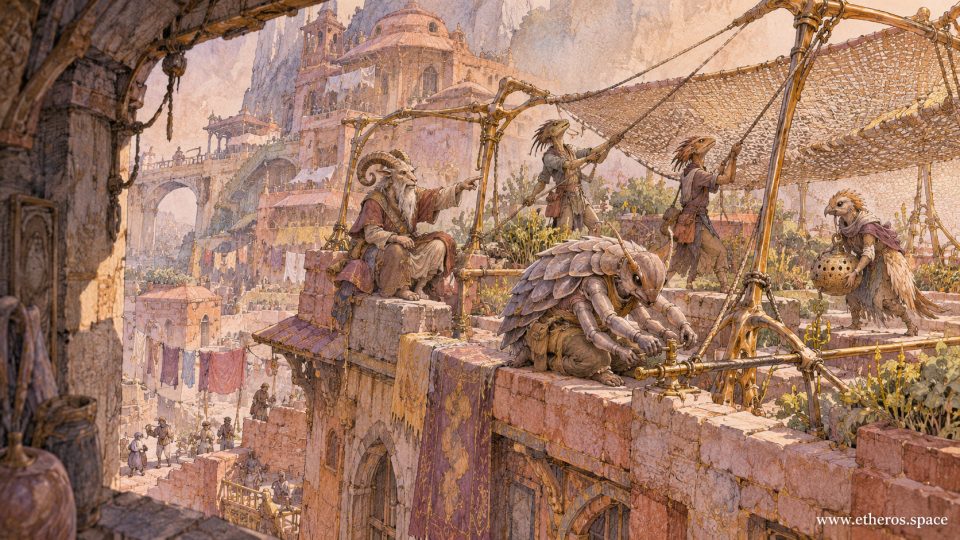
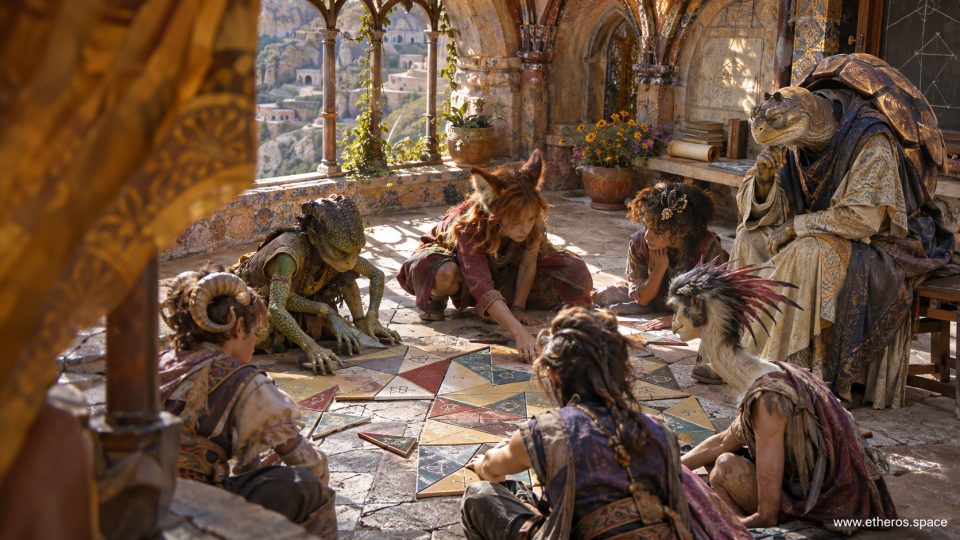
The old school at Hadrin's Upper Steps had no central desk. It had a stone floor so uneven that each new generation learned where the corners caught their sandals, and an arcade that opened onto a dry hillside of white houses and footpaths. In the late afternoon its arches divided the sunlight into long, crooked shapes. The children followed those shapes until the teacher called them back to the lesson.
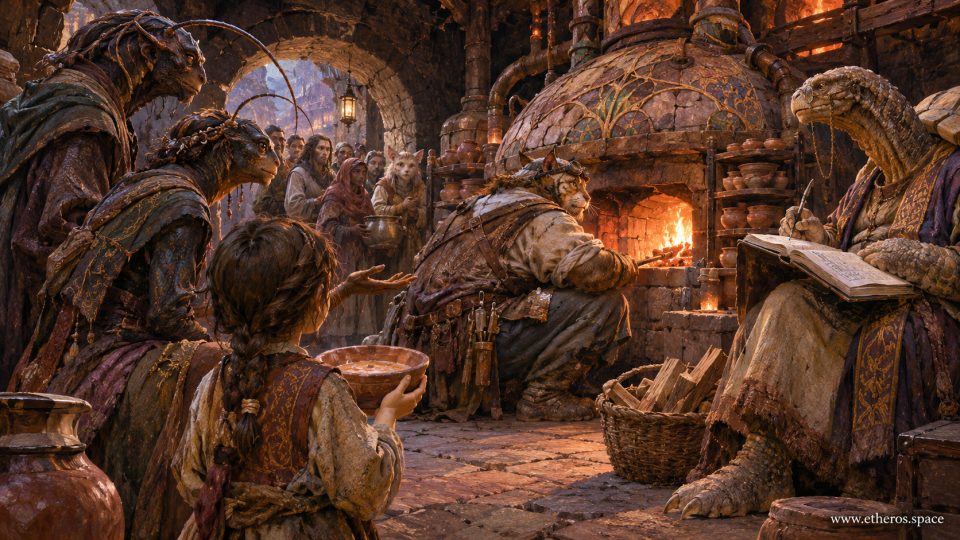
Six learners gathered around a puzzle of triangular tiles spread across the floor. Their teacher, Tovan, sat on a wooden bench with his chin resting against a thick, scaled hand. His shell rose behind his shoulders like a small, weathered roof. He could have told them the answer. He had decided not to.
The triangles were scratched with symbols for roads, steps, shadows and loads. When assembled correctly they described a safe passage from the hill school to the dwellings below. The tiles were not a map of an actual street. They were a model of how different bodies might encounter the same road.
Mira, whose red hair fell between two alert furred ears, was moving a gold triangle toward the center. At the other side, green-scaled Ress held both long hands on the stones and considered the narrow crossing. A dark-haired child called Issa watched from her elbows. At the near edge sat Orri, a younger student with small curling horns, while another pupil with braided hair marked the outer path. Peh, whose feathers rose into a red crest, kept a hand near the board without touching it.
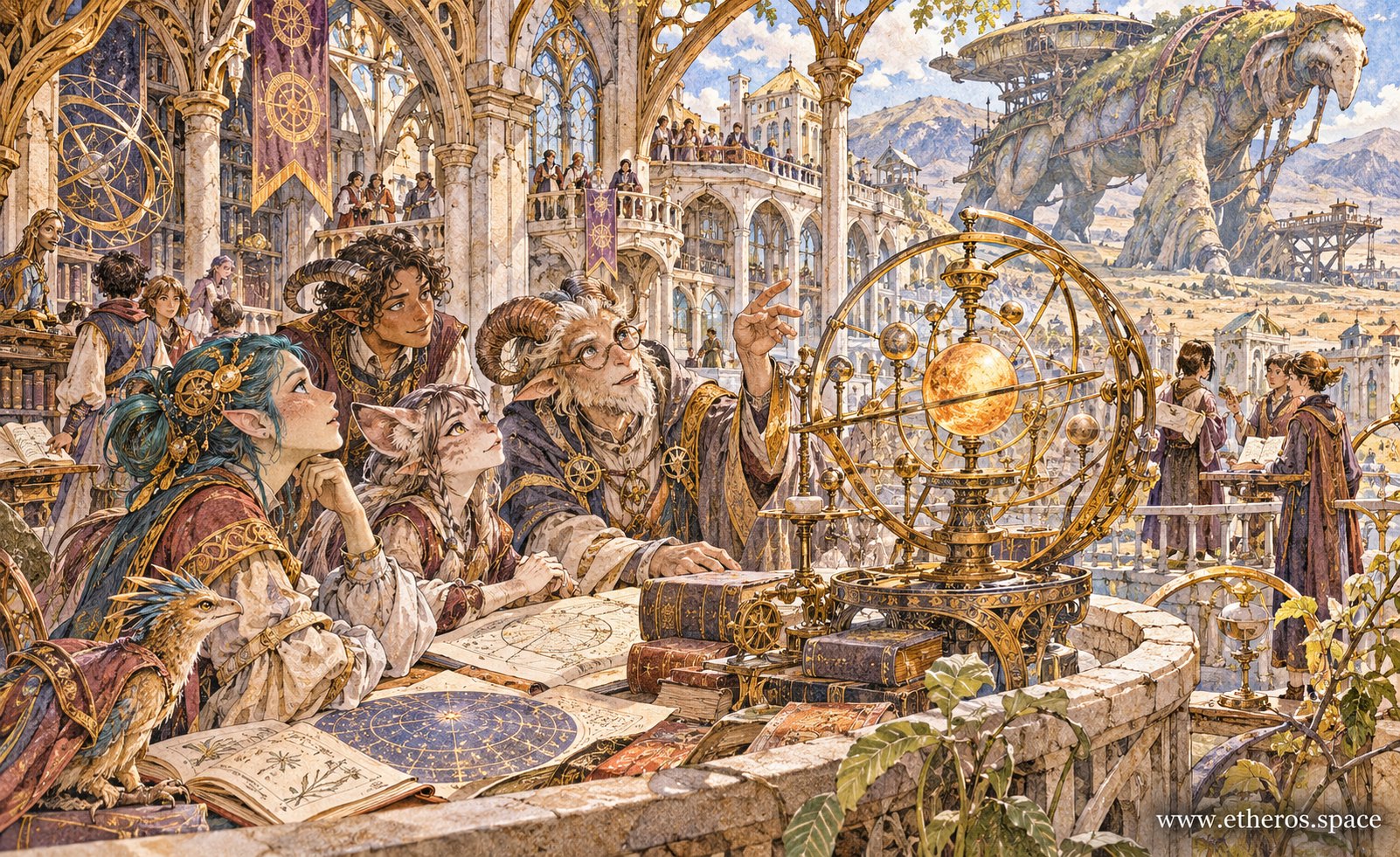
A week earlier the school had received a reasoning cabinet: a beautiful brass device that took a street diagram, measured its angles and produced a route in seconds. The lower district had offered one to every classroom. Some parents were delighted. Their children would learn how surveyors calculated loads, and frightened families could receive warnings faster if a bridge became unsafe. Others worried that the students would merely copy whichever path the cabinet declared best. Children without access to its spoken instructions had begun falling behind.
Tovan did not despise the cabinet. He had once helped design the mechanical relays that made such instruments useful. But that morning it had returned a route with three stairs too narrow for Ress's hands and Peh's long lower limbs. Every calculation was correct. The question it answered had been wrong.
So he had carried the tiles to the floor.
"Which path is shortest?" Mira asked.
"Shortest for whom?" Tovan said.
Mira pulled back her triangle. Ress pushed a blue piece toward a wider corner. Peh showed them how his knees would fold if he tried to follow the drawn turn. Orri insisted that the ramp should be straight, because straight things were easier to remember. Issa disagreed: straight was not always level.
The arguments wandered through the room as freely as the wind under the arches. One child made a path no one could climb. Another made one so broad that it passed through a wall. When the afternoon light shifted, they noticed the imagined crossing would be shaded at one hour and fiercely hot at another. The children moved their bodies around the model, testing a possibility before asking whether they could defend it.
At the bell for home, Mira had not reached the numbered solution printed in her schoolbook. Instead the six children had made a route with three places to rest, a turn wide enough for Peh, and a lower landing that Ress could cross without bearing weight on his fingertips.
Tovan finally stood. The shell on his back scraped softly against the chair as he bent toward the tiles. He lifted one piece and placed it beside the school door.
"What about the person who never arrives?" he asked.
There was a silence. It lasted longer than he expected.
Then Orri pointed to a small unmarked triangle and said that perhaps someone had no family waiting at the lower step. Maybe the path should pass the public refectory as well as the houses. Perhaps an elder who walked slowly would need another landing. The others began to rearrange their work again.
They would not finish before the next bell. That, Tovan thought, was worth telling the council.
Afterward, as parents climbed the stairs, he explained that the reasoning cabinet would remain in the school. It could compare twenty versions of a path, remember a cracked arch, and carry an urgent warning when the hillside shifted. But it would not supply the only answer in the room. Lessons would begin with bodies, questions and the stubborn world outside the windows. The device would help test what they found.
Some parents wanted more cabinet time. Others wanted none. Tovan promised to show both groups the children's work, and to ask the families whose children needed different instructions what the school had missed.
The floor kept its little roads overnight. The sun would cross them again in the morning, showing different shadows and different mistakes. Nothing about the lesson was finished. It was the first afternoon every student had managed to take part in the same question.