The Measure of a Shoulder
Story
THE MEASURE OF A SHOULDER
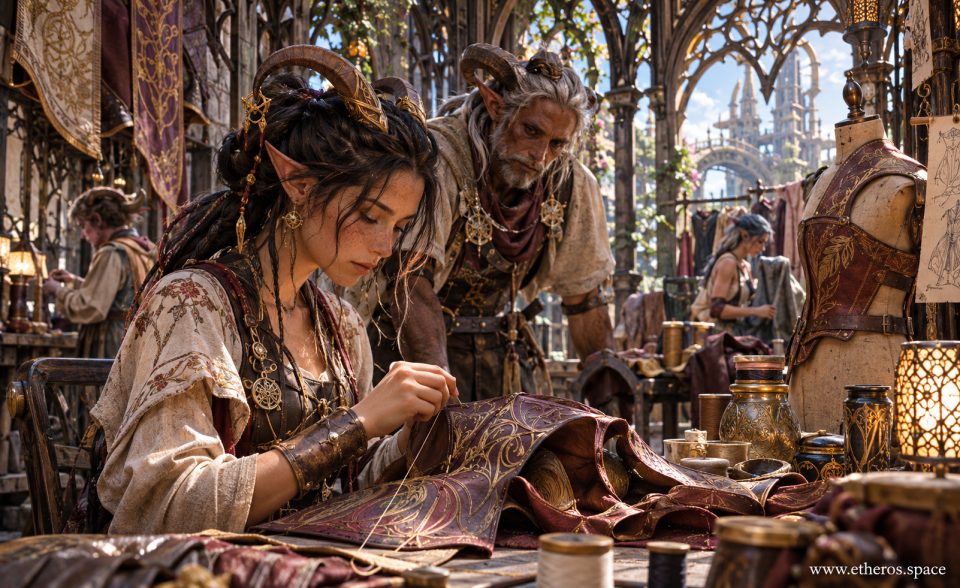
The light reached Selvane's west tailoring arcade by a path of its own. It entered through the high Gothic tracery, passed a tangle of green vines and old iron struts, and settled on the crowded worktables before it touched the street. Beyond the stone arches the district kept moving: footsteps, barter, a cart wheel complaining at a curb. Inside, the loudest sound was the small, repeated drag of a needle through stiff maroon leather.
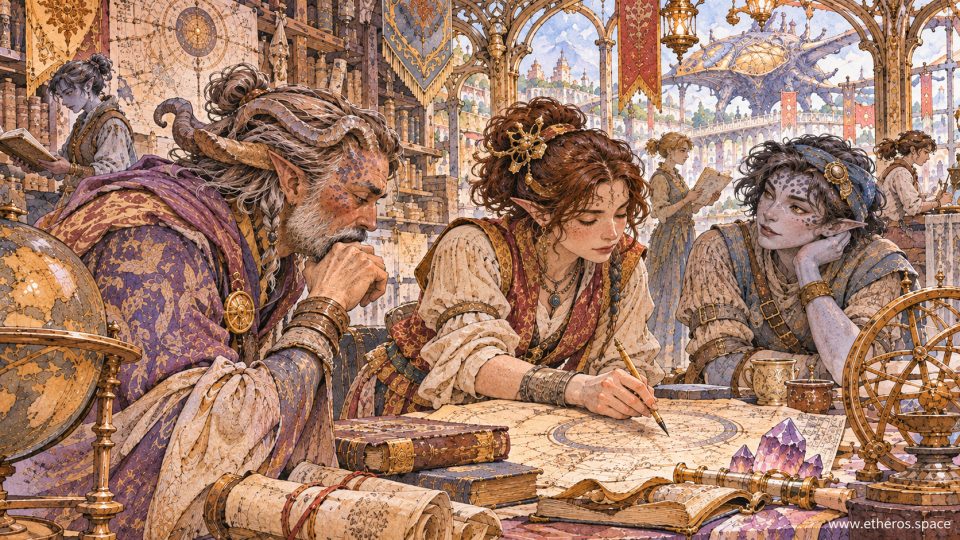
At the near bench, Neralis Venn worked with her head bent and one arm braced against the edge. A curved horn rose from her dark pinned hair; a pointed ear escaped the loose strands beside her cheek. She wore embroidered cream sleeves and leather wrist guards already scored with tiny scratches. The gold pattern on the panel in front of her looked extravagant, but her hand ignored its beauty. The needle was traveling along the seam where the panel would have to bend under load. That invisible line mattered more than the visible ornament.
Dhorren, the gray-haired horned fitter behind her, leaned forward without taking the needle away. For most of his career he had made protective coats that looked immaculate on the shop's wooden forms. He had only recently learned what Neralis knew from three months of fitting real bodies: a mannequin never winces. A garment fitted perfectly to a symmetrical block can hurt the person who lives in it.
The commission had come from the high-road dispatch service, though its recipient had not come to the shop. A courier named Sova had sent measurements taken by a village medic, a small tracing of an old scar, and a note asking not for a lighter coat but for one that would stop dragging her right shoulder backward. It was an ordinary request, one of hundreds that passed through Selvane each season. Yet the guild pattern assumed matching shoulders. The first assembled coat had passed every bench inspection and still failed her.
Neralis had placed that failed section beside the new one, leaving the distorted lower seam visible to anyone who cared to look. The worn places told a story the neat pattern could not: the load had slipped toward one buckle, pinching fabric between shoulder and strap. A brilliant gilded line had hidden the strain. The repair was not simply to add more leather, which would only add weight; it was to change the angle of the bearing seam and let the flexible inner layer take the first motion.
Dhorren rested a large, worn hand on the bench. 'The old pattern would have survived,' he said.
'So would the leather,' Neralis answered. 'She is not leather.'
He said nothing for a while. Nearby, an apprentice sorted lengths of cord, and another worker passed through the arcade carrying folded cloth. The torso form at the right of the bench still displayed a beautifully made conventional vest. Neralis had left it there deliberately. It was a reference, not a command. The new coat was wider at one attachment and slightly lower at the other. When laid flat, it appeared wrong. In use, if the figures from the medic were trustworthy, it would sit right.
There was an older civic custom that every working garment be shown publicly before its owner received it, so the maker's reputation traveled with the work. Dhorren liked that custom. Neralis worried that it rewarded ornament more than comfort. But she could not abandon it, because the custom also made makers answerable for failures. She asked him to change the ledger: every fitting would henceforth record the wearer’s own report, not just the master's visual approval.
'And when the wearer is two ridges away?' he asked.
'Then we wait for the message. We do not declare the job finished because the needle stopped.'
From the open arch came a clatter of wheels, and a stranger called for a repair to a torn travel bag. Neither artisan looked up immediately. Their work was quiet enough to be mistaken for indifference, but the opposite was true. Every stitch held a borrowed measure of someone else's body and the possibility of giving that body a little more freedom.
Neralis drew the thread taut, then eased it back a finger's width so the leather could flex. Dhorren bent closer, searching for the reason in the small movement. At that instant the morning's lesson passed from the younger worker to the elder. It was not an accusation. It was a craft being kept alive by allowing it to change.
When the coat finally left Selvane, no crowd would gather to see it. Sova would pull it over her sore shoulder, tighten the straps, lift the satchel that carried other people's letters, and take the high road before sunrise. If she could walk without thinking about the coat, Neralis would count the work a success. The gold would be there, but its purpose would be to accompany the person, not to conceal the price of motion.
For now, all that could be seen was a young artisan leaning over maroon panels in the warm arcade, an elderly fitter watching her hands, a shop full of ordinary labor, and sunlight crossing the unfinished seam. On Etheros, care often had exactly that size: no grand proclamation, only a change in how weight was carried.