The Visor That Let the Rooftops Be Seen
Story
THE VISOR THAT LET THE ROOFTOPS BE SEEN
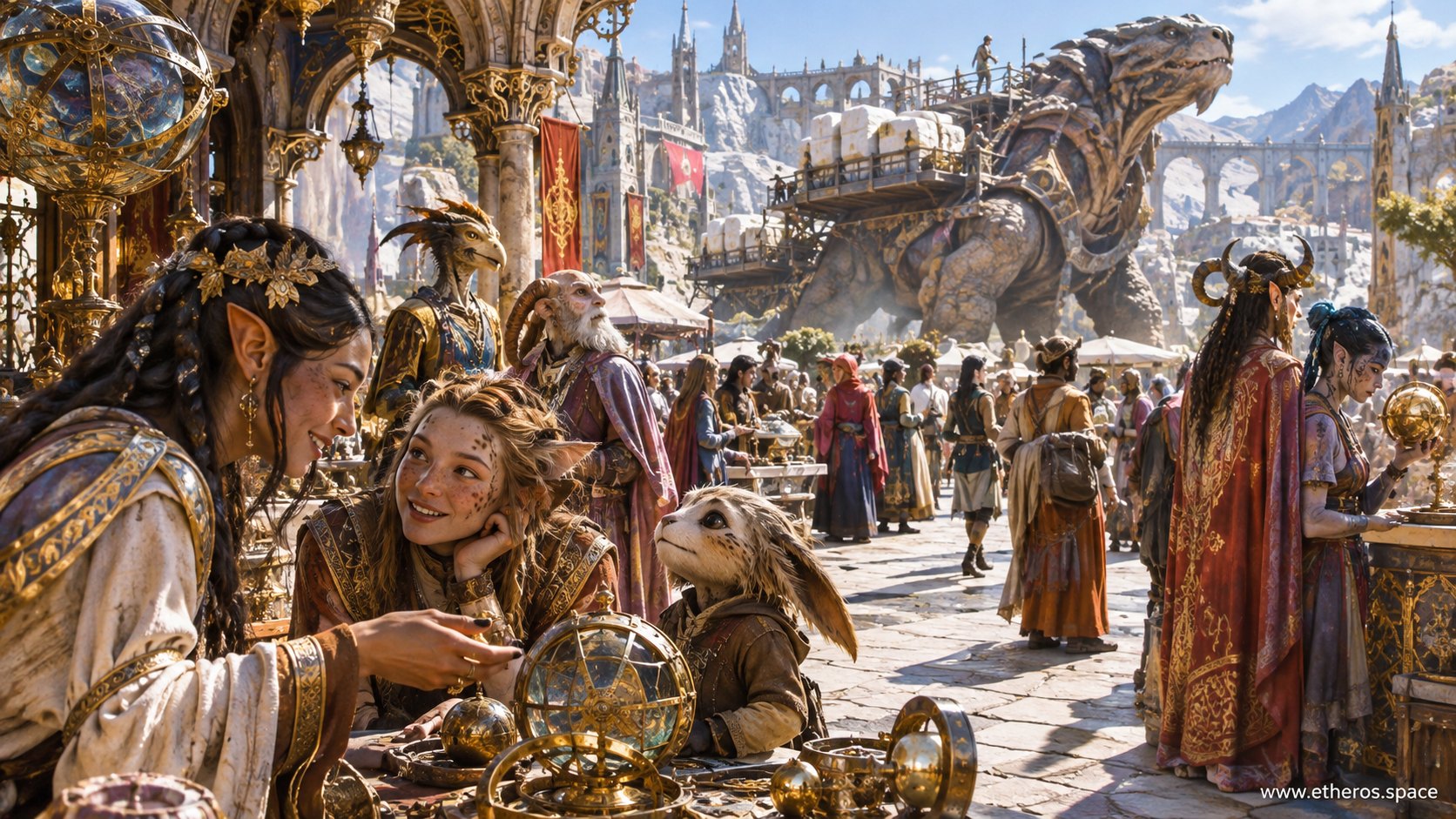
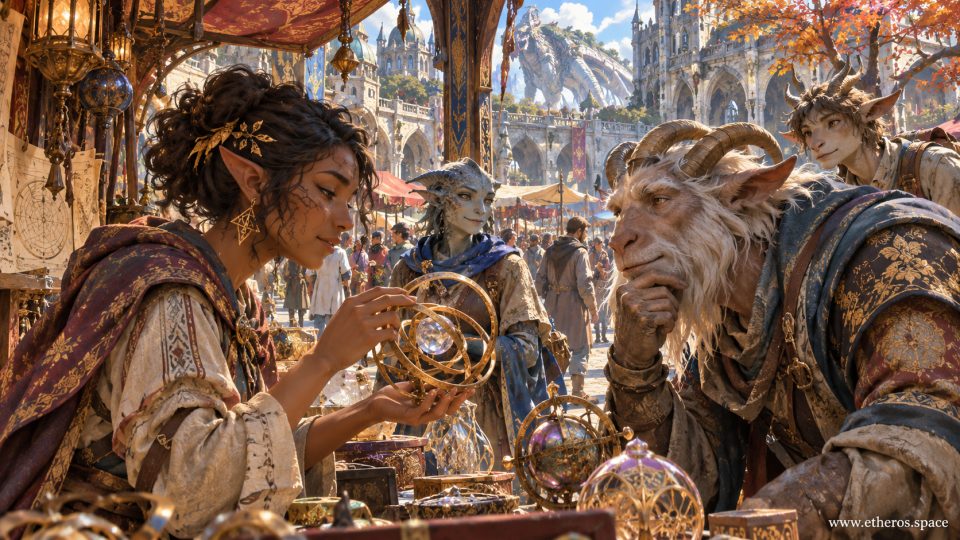
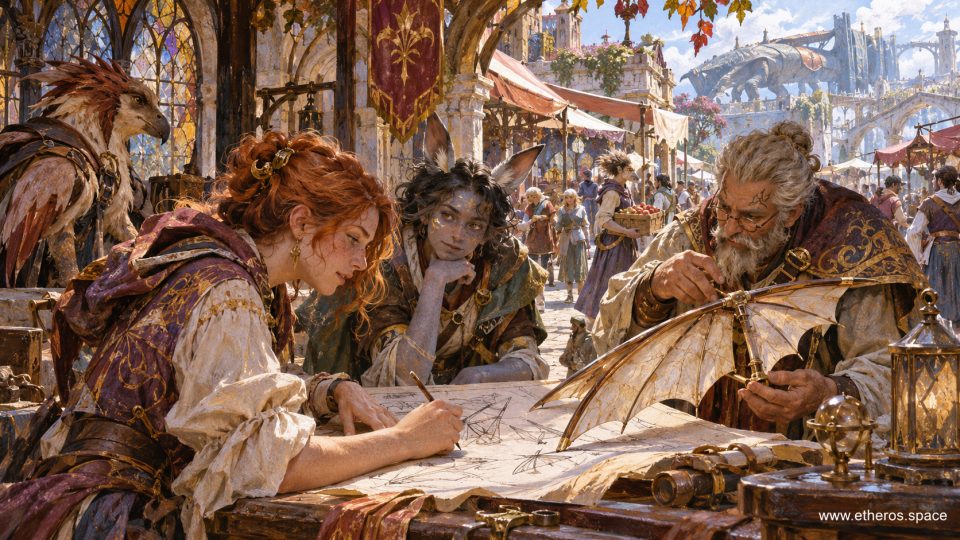
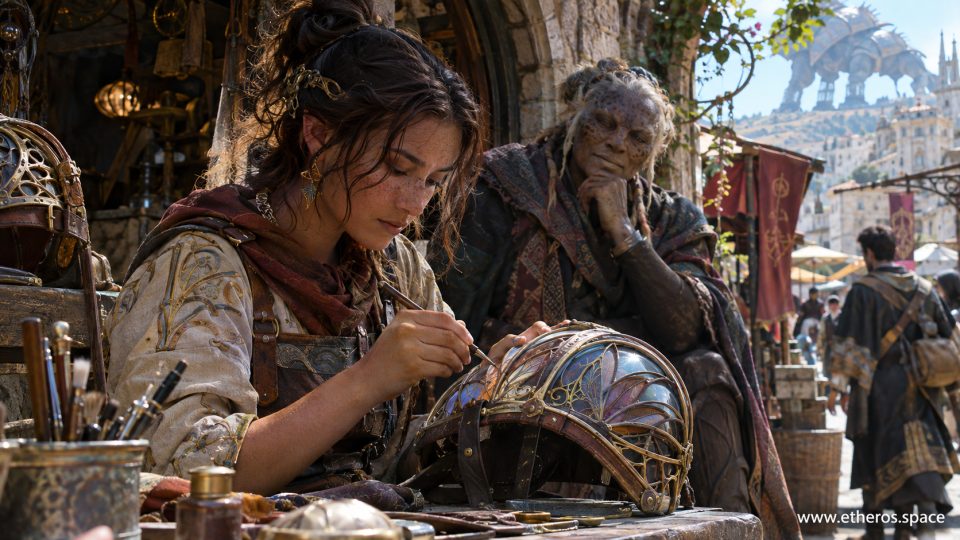
By late morning the west arcade of Thornbrass had gathered the usual small weather around its workbenches: sunlight drifting past stone columns, dust lifting whenever a freight cart crossed the paving, and the smell of warm brass from the grinders. Merchants under embroidered awnings argued about deliveries. A traveler passed the open edge of the stall without looking in. From the hillside beyond the towers, the bulk of a walking biomechanical worker hung in the pale distance, too far away for anyone below to see the job it was doing.
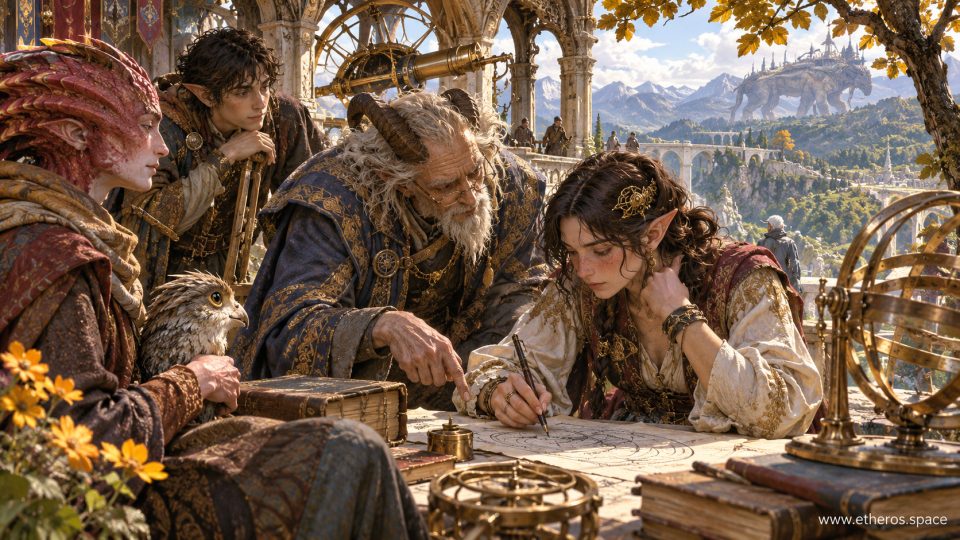
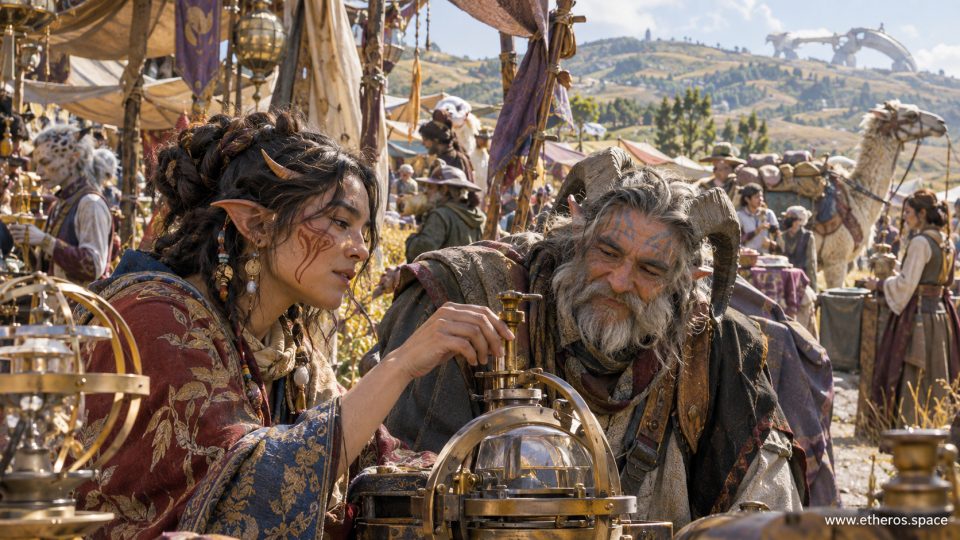
At the bench, Tessa sat with an iridescent protective visor balanced on its metal frame. She had pinned her dark hair in a loose knot, but strands had fallen across the freckles on her face. Her cream sleeves were stained at the cuffs, and she held a fine marking tool against one of the curved golden ribs. The shell was elaborate, all translucent blue-violet facets and leaflike metalwork, yet most of her attention went to the plain dark strap beneath it.
Behind her stood Amm, a broad-shouldered, spotted elder whose gray hair had been tied back in a thick coil. One hand supported his chin. He did not reach for the visor. He had learned years ago that a good apprentice needed time to find what was wrong before being told.
"The outer rib is beautiful," he said at last.
"You say that whenever you mean it isn't finished."
"The outer rib is beautiful."
Tessa placed her tool down. When the shell caught the sunlight, its filigree seemed almost alive. There were other helmets stacked behind the workbench, easier to make and cheaper to sell. This one was commissioned for the people who climbed above the cloth markets, where the awning supports had begun to loosen in sudden upland gusts.
A sealed letter from Rava Henn, a drafter at Letharn's cloth arcade, had arrived three days earlier. It contained a tracing of a new ventilating hinge and a note about the roof crews who would have to test it at height. The work was ordinary and therefore dangerous in an ordinary way: a small stumble on a narrow ledge, a loose tool, the wrong reflex when a canopy caught the wind. Rava had asked for a fitted headpiece that would protect a worker without blocking the downward view needed to find a foothold.
That last requirement had complicated everything.
The old guild pattern put an opaque brow-guard over the eyes. It stopped falling grit but hid the edge of the beam beneath the wearer's boots. Tessa's design replaced the guard with an arched transparent membrane set between narrow metal ribs. The membrane could deflect loose dust and minor chips. It was not armor against a falling stone, and Tessa refused to write otherwise on the maker's card. Its lower frame was meant to transfer ordinary knocks through a flexible collar rather than into the nose.
"Where does the weight go?" Amm asked.
She pointed to a joint above the ear. "Down through the back rail."
"And if the wearer looks down?"
Tessa tilted the visor on the padded support. The strap pulled tight at its upper corner. A thin metal tongue near the cheek moved closer to the place a living jaw would occupy.
Amm's expression did not change. Tessa watched the joint for another moment, then eased the pin free with her smallest tool.
"I made the line follow the goldwork," she said.
"You made it follow what looked right from the table."
The words stung only because they were true. She had kept the collar symmetrical when the two attachment points needed to lie at different angles. On a drawing, the difference was unimportant. On the head of a roofer looking down toward a foothold, it could decide whether the visor stayed clear or slid across the field of vision.
They had enough material to replace the short rail. Amm fetched a second length from a rack and tested its spring against his thumb. Tessa marked the new bend, leaving space for different ear shapes and for the horns of workers whose species required a wider fitting. The component would be offered in several sizes; nobody would be expected to squeeze their anatomy into a ceremonial ideal.
The elder found the right support piece among the tools and set it within reach. For a while, they worked without talking. Tessa scored the metal, checked the position of the fastening, and held the visor against the workshop's padded head form. The glasslike panels caught passing figures in soft, broken reflections. Beyond the stall, the market kept moving. An awning snapped once in the breeze, and somewhere beyond the arches a carrier called for room.
When the fitting finally turned without pulling, Amm nodded.
"That will do?" Tessa asked.
"That will be worth trying on a real worker."
It was not the praise she had hoped for as a child. Now it was better. They would send the prototype to Letharn with an instruction to test it on the roof at ground level first. The crew would report the blind spots, the pressure points, and the catches against their clothing before anyone took it up the scaffolds. Nothing about the design would be called certain until someone had safely worn it.
Tessa picked up her tool again and added a small, almost invisible notation inside the frame: a reminder to check the back rail after the first hundred hours. Amm watched her make the mark, then turned to another task.
By the afternoon bell, customers would see only an ornate helmet shining at a workbench. They would not know about the shifted joint or the letter from another city's roof crew. The practical decisions were meant to disappear into the finished object. But Tessa liked knowing they were there: a curve of gold made to yield, an edge kept clear, a stranger's next step given a better chance of landing where it should.