The Price of an Unfinished Sky
Story
THE PRICE OF AN UNFINISHED SKY
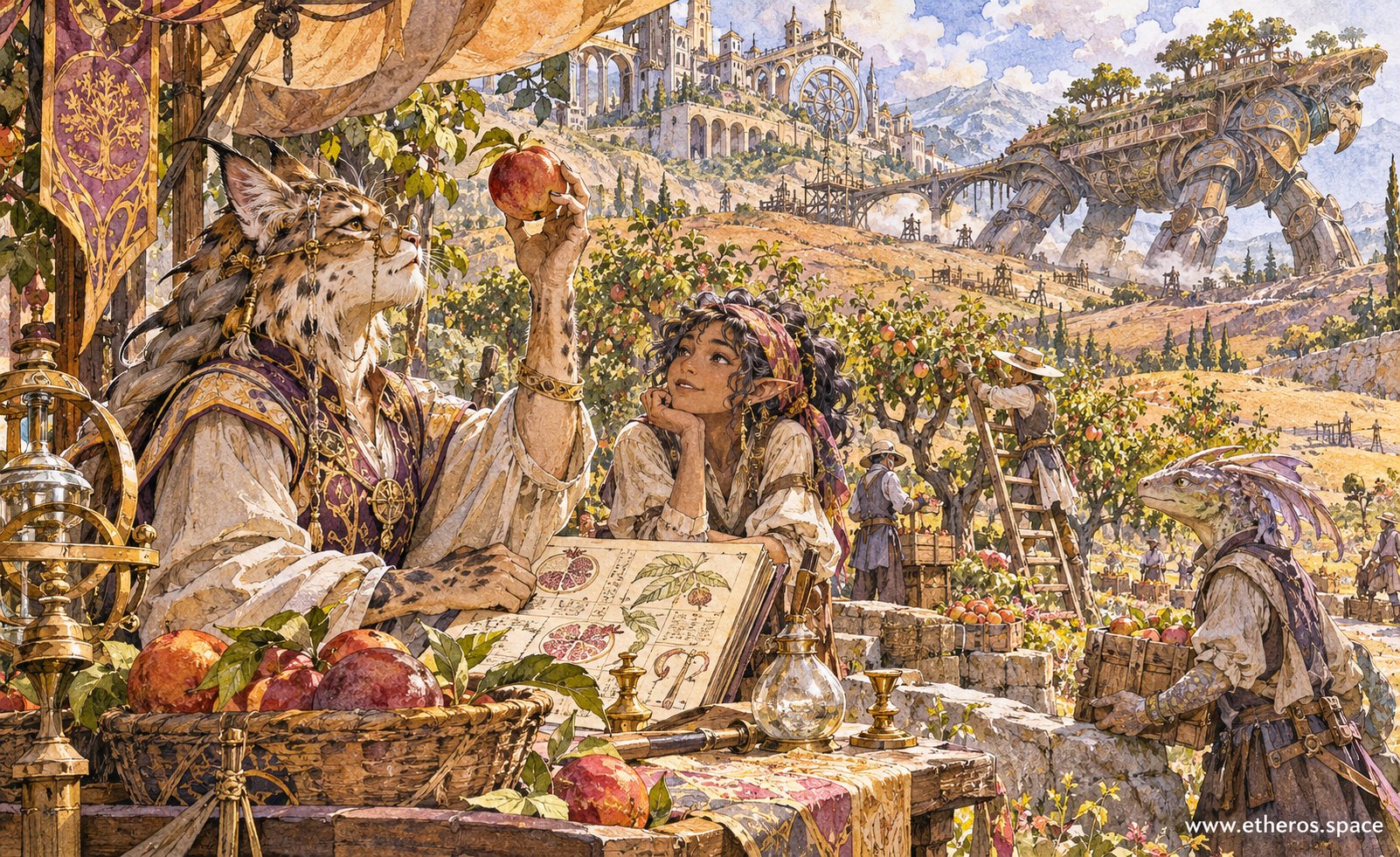
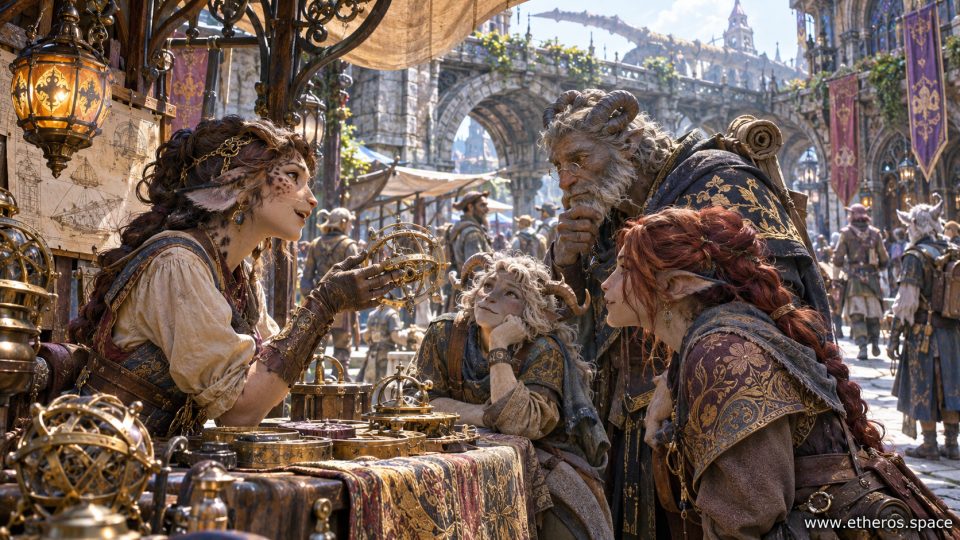
The morning had entered Ardem through every arch at once. High above the cloth awnings, pale towers held their shadow against the nearer bridges. A tremendous plated shape rose beyond a distant gallery, its lower workings hidden by masonry. From the instrument stall nobody could tell whether it was moving or merely outlined by the dust. Carts and pedestrians moved anyway, as they did on ordinary market days. If the city required every citizen to stop and understand every distant machine, nobody would ever reach work.
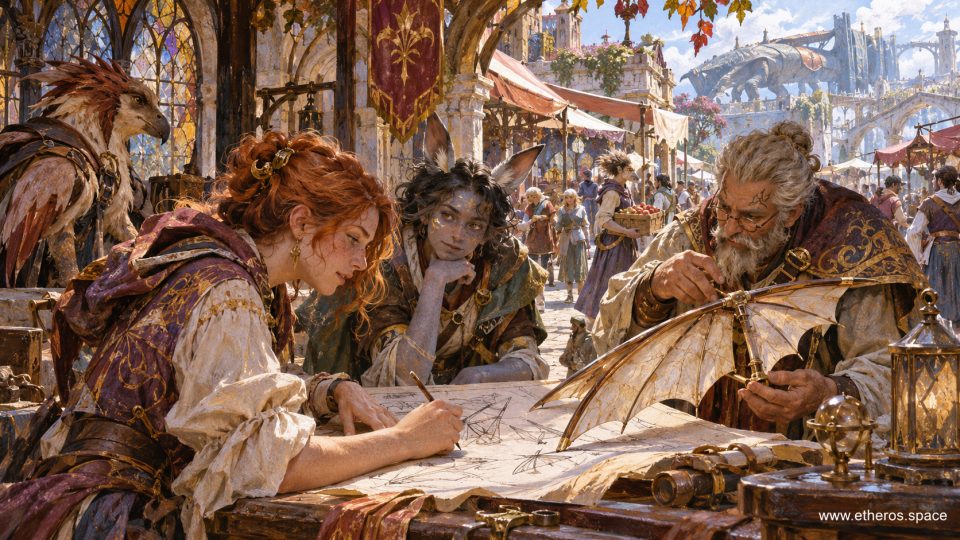
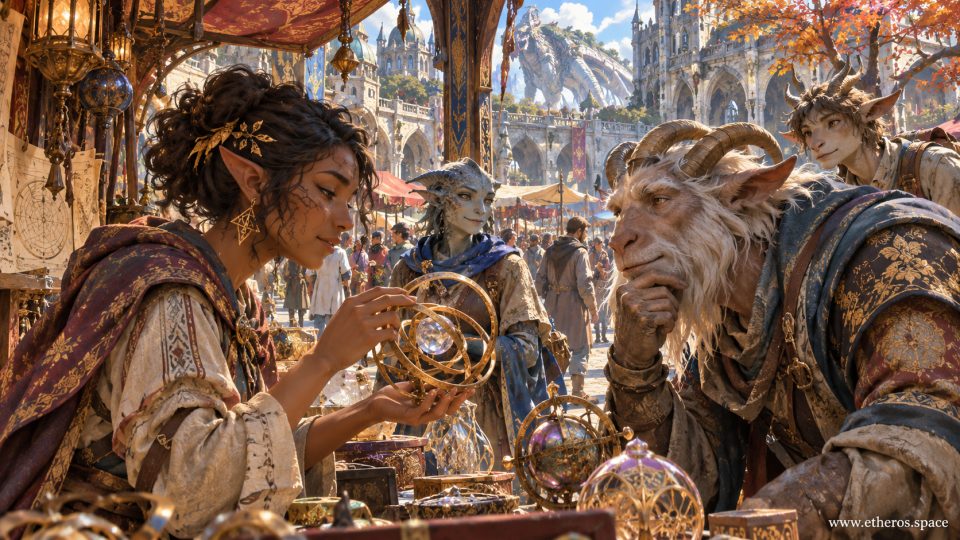
Beneath the red canopy, a small object had drawn four people into an imperfect circle. The brass rings around its glass heart were narrow enough to turn between two fingers. On the table stood other measuring cages, luminous vessels and small lidded boxes; against the rear wall hung a diagram too intricate to read from the street. The lamp on the nearest upright was still burning although the sun had long since reached it.
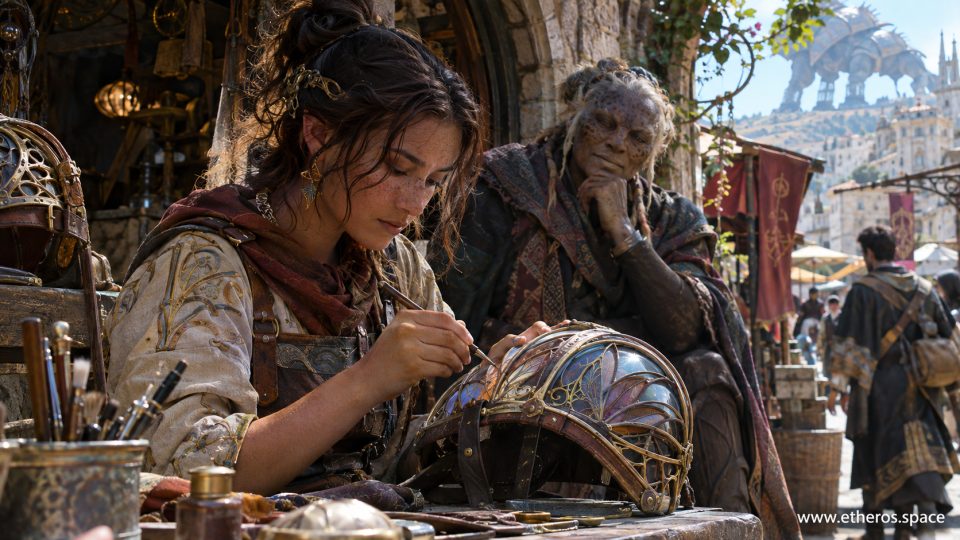
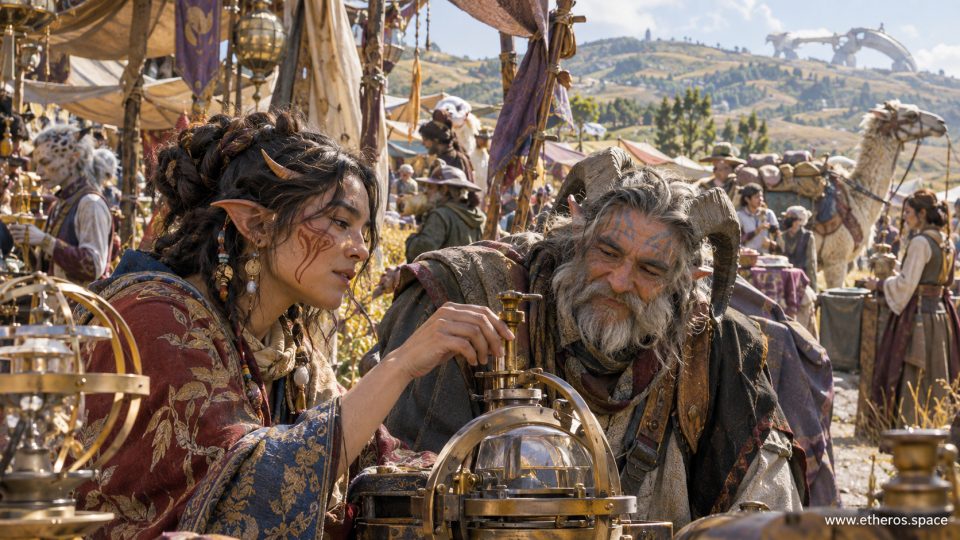
Elya held the device with both hands. She had dark hair pinned in a tired knot, pointed ears, and delicate dark markings at her temple and cheek. Her cream sleeves were rolled where the metal might catch them. She turned the outer ring slowly until the blue glass caught a sliver of daylight, then stopped. A tiny engraved index had come to rest not where the painted demonstration card said it should.
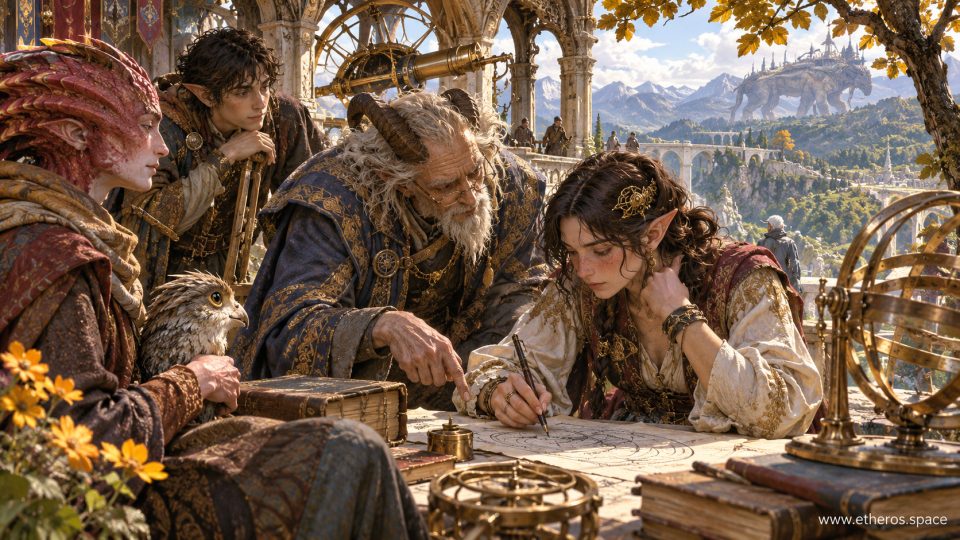
The older customer opposite her, whom the lane called Master Odran, let his pale beard hang over the blue-and-gold coat while he considered the disagreement. Thick curved horns gave him a commanding silhouette, but his hand was tucked against his chin, not raised to command anyone. He had spent forty seasons checking freight weights and measuring ropes; in his experience it was often the prettiest instrument that concealed the least forgiving error.
"You could adjust the label," he said.
"And leave the scale wrong?" Elya asked.
He did not answer. Behind them, a blue-scaled traveler named Neral watched the exchange from the narrow passage between stalls. Neral wore a blue travel scarf with the dust of the eastbound track in its folds. Neither friend nor buyer, they had come to ask for a public reference that any wayfarer might use without paying the surveyors' guild to repeat an elementary measurement.
A young horned student, Senek, leaned in from the other side. He was delivering a bundle of route cards from the upland school. The cards showed the sky as the guild had printed it last year. A single line on each sheet had been copied from a master index, and every pupil was taught to trust that line before trusting their eyes. Senek had brought one back because at the old eastern stair, where winter sun fell between two bridges, the prediction missed by almost the breadth of a stair tread.
Nobody needed to invoke a curse to explain it. Odran asked to see the small suspension point where the rings carried the glass. When Elya loosened the outer hoop and turned it independently, the weighted inner cradle should have sought a stable reference below the pivot. Instead the brass collar leaned a fraction toward its scarred side. The ring's engraved graduations were sound. The bearing was not. Whoever had polished the original instrument had burnished the wear until it could no longer be seen.
The temptation was to treat the discrepancy as private knowledge. Elya could have sold a corrected instrument at a high price and left a hundred flawed copies in the hands of schools, drivers and repair crews. Master Odran could have ordered her to say nothing until the merchants' committee met, and most of the people in the passing crowd would never have known whose convenience had been protected.
But there were other kinds of cost. A misplaced line on a decorative chart was a nuisance; a misplaced line on a freight approach could become a broken axle, a tipped cart, or an animal forced across ground its keeper had not judged. The market itself was built on repeated small acts of trust: labels on weights, steps in ladders, knots in load-bearing cloth, directions given to strangers without a fee.
Neral set a coin on the edge of the counter. Elya pushed it back.
"Not for the error," she said. "You can pay me for a sound bearing after I know how to make one. The warning has already been earned by everyone who used the old scale."
Senek smiled in the embarrassed way of a student hearing an adult admit what the classroom had not allowed. Odran examined the little brass frame again. He had come ready to defend the guild's certainty, but what he had witnessed was more useful than certainty: a method by which any careful pair of hands could find a false result. He took from his travel pouch the plainest of his measuring weights and placed it beside the ornate device. There would be no performance. They would repeat the test in open sight, write down the offset, and post the correction before the midday carts departed.
The instrument did not suddenly make the world safe. The glass still flashed blue. The engraving remained delicate, and the crooked collar would still need replacing. The crowds behind the table did not halt to applaud. Somewhere above the distant arches an enormous obscured shape stayed as mysterious as before. Elya had not repaired the whole sky, nor even the whole instrument. She had only refused to let the beautiful thing tell an unchallenged lie.
By afternoon, students and freight keepers could compare their own readings against a shared correction. Senek would carry the first handwritten copy back toward the uplands. Neral would carry another along the east road, not as a warrant of absolute truth but as an invitation to check the next number independently. Odran stayed until Elya drew a line across the false demonstration card and wrote the tested value beside it.
On Etheros, most public repairs did not look like great moving machines on the horizon. Sometimes they were a young maker, an old specialist, and two travelers agreeing that knowledge was strongest when someone else was allowed to test it.