The Wing That Could Hold Silence
Story
THE WING THAT COULD HOLD SILENCE
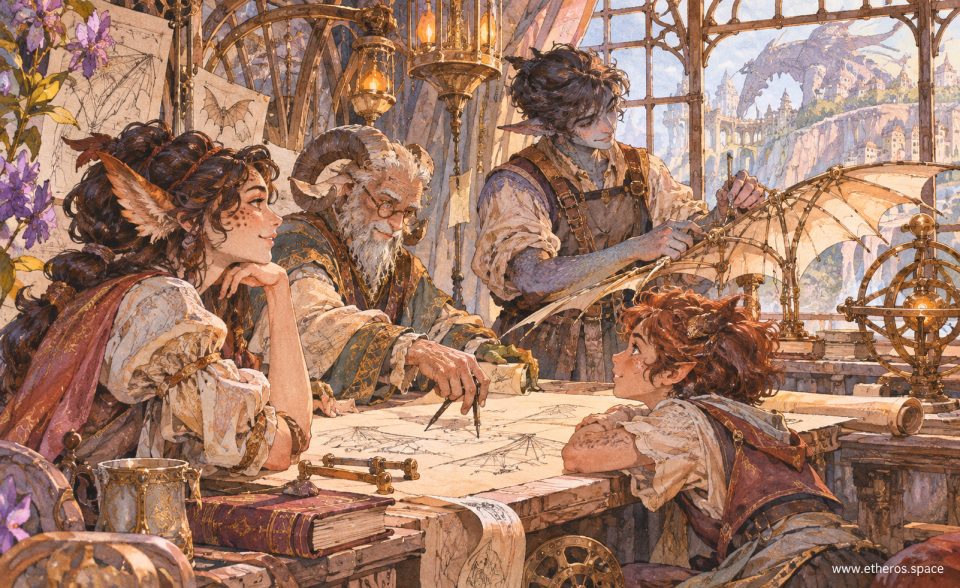
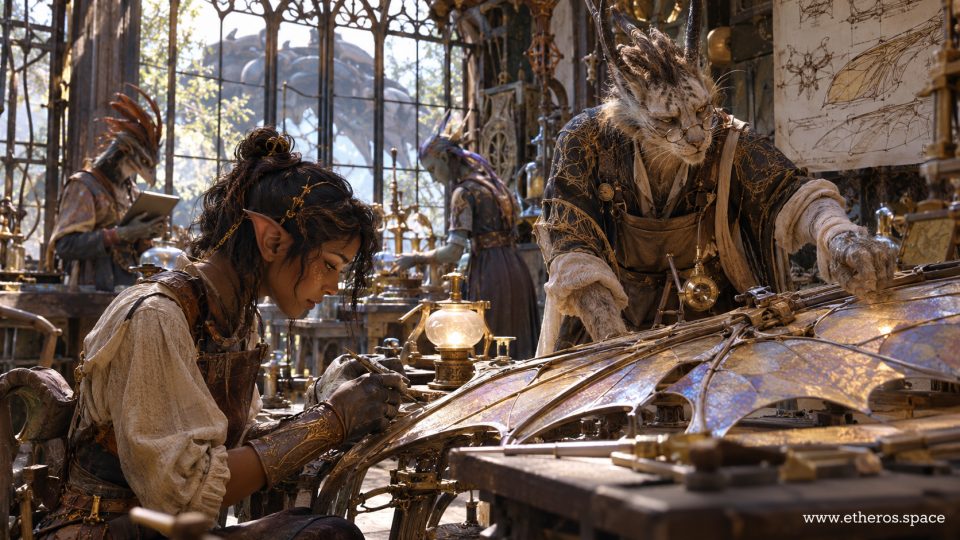
By the fourth bell, the windows of the old Letharn shop were bright enough for the apprentices to put away their measuring lamps. Sun passed through a forest of narrow iron mullions and fell in broken golden shapes across the long table. The glass within the wing frame caught those shapes and returned them in colors no one could name precisely: pale copper, bruised blue, violet, the soft yellow of polished shell.
At the near end of the table, Issen held her engraving tool against a rib no wider than her finger. Her dark hair was pinned up unevenly, and she had not raised her eyes from the seam since breakfast. Opposite her, Old Rem, whose pale feline face and long ears were half hidden behind spectacles, pressed a broad paw against the upper spar while he checked the tension of a coupling.
Neither looked at the other. They had spent enough mornings at this bench to know when silence meant concentration and when it meant disagreement.
The wing was not intended for flight. That was what caused the arguments.
Every visitor to the workshop assumed a craft so beautifully jointed must belong to a glider, a courier's back, or one of the broad sail-beasts that crossed the upper valleys. Issen had once believed the same. She had joined the guild to build things that escaped the ground.
But the order on the wall was for an acoustic canopy above the South Foundry's night hall. Three thousand residents lived below that hall. A great stamping machine rang through the cliff foundations after dark, not because anyone had wanted to be cruel, but because the newer buildings had been constructed over the only available load-bearing stone. Their floors transmitted every blow. The elders could not sleep, and children whose hearing was tuned to the finer frequencies of forest insects woke frightened even when their parents heard nothing at all.
The foundry could not simply close. Its presses supplied braces for the stairways and articulated joints for the freight towers. Their work carried people and provisions through winter. It was the sound of useful labor reaching people who had nowhere else to rest.
So the guild had been asked to make a roof that listened.
The iridescent wing would hang beneath an existing vault in overlapping sections. Its curved ribs would gather the most damaging resonances, carry their vibration into layered membranes, and release the energy gradually through insulated mounting feet. A shallow gap above each panel would maintain airflow and allow warm air to leave the work hall. Nothing in the design could be allowed to obstruct an emergency bell, whose lower notes must remain audible through every sleeping quarter.
Rem tapped the near joint with one claw. A dull note came back.
"Too stiff," he said.
Issen continued engraving for a moment. "It holds the shape."
"A shape can hold a mistake."
She set down her tool. Across the room an avian assistant was reading the daily measurements from a slate. Another worker adjusted a brass instrument under the windows. They were occupied with their own tasks; nobody gathered around to watch the argument.
Issen pulled a strip of translucent membrane from the frame, examined the small bend she had cut, and fitted it back between two ribs. "If we loosen it again, the panel will lose alignment."
"And if we do not," Rem replied, "the sound goes into the wall."
He guided her hand toward the spar. When she pressed it, the entire assembly trembled. The beautiful surface appeared calm, but she felt a rapid vibration travel through the joint into the table.
It reminded her of a winter night in her childhood dwelling, when the eastern freight engines had been visible only as lights beyond the roofs. She had believed their noise came from far away. Only later had she learned that stone could carry a city's work into rooms where no machine was visible.
She looked at the technical drawing pinned above the table. There was a small blank space beside the coupling, left for a flexible anchor that the council's dimensions had not specified.
"A tendon loop," she said.
Rem glanced at her. "Show me."
Issen fetched a length of braided biofiber from a drawer, threaded it between the spar and the next support, and eased the rigid clip away. The living fiber was grown for repeated flexion: strong under steady load, yielding a little under a sharp impulse. She wrapped its ends around bronze sockets so that the material could be replaced without damaging the wing.
Rem shifted his weight and tested the panel again. The surface flexed a few millimeters. The table no longer rang.
"That may do it," he said.
"It might," she answered. "We should measure."
For the next hour they took readings instead of celebrating. A vibration that vanished at their bench might reappear when the canopy was attached to the great stone vault. They marked the boundary conditions, recorded the replacement interval of the fiber, and wrote a warning in the margins: *do not tighten to eliminate all motion*. Something intended to protect a neighborhood could become dangerous if maintained by someone who misunderstood it.
When the fifth bell sounded, the avian reader brought them the latest figures from South Foundry. The night shift would begin in two days. That was enough time for one full trial, and perhaps not enough for a second.
Issen looked at the wing, at its patterned cells and gold-dark framework. She had still made a thing of astonishing beauty. It simply would not carry anyone into the sky.
"I used to think flight was the kindest work a wing could do," she said.
Rem removed his spectacles to rub the bridge of his nose. "Most things that keep us alive never leave the ground."
Outside, a distant form passed behind the trees and iron windows, too far and too obscured to identify. Inside the shop, the apprentices continued reading, adjusting, fastening, and making space for the next task. Issen returned to the near rib and engraved a small mark beside the new anchor so the person who serviced it years from now would know why it was there.
Nothing had yet been installed. No sleeping child had yet heard the improvement. The wing was still a prototype, and the night hall still rang.
But the measured vibration had changed, and a workshop full of people knew exactly what to test next.