The Weight of an Unsent Letter — Evening at Kareth Wingwrights
Story
The Weight of an Unsent Letter — Evening at Kareth Wingwrights
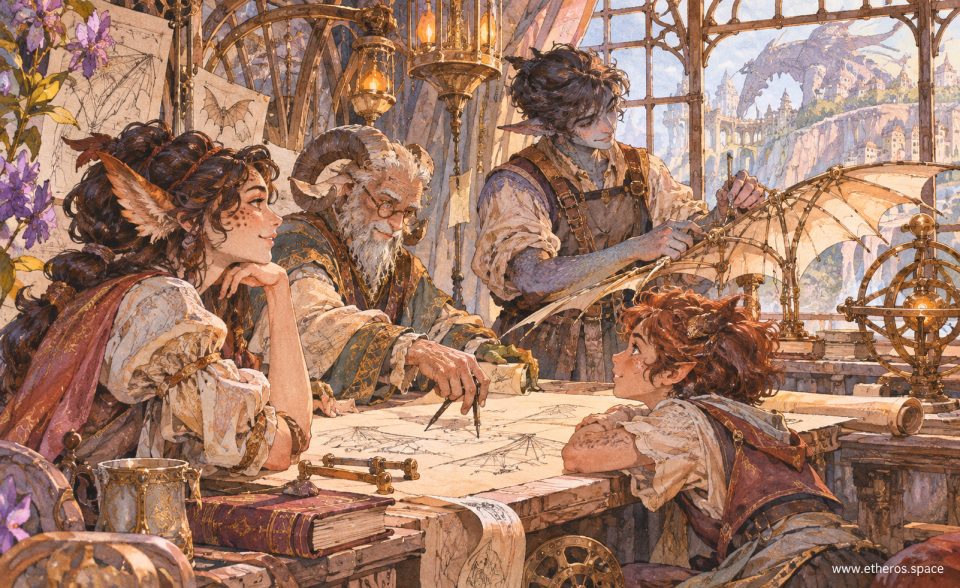
From the lower end of Kareth's cliff road, the wingwright's workshop looked less like a business than a room in which several generations had left their questions unfinished. There were moth-wing diagrams pinned above the shelving, scrolls slowly escaping their bindings, warm hanging lamps, a globe caught inside its brass circles, and a window large enough to admit a view of the stacked city beyond. A far-off shape rose past the roofs; from this distance even its scale and nature were hard to judge.
On the crowded drafting table lay a plan for a small, ribbed flying apparatus. Its spars were as fine as a bird's bones. Its pale membranes were not wings borrowed from an animal, but deliberately constructed surfaces whose tension would have to be balanced against the hinges and ribs holding them open.
Master Irven, a horned elder with round spectacles and a beard the color of paper dust, steadied a compass on the plan. Beside him, Sel, a blue-gray-skinned wingwright, was working on the actual mechanism: one hand at the leading-edge joint and the other supporting a strut where it joined the membrane. There was no triumph in his concentration. The piece was still unfinished.
To their left, the feather-eared archivist Orla watched without moving her elbow from the table. On the right, a small pointed-eared child named Pell leaned into the drawings so far that his chin nearly touched the parchment. They were not posing for anyone. Orla's gaze followed the spar Sel was adjusting; Pell followed Irven's compass instead. Their different attentions were the whole conversation.
Pell had arrived with a letter that morning.
It had been written by his grandmother, who lived above the northern quarry. Three days of rockfall had closed the ordinary stairway, and the message runners could not pass the exposed ledge without endangering themselves. A letter was not heavy, but sending one over a broken stair was suddenly a problem of distance, wind, labor, and risk.
The elder had read the address, then folded it back into its envelope. He refused to promise the child that a machine could fly before anyone had tested it. He did, however, bring out the workshop's neglected glider plans.
"A letter weighs less than a sparrow," Pell had said.
"A falling letter weighs enough to break a promise," Irven had answered.
By late afternoon they had settled on a design. The apparatus would not flap or levitate. Launch energy would come from a small tensioned cradle on the ridge, and its wings would exchange height for forward travel while stable air permitted. It would be a one-way courier, to be recovered where the ground was safe. The scheme required an open descent path, a known wind, and a recipient who understood the recovery marker. Nothing in the workshop drawings could provide those conditions by itself.
Sel lifted the prototype's right wing and found that the outer joint dragged. He had made both spars identical, assuming symmetry would make the machine stable. But the leading edge carried a slightly different load after they attached the letter container beneath the body. The adjustment would have to account for the actual center of mass, not the beautiful mirror image on the original chart.
Orla pulled the folded envelope from her coat. She weighed it against an empty tube and placed both near the compass. The child's letter was only one possible payload, she reminded them. Medicines, seed samples, and fragile pages might eventually follow, but the machine must first prove it could carry a known weight without tumbling.
"Could we send it tonight?" Pell asked.
"No," said Sel, and loosened the binding around the troublesome joint. "We can make the hinge move freely tonight. That isn't the same as making a flight safe."
Pell did not like the answer. His grandmother had once told him that patience was merely waiting given a nicer name. He had never found the distinction persuasive.
Irven turned the compass until its points spanned the projected wing tips. He showed Pell the triangle of forces they needed to understand: the downward weight of the apparatus and its letter, the support that moving air could produce, and the resistance that would consume height. A strong hinge would be useless if the membrane folded under load; a strong membrane would be useless if the launch began at the wrong angle. The smallest failure might be the one too delicate to notice at the workbench.
As Irven spoke, Sel slipped a narrow flexible washer beneath the joint. It held the wing close enough to transfer force, but not so tightly that a gust would snap the fastener. The prototype settled into a slightly changed shape. Nothing dramatic happened. Pell leaned forward anyway.
From the window came the muted sound of the city finishing its day. Bells carried through the cliff streets, and a distant vessel crossed the bright gap between towers. Somewhere beyond the visible rooftops, crews would be preparing stair repairs, checking their hoists and calculating the loads the damaged path could bear. The letter's route was one small part of that larger civic labor.
Orla wrote the date at the edge of the design and added a note: *Prototype joint revised; no flight undertaken.* In a city fond of monuments to brilliant inventors, she preferred records that said exactly what had happened.
The light beyond the window turned copper. Pell unfolded the envelope and read the first sentence again, silently this time. He could not make it arrive sooner by wishing. He could, however, help.
"May I mark the test weights?" he asked.
Sel handed him the pencil. Irven moved the compass aside. And the four of them made room on the table for a list of small, ordinary things that would have to be true before a letter could safely cross the empty air.
The city outside remained immense. Inside the workshop, the distance between two people had become something they could measure, argue about, and perhaps one day cross.