The Ring That Would Not Close
Story
THE RING THAT WOULD NOT CLOSE
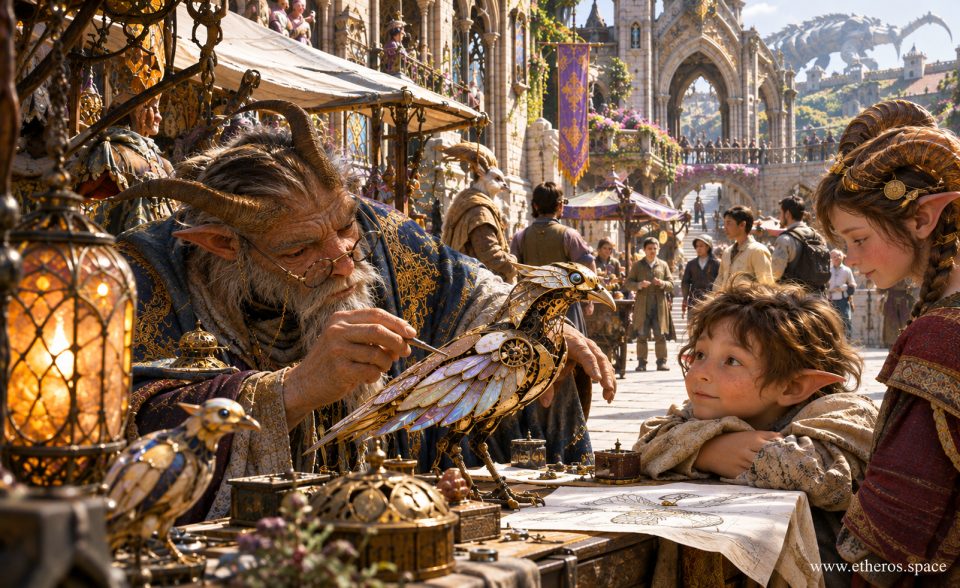
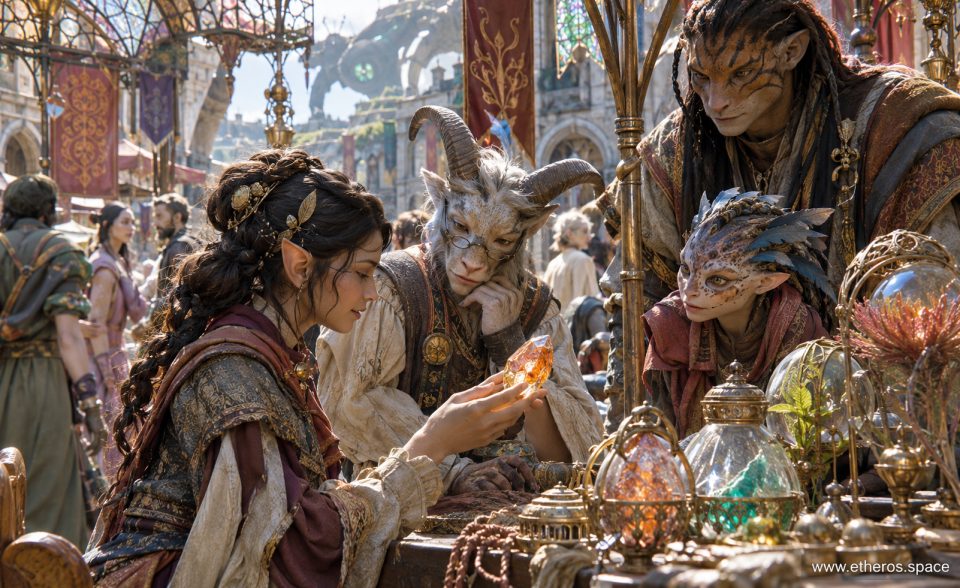
By the third transit bell, the lower instrument market of Ardem had become crowded enough that the merchants could distinguish customers by voices rather than faces. Porters threaded their way past awnings and carved doorways. Every so often a shadow passed across a banner, but the distant bulk above the roofs was too far away to tell what, if anything, it was carrying.
Varek had been at his stall since sunrise.
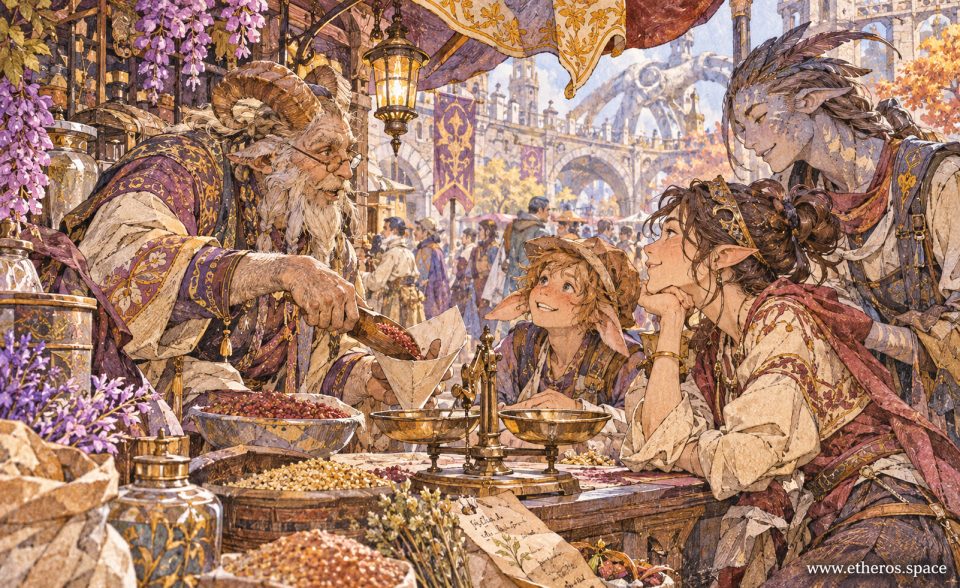
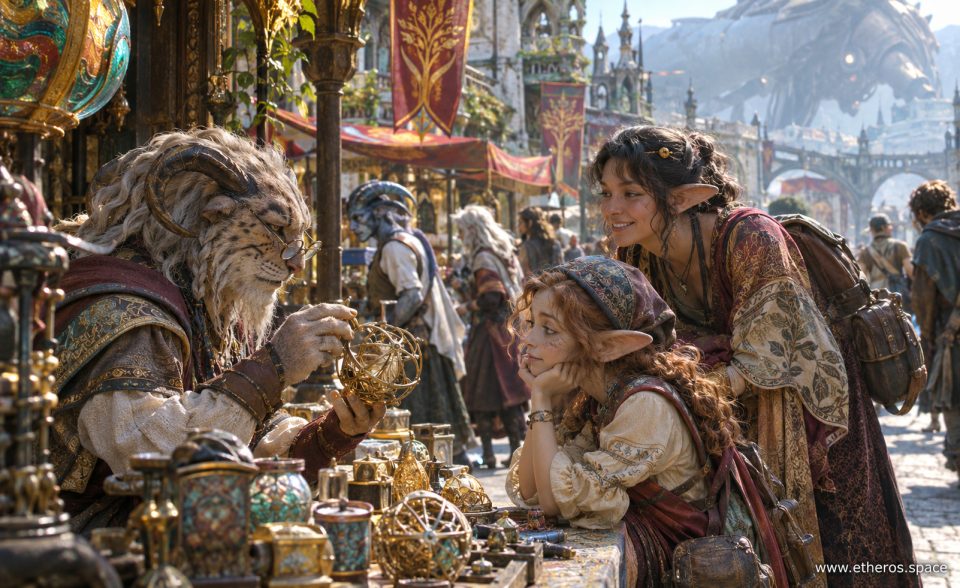
His spectacles rested low against the pale fur of his muzzle, and a short white braid hung beneath the inward sweep of his dark horns. On the crowded table were small glass vessels, copper measuring cups, and nested rings of gilded brass. He held one of these instruments in two careful hands, touching a slender pivot with the tip of one finger.
Across from him, Iri watched with her chin propped on her palms. Her freckled face and pointed ears were framed by a patterned travel hood. Her mother, Maela, leaned over her shoulder, still wearing the pack she had carried across the city.
The armillary had belonged to Iri's grandfather, a surveyor who spent forty-two years measuring the movements of Ardem's elevated roads. When he died, the family found it in a cabinet beneath his old work maps. One of its inner rings would no longer turn.
“Can you make it work again?” Iri asked.
“Perhaps,” Varek replied.
“Then why haven't you?”
He set the gold sphere against the light and examined a hairline fracture beneath its lowest bearing. “Because I haven't decided what broke it.”
He explained what each band had once measured. The widest ring held a local horizon reference; two narrower bands recorded elevation and seasonal shifts of the old viaducts; the smallest indexed the distance between fixed markers at opposite ends of a span. Unlike the decorative instruments sold next door, this one had marks worn into its surface by years of adjustment.
It could not predict the future. It could record where a structure had been when somebody last looked closely enough to measure it.
Iri leaned toward the instrument. “Is it ruined?”
“Only if we pretend the damaged part was never there.”
The fracture was older than the grit gathered around it. Its edges had been polished by motion, suggesting the sphere had remained in use after the damage. Varek could replace the bearing, polish the surfaces, and make the rings spin smoothly again. But the repaired piece would lose its last exact setting unless he copied its position first.
Maela's hand tightened on the strap of her pack. Her father had always argued that measurements should be preserved even when they contradicted the official reports. In his final years he suspected that the east freight arches expanded farther in summer than the municipal estimates allowed. The council had disagreed. The arches were still standing, but that alone did not prove every old calculation had been sound.
Varek adjusted the sphere just enough to expose a faint index mark. He did not move the broken band. Instead he took a scrap of paper and copied the alignment of all four rings, checking each reading twice.
“Your grandfather might have been preserving a measurement,” he said.
“Of what?” Maela asked.
“I don't know. Not from this object alone. We'd need his survey dates, the bridge temperatures, and the load records.”
Iri looked disappointed. She had expected an answer, not a larger collection of questions. For her the instrument had been a mysterious heirloom. The idea that it might simply be a clue seemed less satisfying.
Varek recognized the expression. Most apprentices believed a good instrument existed to provide certainty. Eventually they learned that its more important work was to reveal the limits of what could be known.
He pointed to the worn edge of the bearing. “Someone kept using this when the ring no longer moved freely. They risked ruining it. That tells us this position mattered to them, but it doesn't tell us why.”
“Was that foolish?”
“It depends on what they were trying to protect.”
Maela drew an old survey sheet from her pack, folded into quarters and softened at its creases. Varek spread it on a clean corner of the table. Between the engraved columns was a date thirty-one years old, and below it a small hand-drawn cross beside one of the east bridge's supporting arches.
He compared its references with the surviving marks on the sphere. The figures were incomplete, and he said so. Still, the alignment was worth investigating. He could preserve the broken bearing and build a working replacement alongside it, allowing the instrument to move again without erasing what its owner had left behind.
Iri's eyes brightened. “Will it still be Grandfather's?”
“More than if I made it look new.”
Behind them, a passerby paused to admire the stall, and two travelers argued about which street led to the upper district. Above the crowded roofs, the immense partly obscured biomechanical form remained faint against the afternoon haze; from here there was no way to determine its immediate task. Nothing in the market stopped for their small discovery.
Maela asked how much the repair would cost. Varek named a modest fee, then reached for a second gauge.
“Could I learn?” Iri asked.
He considered her for a moment. “Not the repair today. Today you can learn to measure the bearing before you touch it.”
He handed her the gauge. She took it in both hands, careful not to knock the brass figures waiting beside her elbows. Her mother watched, smiling but saying nothing.
There was no dramatic revelation, no accusation against the city, and no instant solution for the eastern bridges. There was an unfinished measurement, a family unwilling to discard it, and a child learning that useful questions can survive longer than the people who first asked them.
For the first time that morning, Varek let another pair of hands hold the old sphere while he studied the figures on the page. The market around them kept moving, and the little instrument, still broken, had finally begun to give them somewhere to start.