The Bearings of a Borrowed Sky — The Windwright of Veyrun
Story
When the third sky-bell rang above Veyrun, every ferry pilot on the upper terraces held one hand against a rail and listened for the answer. The waterfalls were loud enough to drown the bells on most mornings, but this morning the violet freight sails had begun to shiver without wind. A harbor could survive a snapped mooring. It could not survive a sky-road that lied about its own weight.
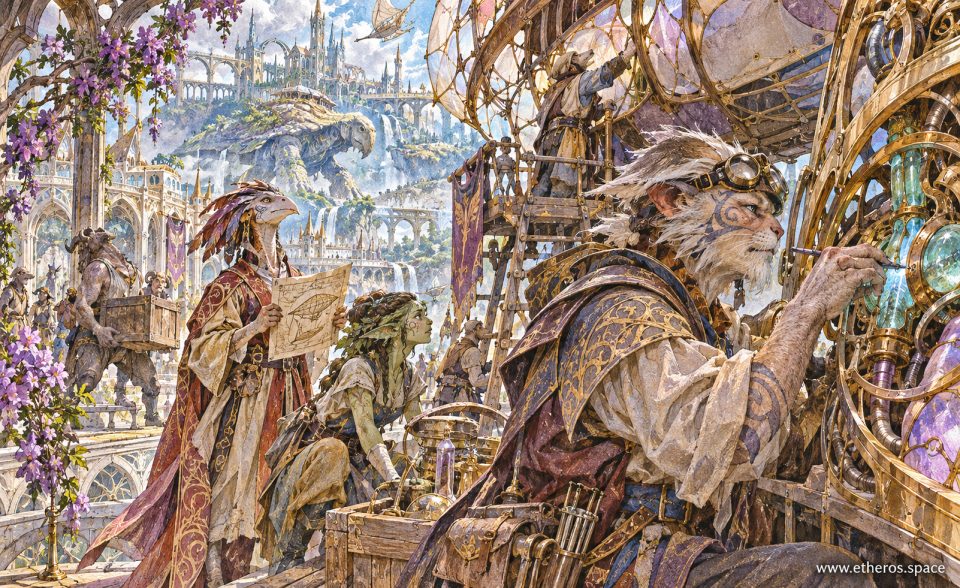
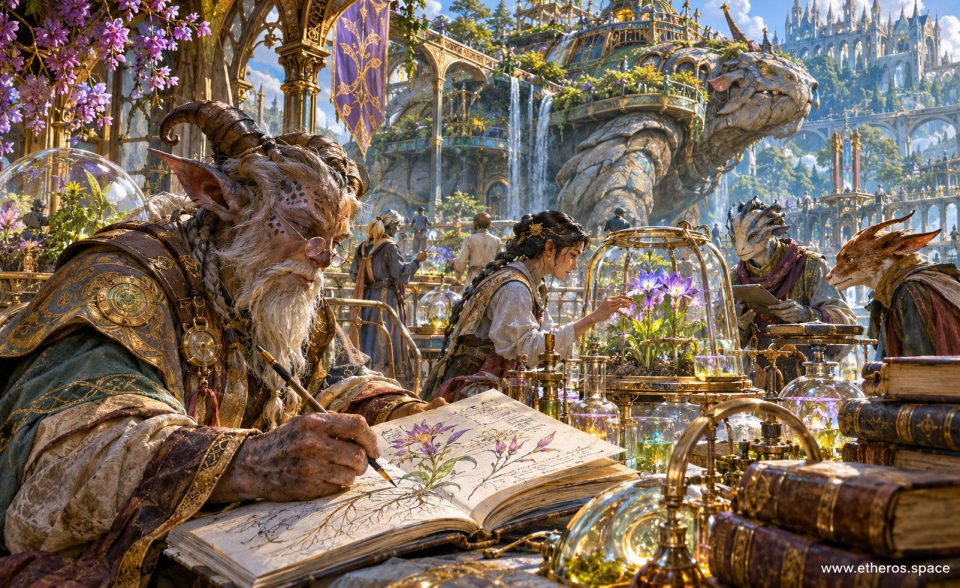
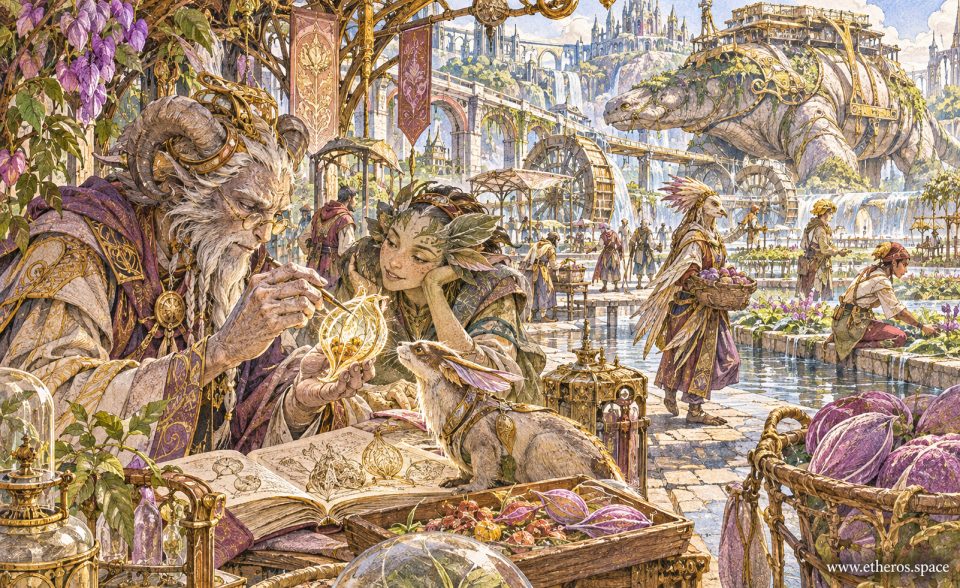
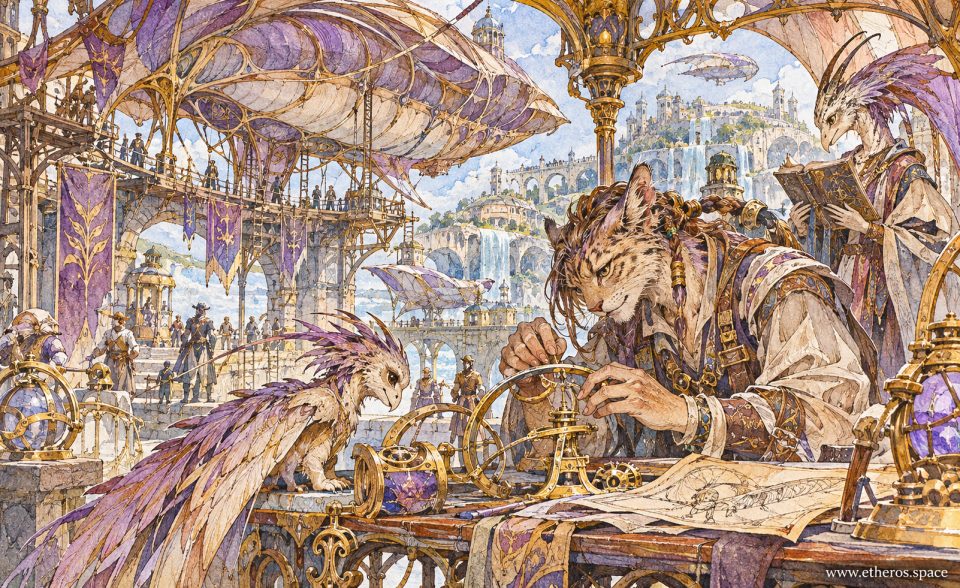
At the outer workbench, Leth Orrin lowered his whiskered face to a little brass ring no wider than his palm. The ring was a bearing for a wind-sense gyroscope: three nested hoops, an amber pivot, and a fine balance wire that told a suspended vessel whether it was climbing, settling, or being dragged sideways by a change in pressure. Leth's two hands were steady. They had learned steadiness during the winters when his family had been paid in hot water rather than coin, fixing the hinges on communal lifts long after the owners had gone to bed.
Beside his elbow crouched Nima, an apprentice not yet old enough to carry the long flight-feathers of her species. Her small talons held the edge of the bench, and her feathered crest leaned toward the mechanism. She had been rescued from a squall near the western bridges years earlier. Leth disliked the word rescued: Nima had found his missing tool satchel before he had found her, and since then neither would admit who had saved whom. The present work was mostly silence. Each time he moved the pivot a hair's breadth, her head turned to follow its smallest tremor.
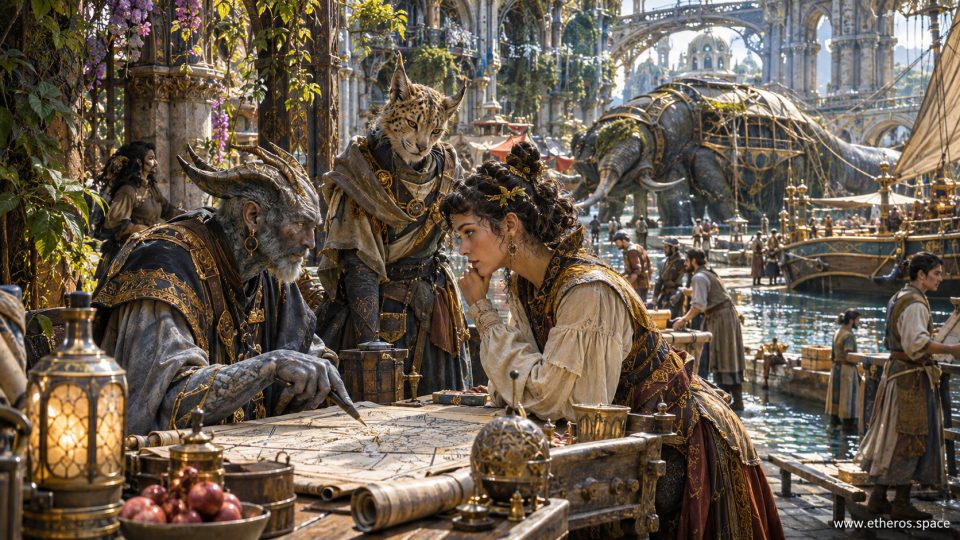
Farther right, the tall, sharp-beaked auditor Kes Valen read from a bound ledger. Kes's pages held the weights of passenger gondolas, freight nets, ballast water, and the dense rootstone that bound Veyrun's terraces to their living foundations. He was not an inspector in the punitive sense. He had lost his brother in a platform collapse and now knew that a number written accurately was an act of affection toward strangers. When Leth asked for yesterday's load, Kes did not give the published figure. He gave the corrected one, with the unreported baskets of mineral fruit included.
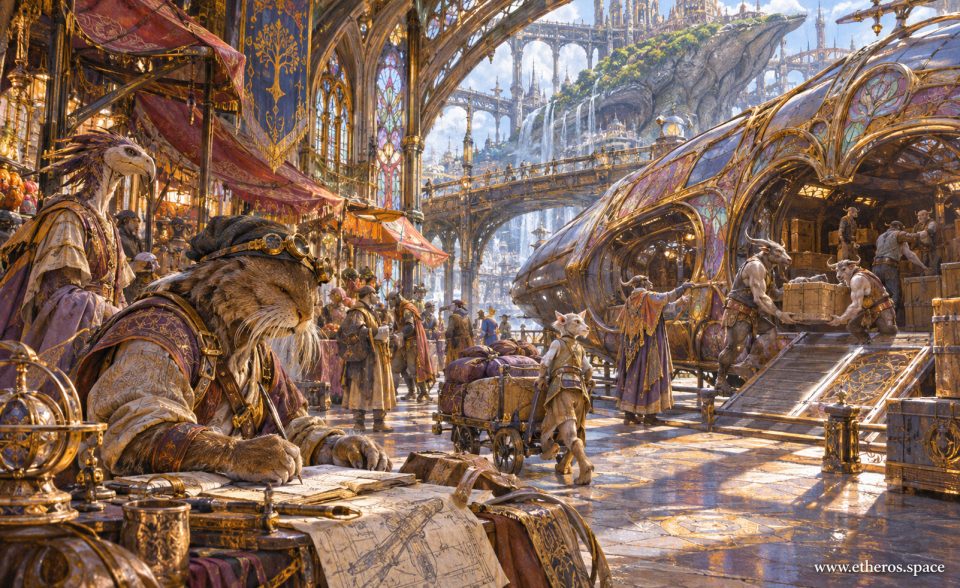
Above them, a great purple canopy stretched over the harbor's gold-ribbed frame. Its cords passed through suspended guide eyes, pulled around curved spars, and disappeared into a network of counterweights and living anchor tissue inside the stone. On the scaffold a line of workers tightened the fabric one span at a time. The system used more than air: falling water beneath the city turned slow pumps; those pumps stored pressure in elastic chambers; the chambers helped compensate when a cargo sail crossed an exposed gap. Matter moved in crates and ballast pipes, force in cords and ribs, information along gauges and bells. No part of the spectacle was merely decoration, although Veyrun's makers had never accepted ugliness as proof of usefulness.
Across the valley, archways overarched other archways, and green ledges spilled their water into bright falls. Pedestrians moved between market steps and high bridges. A smaller violet vessel drifted through the open middle distance, its crew watching the larger rig with the fixed attention of people who depended on it for their evening journey. Leth could see all of this past the measuring wheel. He could also see what the crowd could not: a pencil line in the drawing of the avian steering vane, barely different from the line on yesterday's plan.
'Here,' Nima clicked, tapping an empty notch in the blueprint. It was the first sound she had made in an hour.
The notch belonged to a reed-thin compensator that should have flexed as the sail filled. A replacement had been forged from beautiful but too-rigid gilded bronze. It had held during the fair-weather test and now returned each gust to the ring as a false command to climb. Kes read the discrepancy twice, then closed his ledger with one finger between the pages. Leth took the bronze pin out and set it beside the inkpot. Its shine looked suddenly small.
They had no original compensator left. The suppliers would not open until the next tide, and an entire terrace of workers waited for a safe crossing home. So Leth stripped a narrow spring from his own old field gauge, softened its setting with heat from the orange-veined pressure lamp, and gave Nima the task of choosing the flexible sleeve. She chose a piece of woven membrane from her first flight harness, carefully unstitched from the lining. Kes recorded the substitution instead of hiding it. A repair not written down, he believed, was only a future mystery.
By afternoon the new pin moved through its full arc. Leth lifted the instrument toward the light. Behind it, gold rails curved across the harbor like the strokes of an engraver; beneath them, water struck the lower basins and went on turning the pumps. The great sail gave one long, gentle breath. The gyroscope settled level. Three bells rang in sequence, not as warning now but as consent.
The smaller vessel crossed first. Its passengers waved at no particular person on the terrace, which suited Leth. He was already sketching the next repair. Nima pressed her head against his wrist for a moment, then went back to inspecting the ring. Kes finally added a final line to his ledger: 'The crossing held because three people reported what they saw.'
That evening Veyrun would remember the violet sail against the waterfalls and the untroubled procession of lights over the gorge. Almost no one would remember the little bearing on the workbench, or the older craftsman's borrowed spring. The sky itself, however, would remember: not as gratitude, but as a passage kept true by their hands.