The Lantern Seed of Orren Vale — A Morning at the Living Waterworks
Story
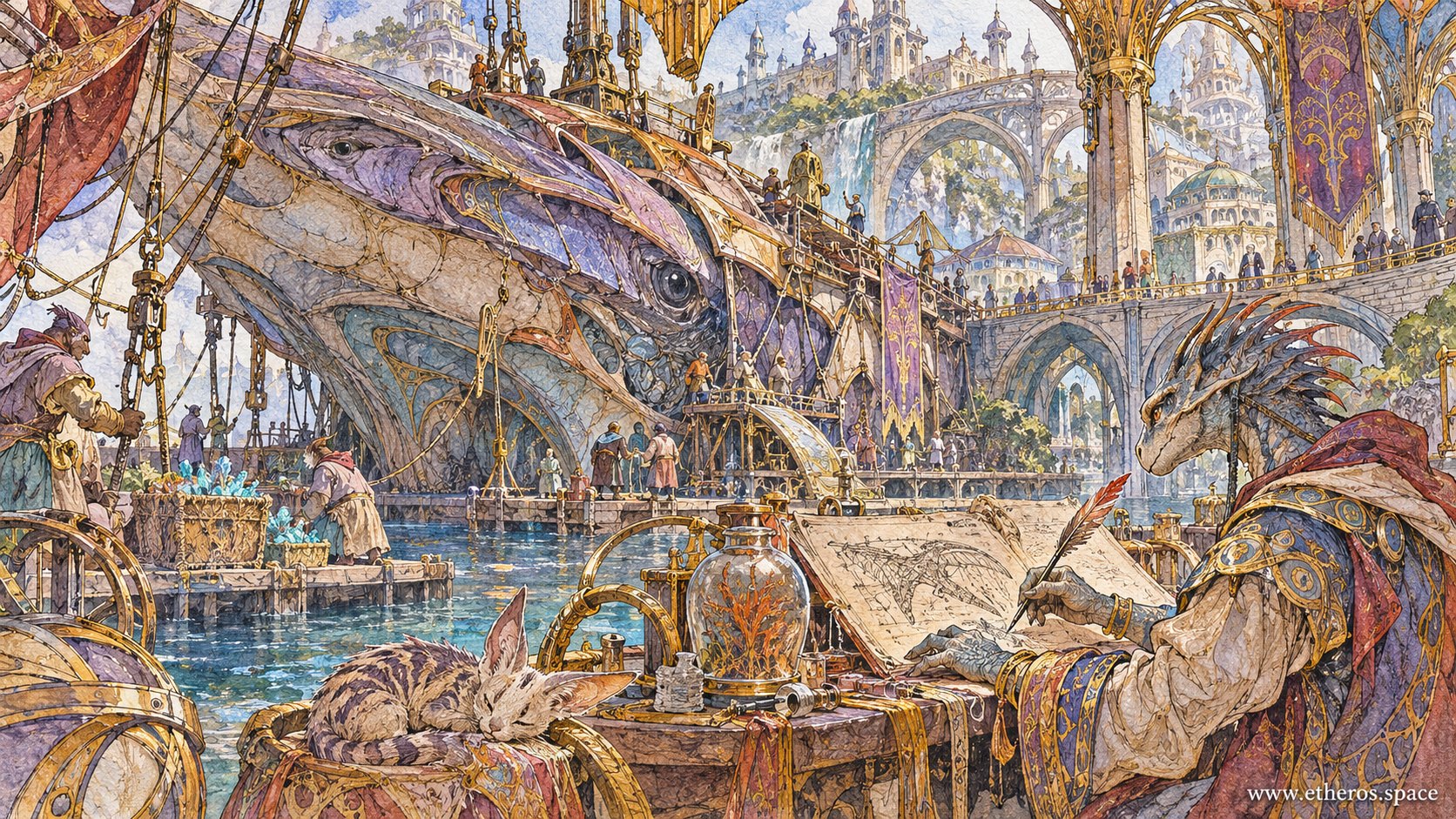
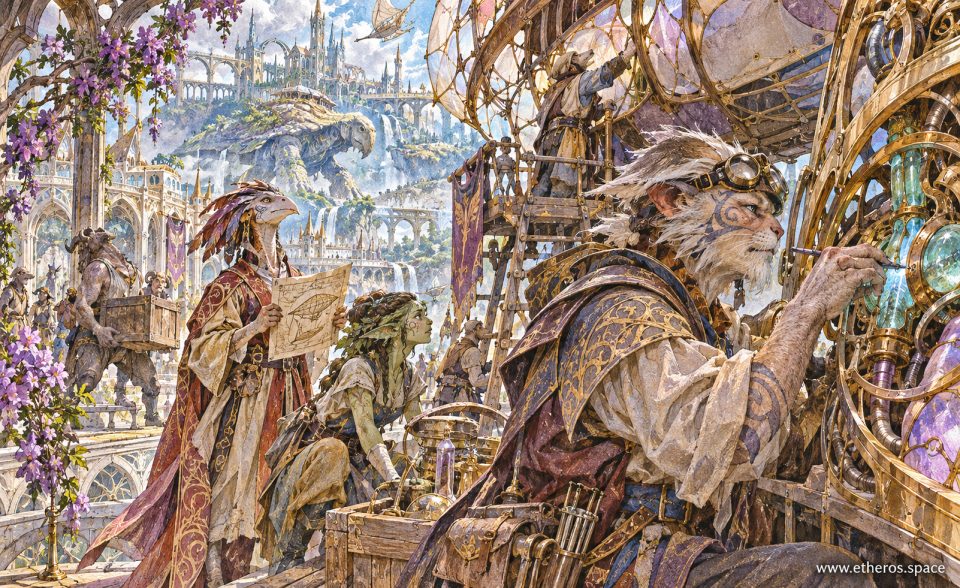
By the time the upper terraces caught the sun, the water in Orren Vale had already traveled through three kinds of body. It had seeped through the hill's dark root-lattice, passed the stone throats beneath the cathedral bridges, and reached the slow wheels driven by the great shellback whose living shoulders supported the hillside aqueduct works. Nothing in the city was watered merely because someone turned a tap. Every cup of moisture was measured against the wells, the harvest, and the needs of creatures farther downstream.
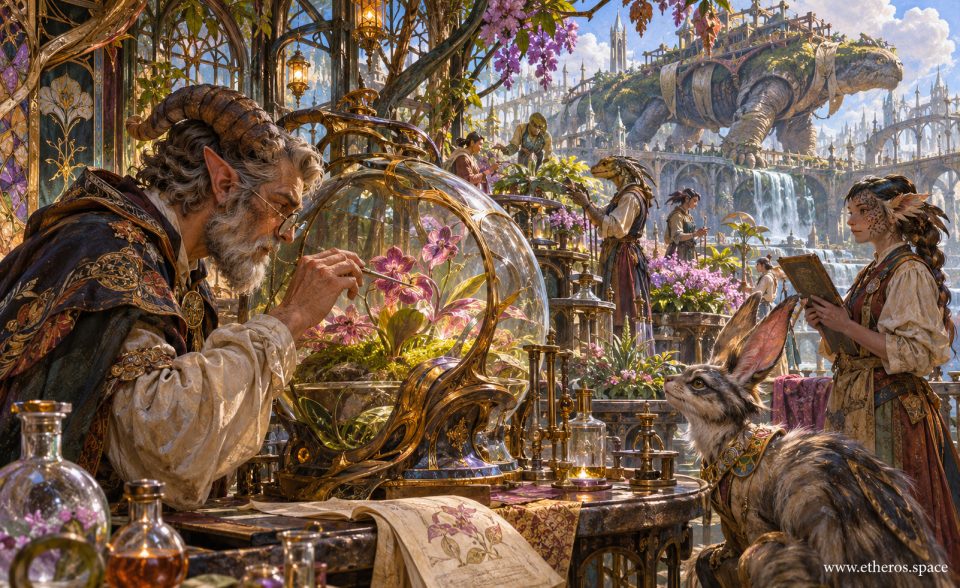
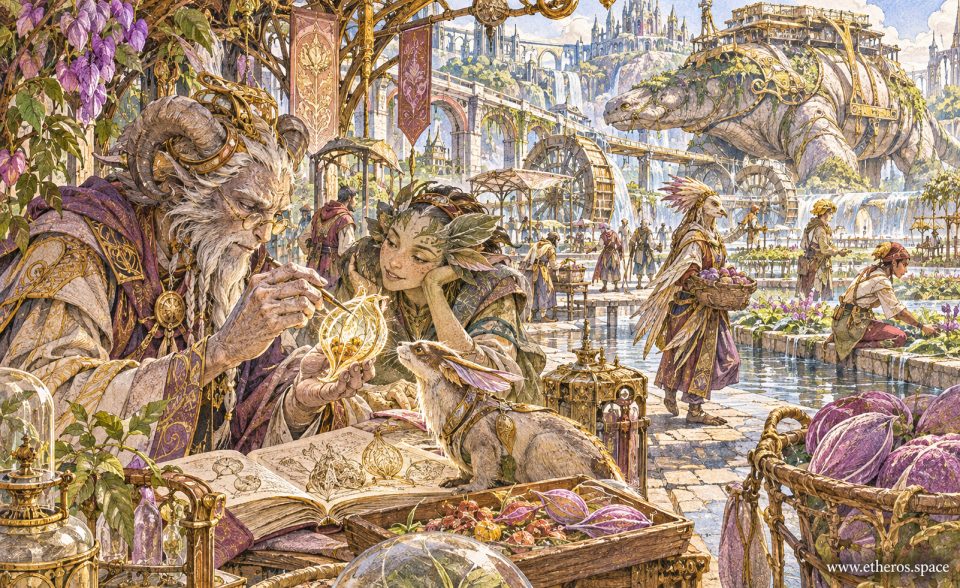
Under a bower of purple hanging blossoms, old Master Thalen bent over a little sphere of amber light. He was a horned Varrin of the southern terrace clans, an engineer whose hands had once been steady enough to rebuild a water clock without extinguishing its flame. Now his long fingers shook, and he wore small spectacles far down his muzzle to see the silk-fine tendrils within the living pod. At his elbow stood the open fieldbook of the municipal seed nursery: pages of careful drawings made by Thalen and, before him, his late sister, who had spent her life teaching the city how to grow with its machinery instead of in spite of it.
Ivara, the leaf-eared apprentice leaning on one hand beside him, knew why the old engineer had asked her to come before the noon bell. One of the terraces had begun returning clear water to the drains, clear when it should have carried a faint gold haze of dissolved nutrients. The vegetables still stood upright; the gardeners were still laughing across the footpaths. But a nursery can look healthy for days after its roots stop feeding. Ivara had found the first failing vine the previous evening, curled behind a brass irrigation collar, its leaves intact but cold to the touch.
Thalen lifted the lantern seed toward the light. Its golden threads were not filaments made in a workshop. They were vascular roots, trained around a cage of etched brass so that their sap could move through tiny pressure channels. Fed with warmth from the adjacent glass condenser, the seed would change its internal tension with the mineral concentration of the passing water. That movement opened a valve. In Orren Vale, biology and mechanics did not compete for the same task: the living tissue sensed what the metal could not, and the metal carried a load the tissue should never be asked to bear.
A little long-eared dock creature put its forepaws on the fieldbook and sniffed the glowing vessel. It was Nettle, a pipe-runner rescued from a broken sluice two seasons before. The fin-like membranes along its ears quivered at vibrations too small for the older Varrin to feel. Ivara watched those membranes, then looked at the engraved drawing beneath Nettle's feet. The seed was responding. The water was not. Somewhere between the nursery basin and the wheelhouse, something had taken the channel's mineral current away.
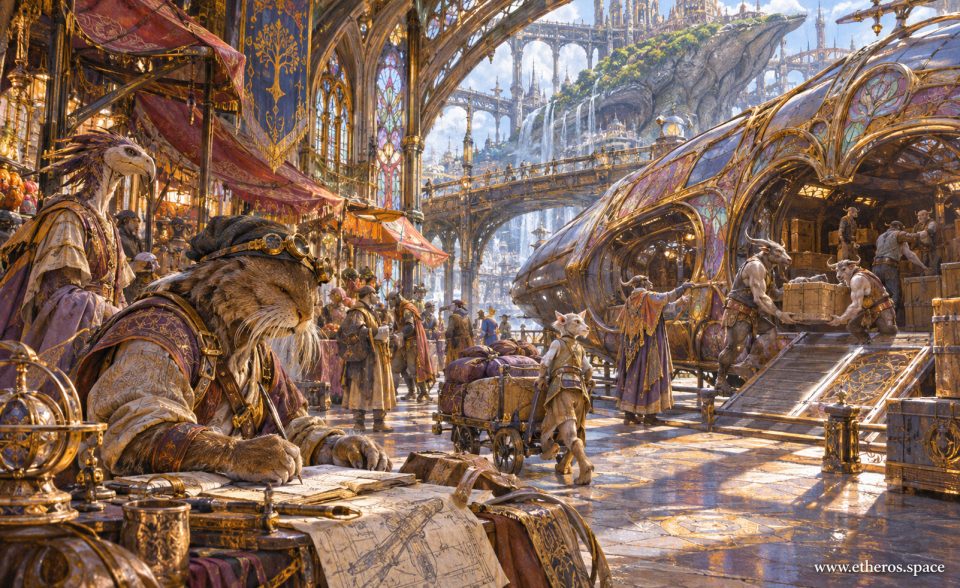
Beyond their worktable, Orren Vale continued with the astonishing calm of people who did not know they were standing inside a narrow margin. An avian vendor carried a basket of purple fruit across the wet stone path. A gardener knelt beside rows of broad violet leaves; others crossed narrow bridges with empty trays that would soon return heavy. Water shone between the plant beds. Ornamental arches held the public walks above the canal, while the huge shellback, clothed in moss and strapped with gold load-bands, worked among the spillways. Its feet and shoulders rested on engineered abutments. Cables transferred pulling force to the wheel assemblies; the wheel assemblies lifted water to the high beds. A creature that large was not decoration on the horizon. It was a working citizen of the watershed.
Thalen touched a thread of the seed with a narrow probe. Nettle's ears flattened. He stopped at once. The little animal had detected a shudder through the metal table: the distant wheel had taken a brief uneven stroke. Ivara traced the symptom with her finger along the old illustration. If a silt gate downstream were partly closed, water could still look abundant in the canals while the deeper mineral-rich flow returned below the nursery intake. That would starve the seedlings first and leave the public fountains unchanged.
"Not the seed," Ivara said softly. "The road the water takes."
Thalen looked at her with the familiar mixture of pride and sorrow that had become his answer to good news. His sister would have liked the phrase. He reached for the brass collar that would protect the sensor until they could reach the gate. A messenger could carry the diagnosis to the shellback's handlers, who would unload the pulling cables before the gardeners opened the submerged silt chamber. No one would ask the giant animal to strain against a jammed gate. The great body's tendons, the water's weight, the gardeners' tools and the roots of tomorrow's harvest all belonged to one accounting.
For a moment neither of them moved. The suspended pod held its amber pulse between old hands, young eyes and Nettle's twitching ears. The market continued behind them, unaware that its breakfast vegetables, hanging flowers and hundreds of future dinners had depended on a single quiet observation. Thalen smiled for the first time that morning. The seed had not failed. The city had given them a way to listen, and someone young enough to hear it had listened. In Orren Vale, that was how a machine was repaired, and sometimes how a family went on.