When the Violet Roots Answered

Story
There was a rule in the botanical terraces of Serein Reach: a flower was never counted alive merely because it bloomed. Its roots must drink without poisoning the stone; its pollen must feed something that could carry it; and its light must reach a place that would otherwise remain dark. Elder Auvren had copied that rule into the first page of every field volume he owned. He had outlived four flowering cycles of the reach, yet he still held his pen as though today might contradict him.
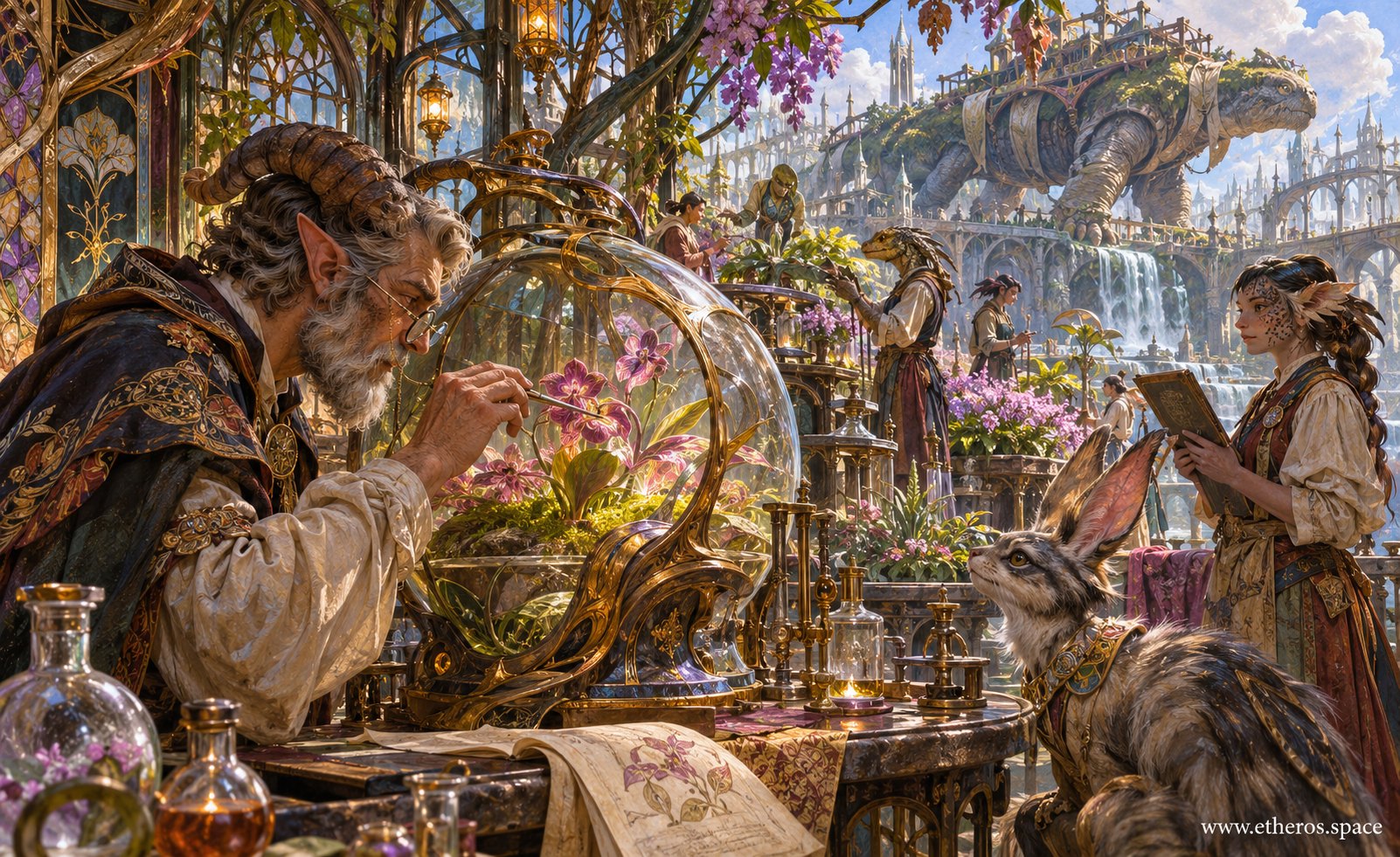
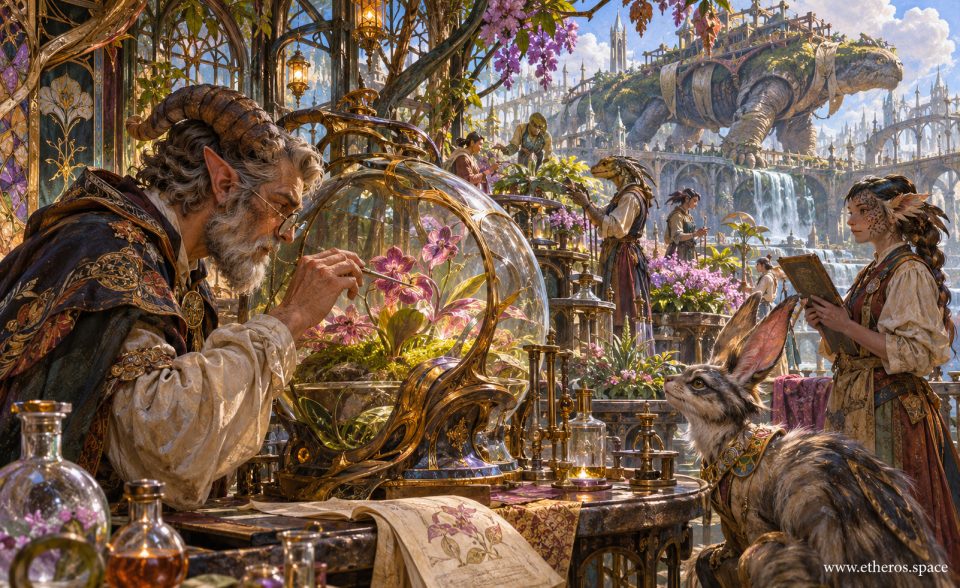
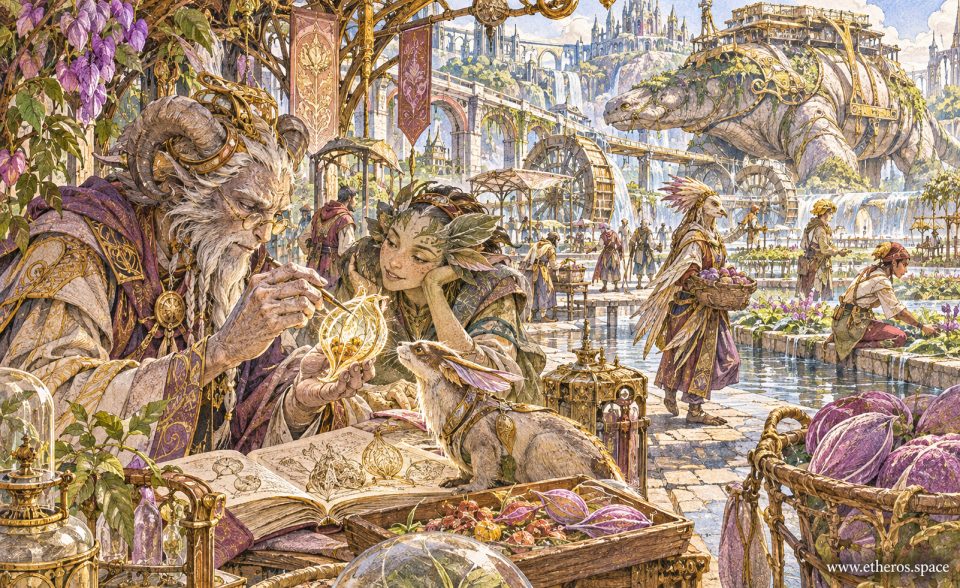
At his left, violet bells hung from the copper arches, dripping afternoon brightness onto the glass and brass of the public research terrace. Auvren, whose curling horns and spotted cheek plates identified him as one of the older Vaelkin lineages, was attempting to draw a single star-petaled bloom without making it look like a charm sold in the market. He had found the problem in the roots. The drawing beneath his inked leaves showed a web of threads running much deeper than their delicate stalk could explain.
Across the workbench, his youngest colleague, Neris, bent toward the living specimen beneath a protective glass dome. Her hand stopped just above the purple petals. She was not afraid of the plant. She was waiting for the tiny blue flicker that came only when the entire terrace was drawing from the same pressure channel. A brass collar supported the dome, narrow glass vessels stood around it, and a faintly colored liquid rested in each reservoir. The instruments were ordinary to the botanists, but the young apprentice felt that the smallest of them carried the pulse of the whole city.
Farther along the table, Sereth, a blue-crested marshkin with patient hands, held a flat dark slate while the fox-eared courier Calru leaned close to hear. Neither was posing as a scholar. Sereth recorded which channels received seed-cultures; Calru carried those records to district gardeners who would need to open or close their valves before the night shift. In Serein Reach, a mistaken delivery was not a bureaucratic embarrassment. It could mean a family waking to dry irrigation beds or a hatchery without fresh oxygen.
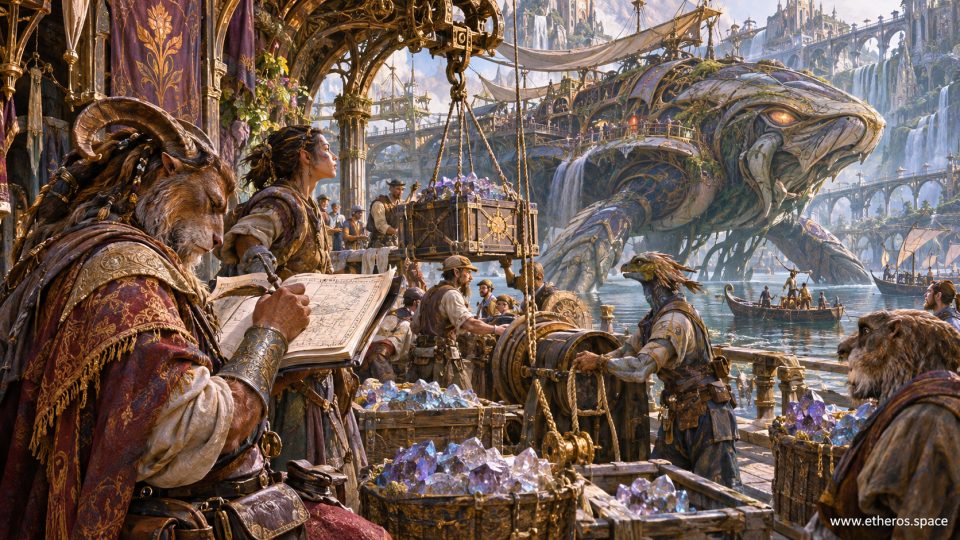
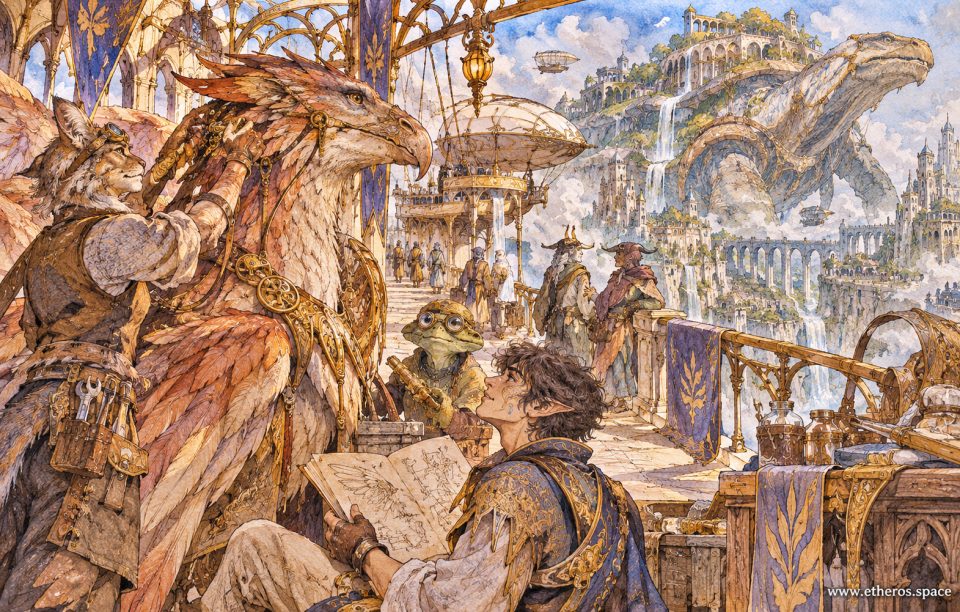
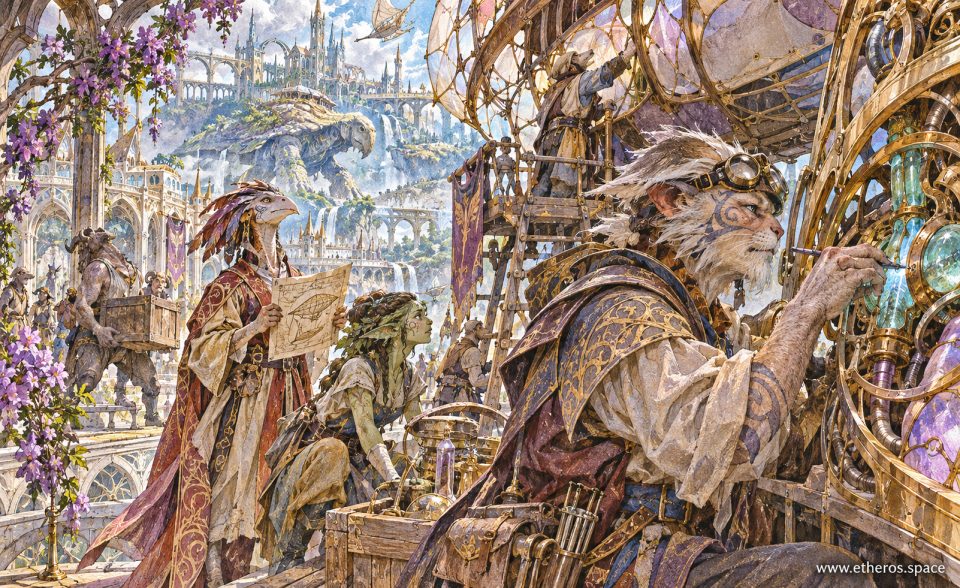
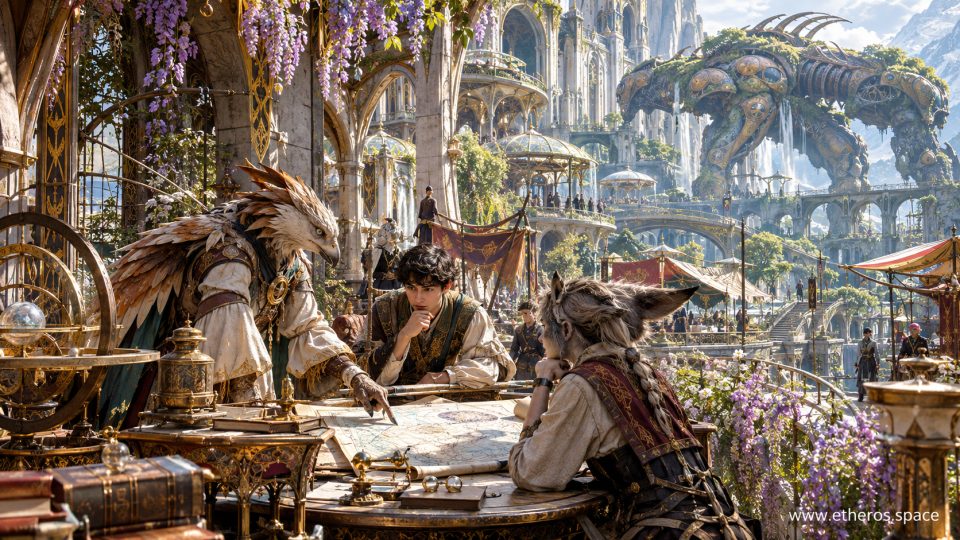
Above the research terrace moved Vessara, one of the vast land-born keepers the people called living viaducts. Its plated neck curved across the avenues, bearing planted galleries, shallow reservoirs, and walkways supported by a structure both grown and repaired over generations. Water poured from its terraces in silver sheets. A thousand small roots drank from its traveling garden, and scores of citizens crossed the upper bridges without pausing to contemplate the weight beneath them. Vessara redistributed springwater from the high basins toward the lower wards, one measured volume at a time. The weight of the water passed through articulated bone and reinforced cartilage to four broad supports; the overflow returned through cascades to the city channels.
This afternoon, though, the violet flowers had begun to glow before the water reached the lower gardens. The older texts called it an impossible early response, a warning that salts were accumulating somewhere in the conduits. Neris suspected something else: the plants were listening to a pressure change caused by Vessara's slow turn at the north bridge. No alarm had sounded, and no crowd had gathered. The only evidence was the pause of one small hand above one glass dome.
Auvren did not tell her to be certain. He drew what was there: five long petals, the hidden branching root, the thin shimmering line at the edge of the flower's throat. He knew that an exact drawing could be braver than an explanation. Neris watched the glow travel from the central bloom into the surrounding stems, then vanish. Calru's ears lifted. Sereth made a small mark on the slate and looked past the glass toward the moving keeper.
They would need one careful test, not a grand proclamation. Sereth would record the inlet readings at the next turn. Calru would carry a warning to the lowest garden only if the second pulse arrived early. Neris would collect a drop from the blue reservoir. Auvren would keep drawing until the ink gave the four of them an honest record of what they had seen.
From the upper balconies came the ordinary noise of Etheros: footsteps on bridgework, water striking tiled basins, distant conversations across the market, and the soft metallic adjustment of a creature large enough to hold a neighborhood upon its back. For one suspended moment, the city did not feel enormous. It felt delicate. Auvren moved his pen from root to petal. The little flower answered with another light, so faint that only those gathered at the bench could have noticed it.
And that, he thought, was why they kept the terraces open to the public. A city did not remain alive through its great machines alone. It survived because someone, somewhere, noticed the instant when the smallest thing began to behave differently.