The Measure Between Two Winds
Story
THE MEASURE BETWEEN TWO WINDS
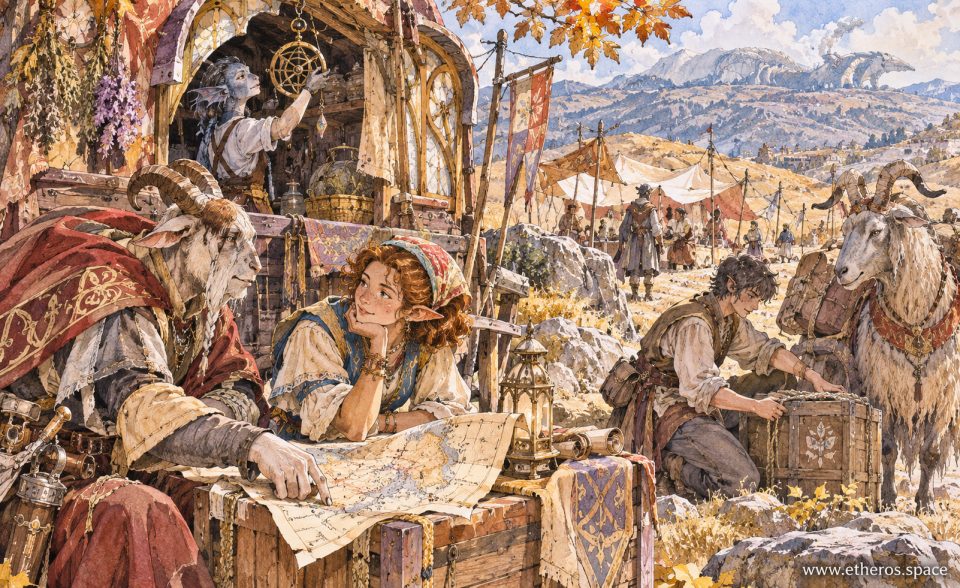
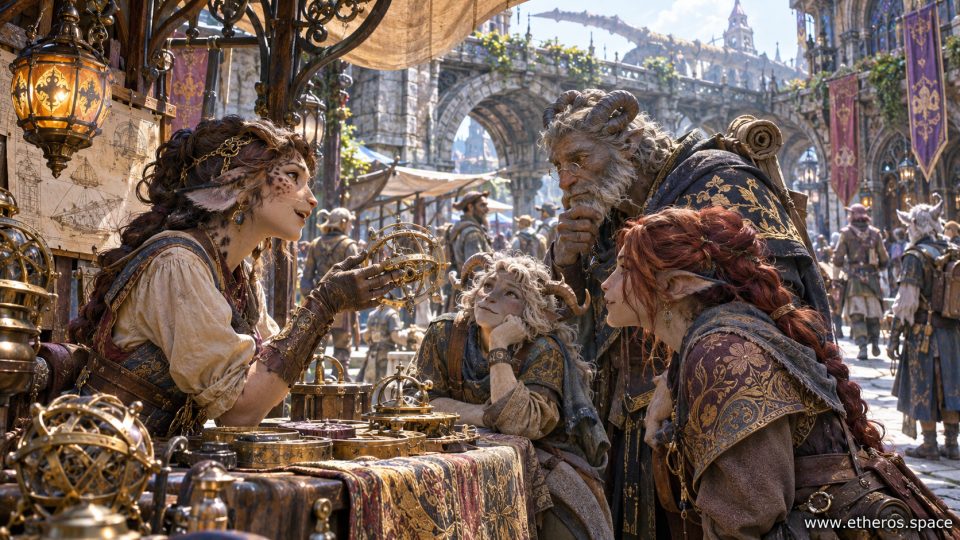
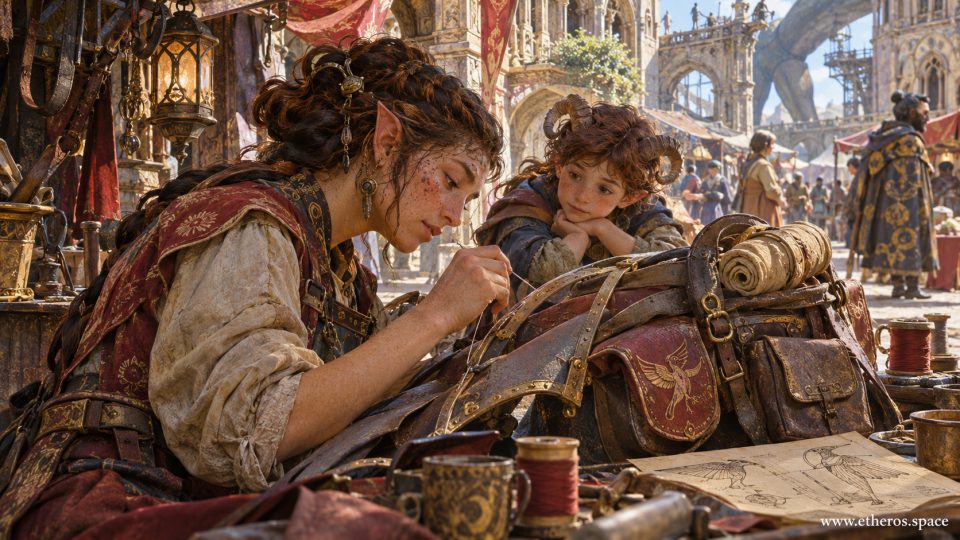
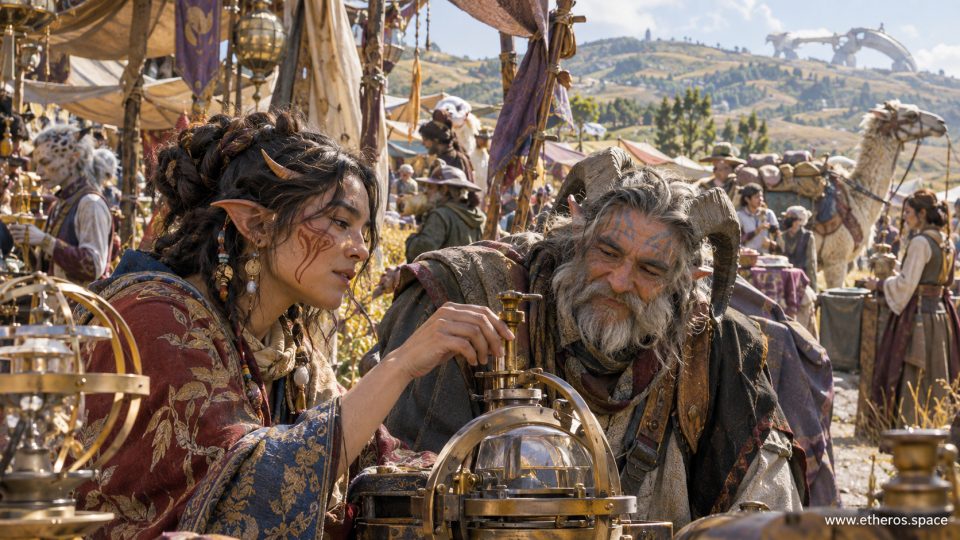
By midmorning the great pasture market of Vel Sora had acquired the gentle disorder of a road that was also a home. Canvas roofs leaned against timber poles, children slipped between the legs of woolly freight animals, and the hill people compared grain prices with travelers who carried their shops on their backs. Above the awnings, the golden grasslands climbed toward the broken remains of an old mechanical arch. Nothing in the open valley was quite still, even when the wind appeared to rest.
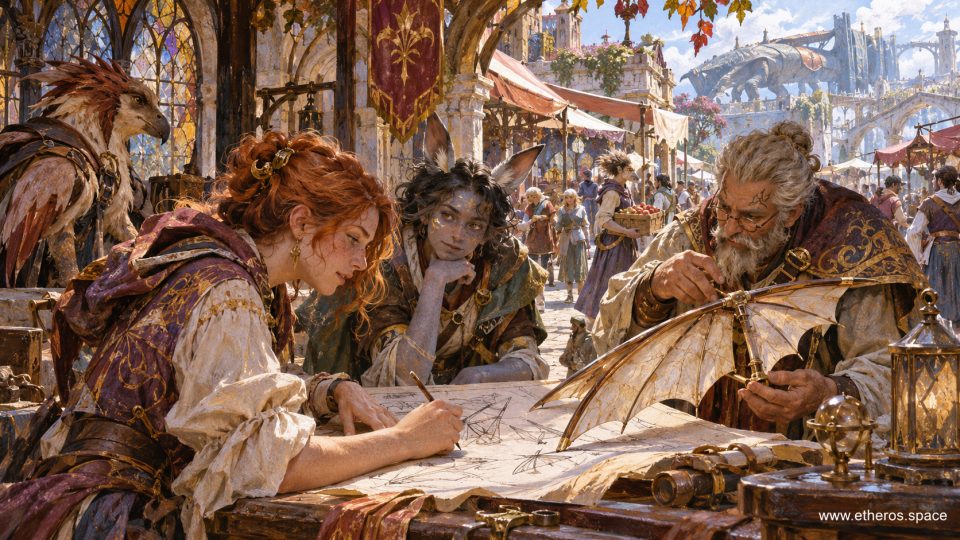
At a crowded instrument table near the western stalls, Senna turned a brass plunger through the top of a glass-domed measuring cage. She wore the layered red and blue robes of an upland recordkeeper, sewn heavily at the wrists so the fabric would not catch in moving tools. The dark hair at her temple had escaped its braids, and a small forward-turning horn showed above one pointed ear. She had been concentrating on the same narrow index for nearly half an hour.
Beside her, Elder Orveth stooped until his white beard brushed the worn collar of his traveling coat. Grey hair fell around the wide horns of his mountain-clan ancestry; thin blue markings crossed his brow. He said nothing while she lowered the needle, lifted it, and lowered it again.
The third reading differed from the first.
“You see?” Senna asked.
“I see that the hand which turns the instrument has a preference,” Orveth answered.
The device was meant to register changes in the upland wind. A narrow opening at the rear admitted air to a tiny flexible diaphragm; a bell-crank passed the motion into the gilded cage beneath the glass. The upper screw set the reference position. In theory, a caravan captain could leave the device beside the road for a short interval and compare its readings with those taken at another pass. In practice, Senna had found that the readings changed slightly every time a different person adjusted the screw.
For months the freight houses had treated the numbers as proof that one route was safer than another. Wagons were sent through the south notch on the strength of a difference so small that the measuring hand itself could have made it.
Orveth had known the plateau before there were freight houses, when the road was marked by wind-bent trees and the stories of mule keepers. He knew that the valley's danger did not lie in a constant storm but in the brief crosswinds that followed the afternoon heating of the west-facing rocks. His memory could tell them when to look. It could not give the council a number.
Senna needed both kinds of knowledge.
A pale pack animal shifted its long neck behind them. The crowd made room for a porter balancing two cases. At the stall to their left a merchant polished a row of brass rings until their reflections broke into little moving pieces of the sky. Nobody paused to watch the trial. To most of Vel Sora, it was another ordinary argument over a small machine.
“It wasn't made badly,” Senna said. “The bearing is too eager to settle in the last direction it was pushed.”
“Then let it settle. We are not waiting for a pleasing answer.”
She released the plunger, lifted her hand away and counted the time by the market's smallest clock. The pointer came to rest. She repeated the test without touching the reference collar. This time it returned to nearly the same place.
She smiled, though not with triumph. A reliable number would still need comparisons against a known load, another instrument and several days of actual wind. She had learned enough from the east-road inspectors' recent correspondence to distrust a result that happened to agree with what everyone wanted.
One letter, passed on by a courier named Rhel from Ardem, had spoken of a newly built bearing that refused to return to its first mark. The writer did not claim to know whether an eastern freight ramp was unsafe. She asked that the next crew preserve all the readings, including the awkward ones. Senna had copied that sentence on the back of her notebook. It was the sort of instruction that made one less popular at a busy market.
Orveth pushed his spectacles higher and looked toward the ridge. “At the third bell,” he said, “the shade will leave that stone. Then we'll learn something the market cannot teach us under these awnings.”
Senna closed the cage and tied a strip of pale cloth around its upper handle. She would take it out beyond the last stall, away from cooking fires, sheltered walls and people talking across the apparatus. She would set it level, check the exposed diaphragm, and make the same measurement three times without shifting its reference.
If the three readings agreed, they would compare them with the old wind flags near the notch. If they did not, she would write down the disagreement before trying to correct it. A day's work might finish with no useful route recommendation at all.
That possibility no longer embarrassed her.
The market continued to move around them. A traveler laughed. Metal fittings rattled against the pack animal's harness. The strange arch on the distant hill remained half lost in sun haze, its former purpose known only to the oldest road maps. Senna lifted the instrument carefully from the table, and Orveth held the dangling strap aside so it would not strike the glass.
For the next few hours the wind would belong to nobody's opinion. They would have to go out and meet it where it actually was.