The Third Sounding at Fellwake Quay — The Weight Below the Waterline
Story
The Third Sounding at Fellwake Quay — The Weight Below the Waterline
The first duty of the harbor was not to move its freight. It was to discover whether the water would let it.
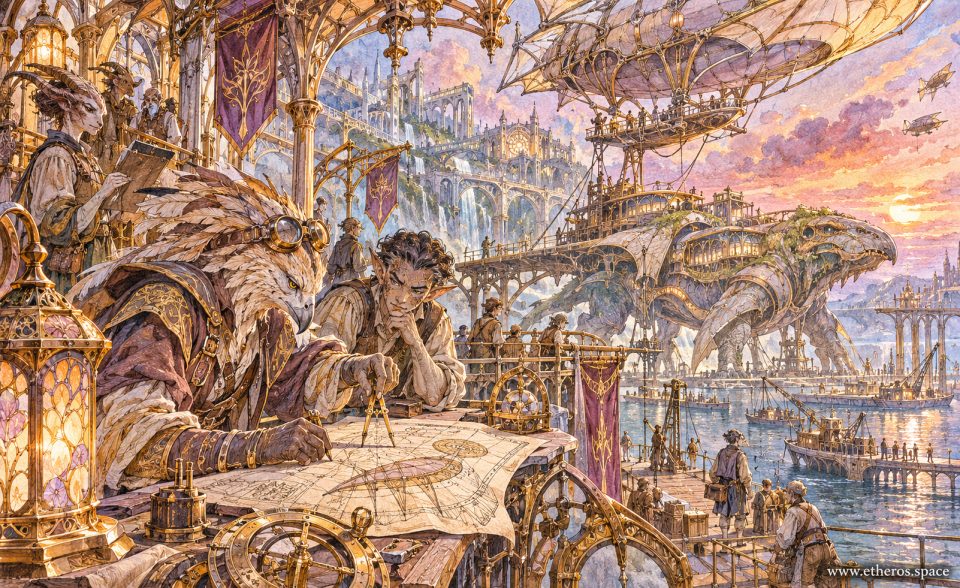
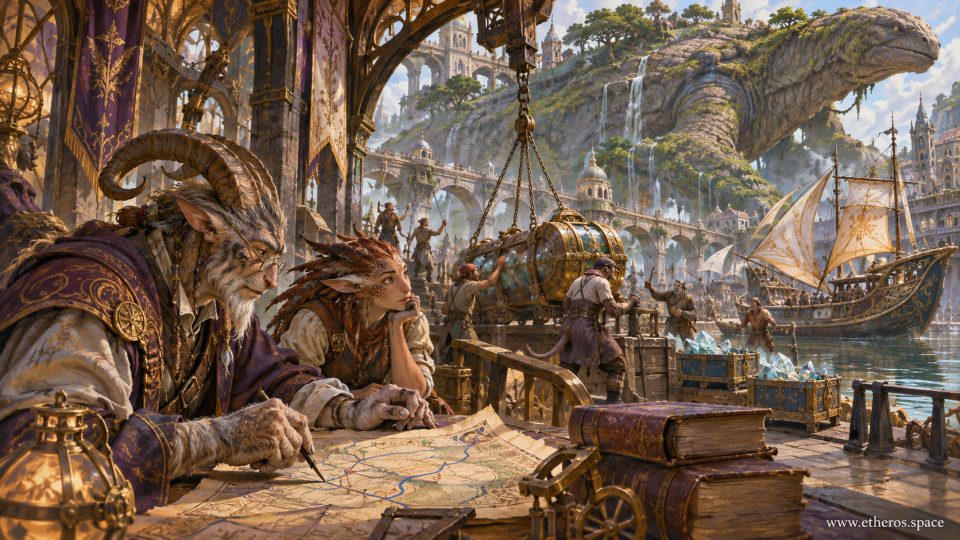
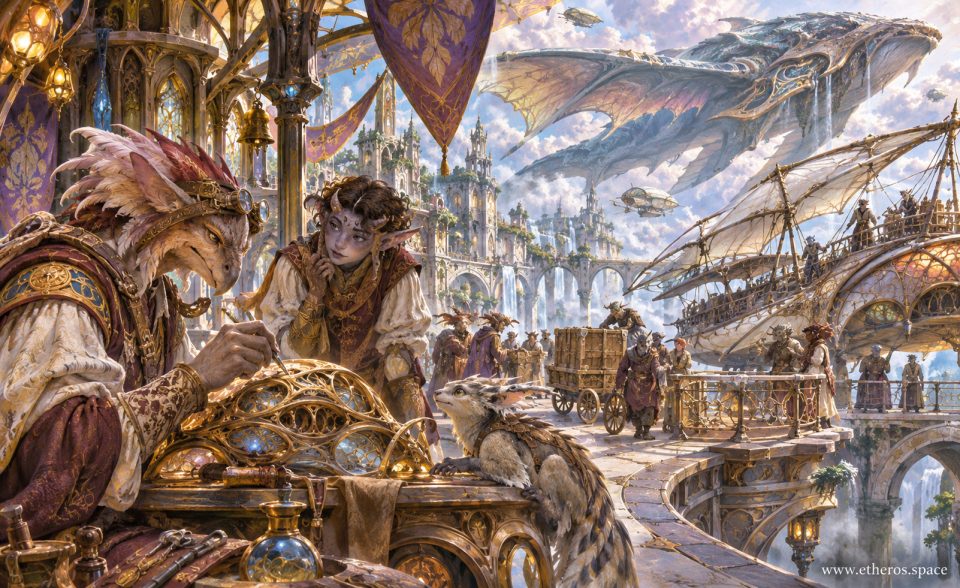
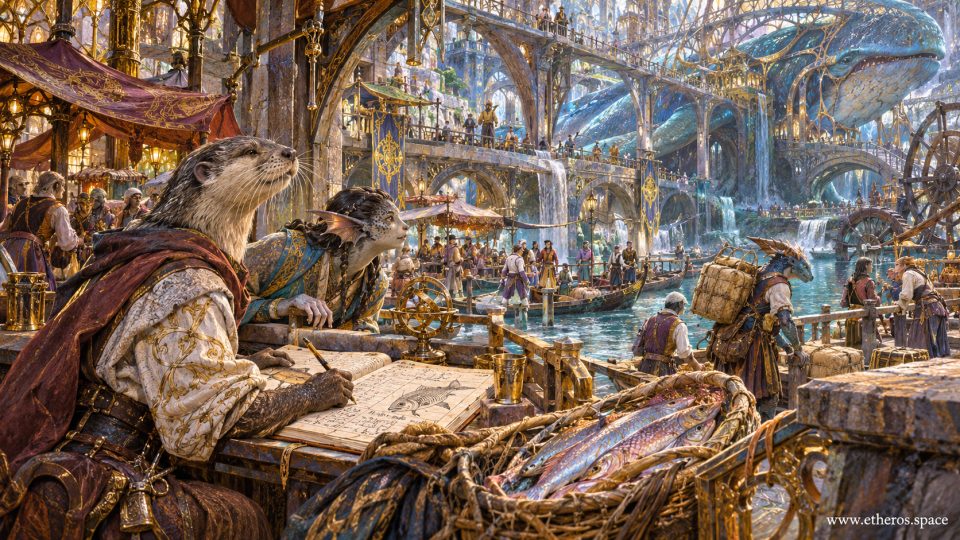
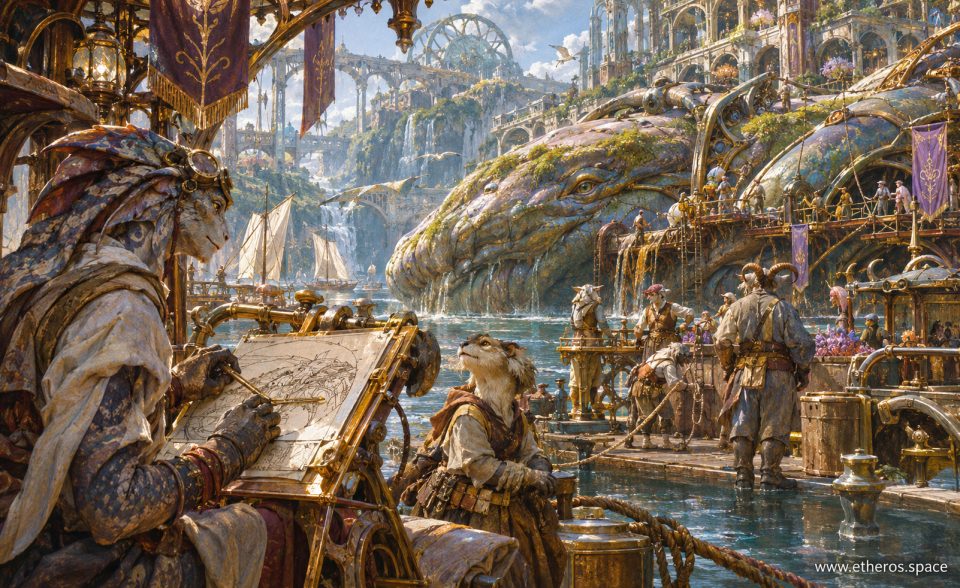
At Fellwake Quay, where terrace roads curved above cataracts and white-sailed skiffs threaded the morning channels, surveyor Teral Quill sat beneath the bronze arches with the tide plan spread across a hinged drafting board. Teral belonged to the scaled river-born people: narrow-snouted, long-fingered, made patient by generations of reading currents. The fine blue pattern on Teral's skin was no ornament. In the guild's telling, such markings resembled the eddies that had once carried their ancestors to the coast.
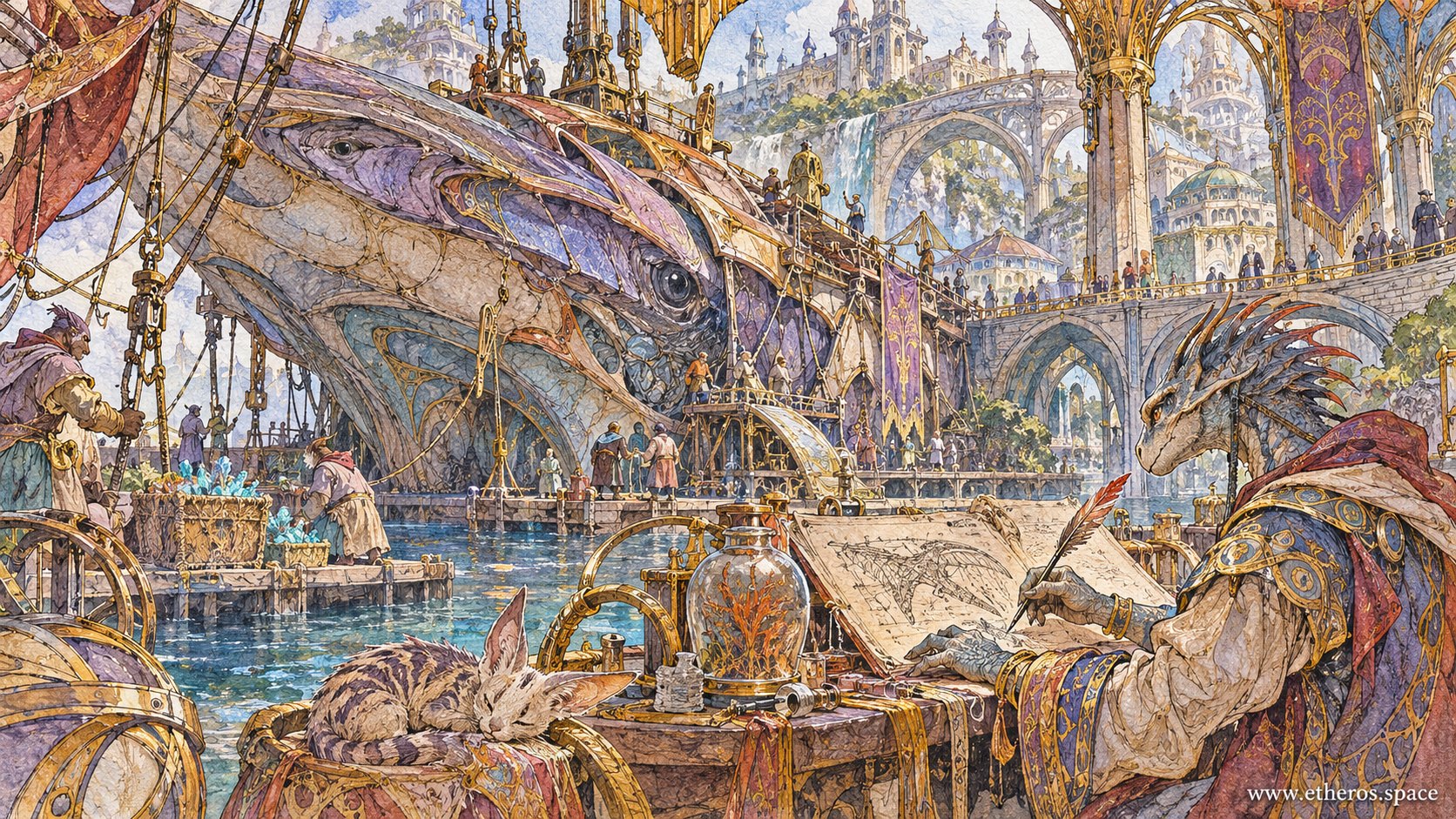
At the foot of the board stood Pell, a compact, furred dock apprentice with bright whiskers and an old leather work apron. Pell was looking upward, not at the chart but at the immense face of the creature resting in the harbor. Its long body ran beneath a lattice of scaffolds and inhabited decks; leaves and moss covered parts of its mineral-plated hide. Water streamed from its mouth and the seams of its armor. Men and women of several species crossed the platforms to check ropes, cargo, and the living conduits connected to its flanks.
They called it Orvath. The planet had grown it over the course of many lifetimes, and the city had grown around it in return.
For the day's work Orvath would carry a shipment of filtration cultures to the coastal settlements beyond the broken cliffs. The cultures were sealed in ventilated crates. Their rootlike membranes could clean brackish cistern water, but a jolt or a prolonged loss of air could leave entire families waiting another week for drinkable supplies.
Teral had already marked the route. The quay's eastern channel was deep enough, the mooring array had been tested, and the morning freight crew had taken its positions. Yet Orvath had not raised its weight from the water, although the other carriers had begun moving.
Pell rubbed a whisker and counted the disturbances beneath its jaw. Three brief ripples. A pause. One long, reluctant swell.
"That isn't how it sounded yesterday," Pell said.
Teral lowered the point of the compass onto the chart. The young apprentice was correct. They had listened to this creature for months. When Orvath breathed through its underwater exchange chambers, the adjacent current folded back in four even pulses. This morning the third pulse was late.
Across the dock, a horned foreman named Marro urged his crew to ease the cargo winch. They did not release the load; the chained platform remained suspended above the receiving deck. Above them an engineer reached for a control lever, while two porters adjusted the tarpaulins over the nursery crates. Nobody seemed alarmed, but everyone had slowed their movements.
Teral lifted the chart and laid a finger over the drainage lines that ran from the city into the harbor. The western cataracts had poured more fiercely after last night's mountain rain. Silt would follow. Some of it entered the great leviathan's exchange channels, where its living filters normally recovered nutrients before releasing cleaned water back to the bay.
"The lower screen," Teral said, almost to the chart. "It's carrying the valley's mud. The balance will be wrong if we pull now."
Pell ran toward Marro, darting around brass mooring bollards and between sailors who were finishing their morning checks. The foreman listened without laughing at the apprentice's small voice. This was a harbor where an otter's hearing, a dragonkin's chart, and a giant's pulse could all be parts of the same instrument.
Marro gave three signals with the rope bell. The crews on the upper platforms opened a side channel in the living scaffold. A pair of nutrient valves relaxed. The bellows in Orvath's bronze-ribbed flank drew water toward the silt bath instead of the lift chamber. At the quay's edge, workers tightened a safety line so the suspended freight could not swing while the organism readjusted its buoyancy.
There was nothing supernatural about the correction, even though few visitors could have explained it. Pressure moved through muscle and mineral, load through tendon and cable, and news through hands, bells, eyes, and old friendships. The city's machinery worked because somebody watched where those paths met.
Pell returned breathless. Teral offered a folded corner of the chart to mark the time of the change. The apprentice wrote the minute, paused, then added the sound of the next pulse in four short scratches. A second later the water beneath Orvath's jaw broke into four clean rings.
"There," Pell whispered.
The immense creature raised one watchful eye above the tide. Across the wharf, a dozen small tasks resumed: a rope fed through a pulley, a botanist tested the damp nursery crates, a porter climbed toward the receiving platform, and a sailboat passed quietly between the posts. No one cheered. Marro merely lifted his hand to signal that the load could proceed.
By noon the filtration cultures would be bound for the outer villages. The people who drank their water would never see the chart, or Pell's hurried notation, or the giant that had waited so patiently for the silt to clear.
Teral watched the channels shine between the vessels. Their father had told them that a harbor's finest hour was one nobody remembered. A place had been kept alive, a thing had been carried safely, and the great motion of the world had continued without needing a name.
Pell leaned against the brass drafting stand and studied the enormous living head across the water.
"Do you think Orvath knew we were listening?"
Teral turned the compass once, gently, until it pointed toward the open sea.
"I think," they said, "it was waiting for us to learn how."