The Ledger of the Turning Shoal
Story
The Ledger of the Turning Shoal
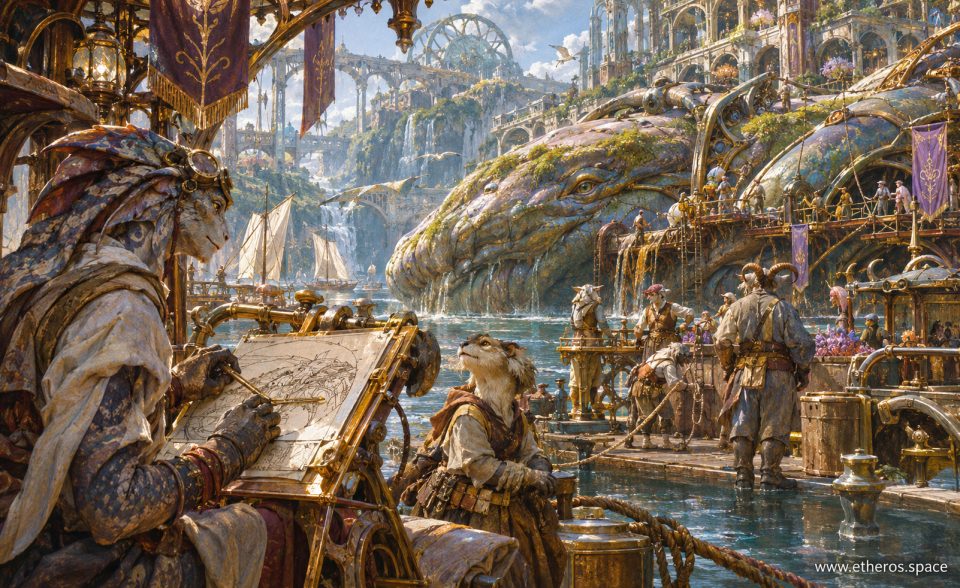
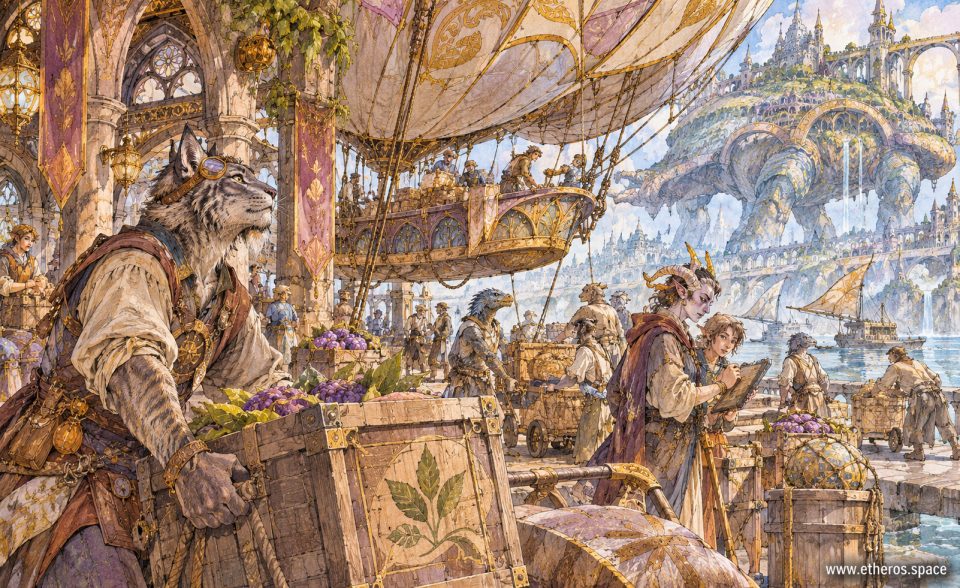
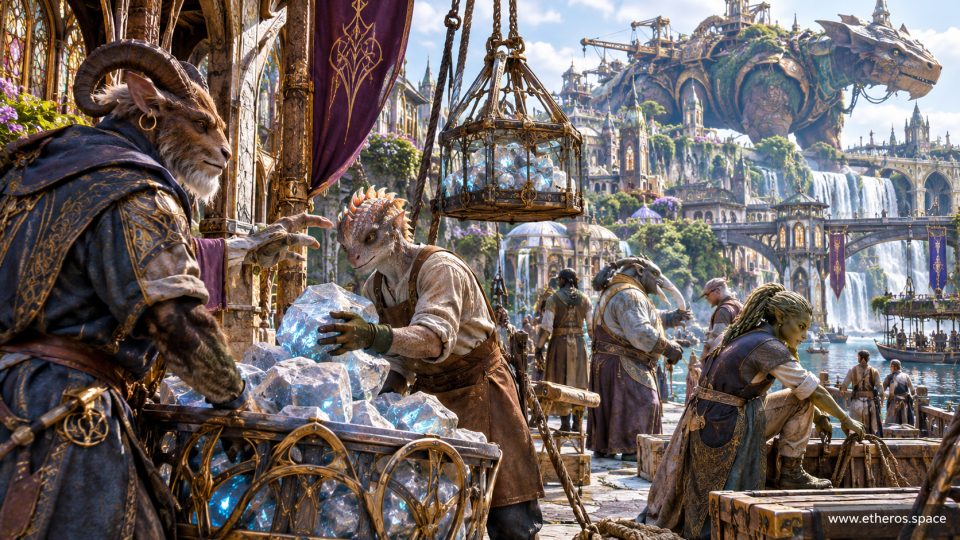
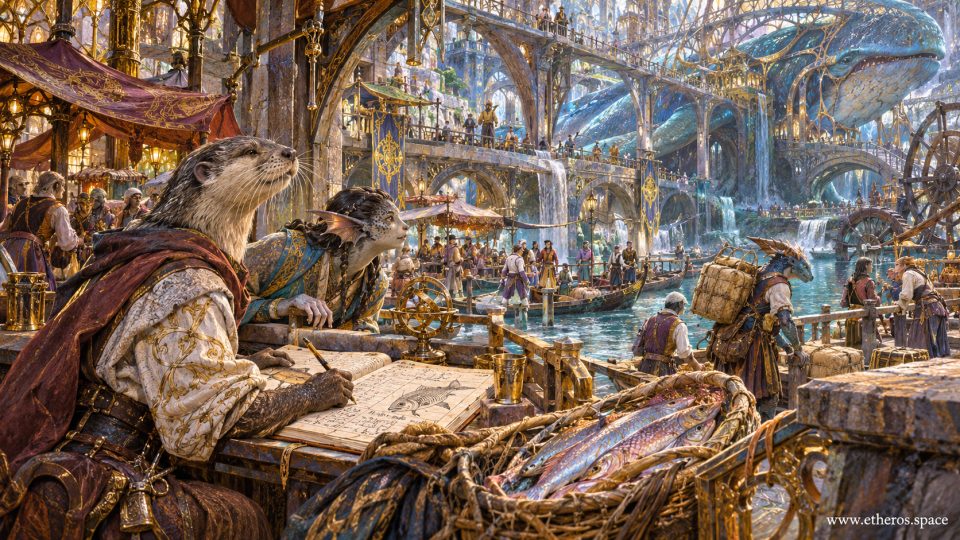
By the middle bell, the water of Nareth's Lower Concourse had already carried three hundred vessels through its arches. Traders crowded the bronze footbridges. Cargo handlers waded at the piers, and the awnings above the fish market warmed from violet to copper wherever the sunlight found them. From the upper galleries, thin waterfalls ran down between the Gothic ribs of the occupied city, feeding the market canal before returning to the living filter channels beneath it.
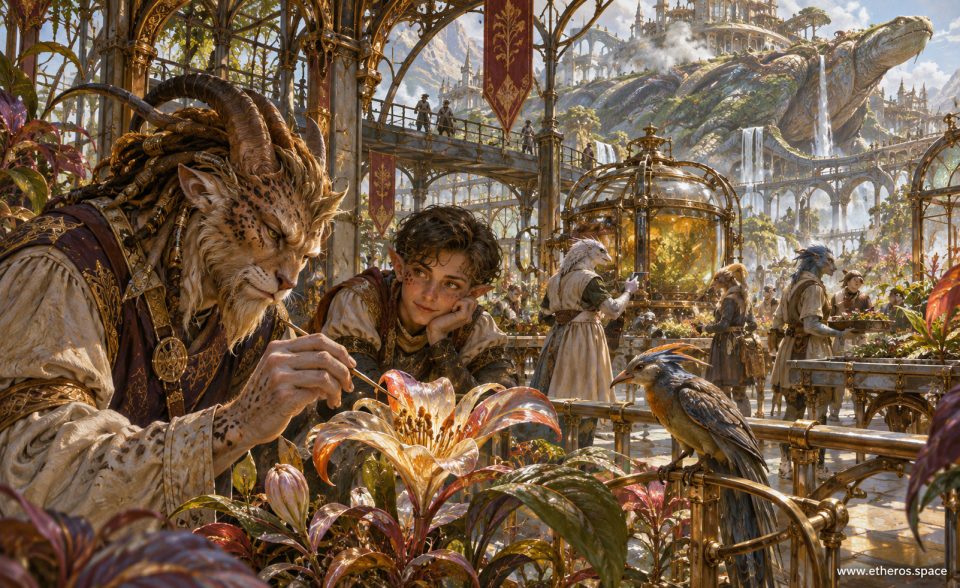
At a desk beside the quay, a river-kin registrar named Ossin Rell bent over his open ledger. His dense brown fur was drying in uneven waves under his embroidered mantle. The sketch beneath his hand showed the long-bellied silverfish that had arrived in baskets at dawn. Every day he drew one specimen, compared its markings with the prior season, and recorded the direction in which the shoals had travelled. He had once been a fisher himself; now, with a damaged shoulder that made lifting nets painful, he looked after the records that kept the fisheries alive.
Beside him stood Luma, a fin-eared apprentice whose spotted cheeks always betrayed her curiosity. She was watching the crowd instead of the book. A blue-scaled porter threaded his way along the right-hand walkway with a pack fastened to his back. A low passenger boat passed behind a busy knot of dockworkers. Above all of them, across the upper bridges, a colossal blue whale-shaped body rested among the city's living waterworks. Its pale eye looked down across the canal.
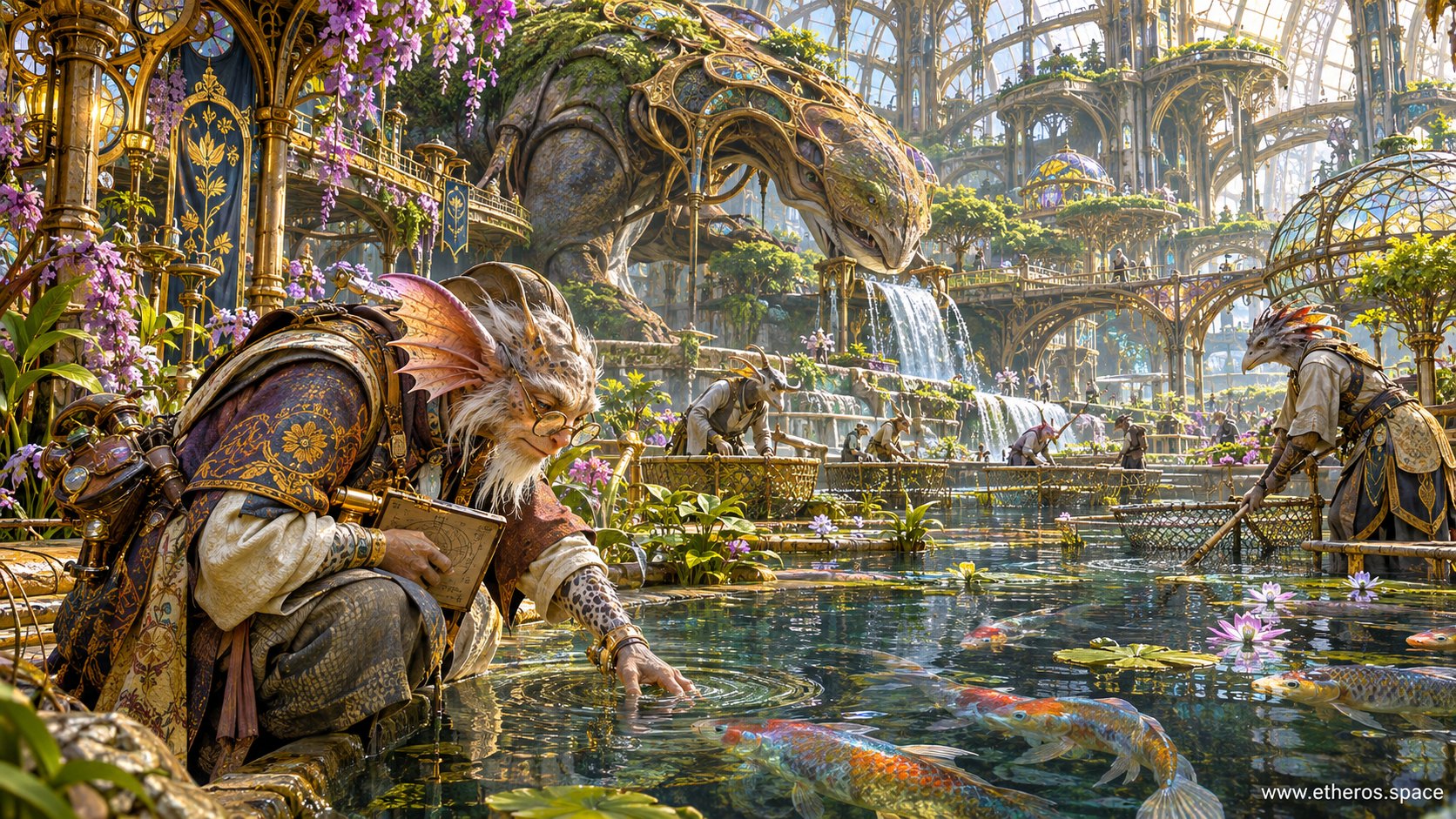
The whale was Dhoruun, a planet-born carrier of water and nutrients. No architect had designed its skeleton; the earliest builders of Nareth had learned to attach their bridges to the places where its immense cartilage could bear them. The copper trellises guiding the waterfalls were centuries old, but the water itself moved because Dhoruun moved. Its gill chambers compressed, lifting riverwater to gardens on the higher levels. The gardens consumed the minerals; their drainage descended again to the canal. Dhoruun returned the flow to the lower basin through living membranes that cleaned it of silt.
On ordinary days the river fish followed the cool, nutrient-rich return currents. That was why the sellers' stalls were here.
But the morning catch was wrong.
Ossin had drawn six fish. All six carried a crescent of new blue scales behind the dorsal fin. The mark usually appeared on animals returning from the far delta after the first winter rain. Yet it was too early, and the fish had been hauled from the inner water. A scribal error would have been easier to explain than a migration occurring three weeks before its season.
Luma leaned over his shoulder. 'The baskets came in from the west lock,' she said. 'Not the delta.'
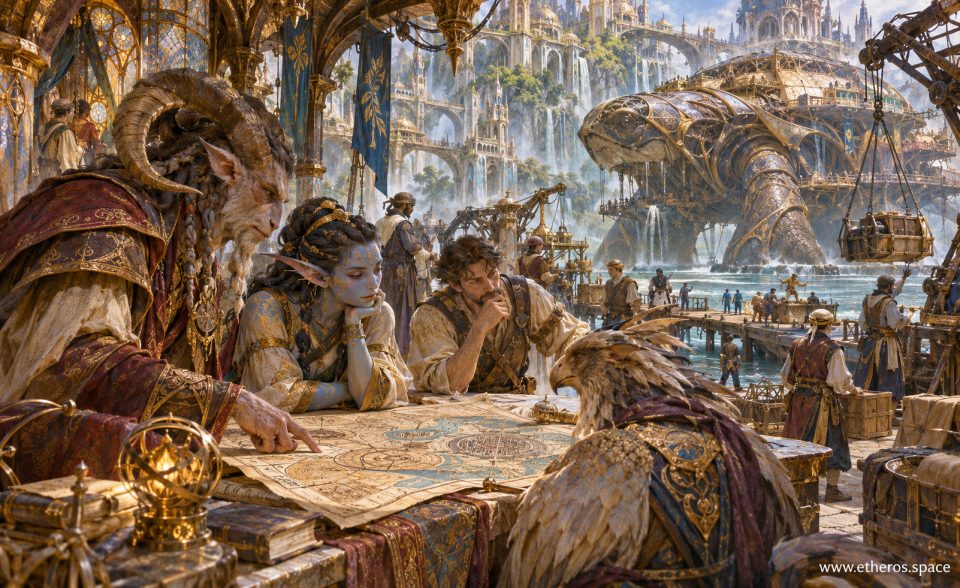
Ossin turned a page. Every mark he had drawn that morning pointed to the same conclusion. The shoal had entered a current that no longer belonged where the map said it did. At the central pier, he asked the boat-keeper to lower a measuring cup. The water was slightly warmer than at the previous bell. No one else had noticed; the canal was full of motion, sunlight and voices.
He could not order the flow stopped. The western lock also supplied the elevated kitchens, the dye works, and the infirmary's clean-water header. It would take a day for the people above to feel a disruption that began here.
So he asked Luma to fetch the lock keeper, and carried the ledger to the side of the canal. The porter with the blue scales recognized Ossin from an old fisheries committee and paused to help. Together they compared a shallow sample from the river edge with one taken from the boat channel. In the first, the suspended mineral flecks moved slowly downward. In the second, they rose. The return current had reversed.
The cause was neither sabotage nor mechanical failure. Dhoruun had grown a new filtering fold beneath the northeastern bridge. Its living tissues had redirected part of the cold return stream into a channel that had long been dry. The old valve, still obedient to the city's static charts, was forcing warm surface water against the new organ's outflow.
The vast creature above them was not sick. It was changing.
Ossin felt the old impatience return: the kind that comes when instruments describe exactly what they were built to measure and still miss what matters. He pointed to the sketch of the fish. These animals had encountered the new channel before any human surveyor. Their bodies had mapped it before the city's paper charts could.
The lock keeper arrived with a crew of three. They did not cut the organ or seal the unfamiliar channel. Instead they opened the secondary return gate by a finger's width, watched the warmed stream bend away from the nursery pool, then let the cold filtering current enter the western passage. Every adjustment was slow enough for Dhoruun's living walls to respond. On the bridge, foot traffic continued. On the water, passengers moved past the market as before.
By late afternoon, the unwanted warmth was leaving the fishery, and the cool return stream once again flowed along its intended bank. The fish were still restless. Ossin suspected they would remain so until the new channels settled. He added an annotation to the ledger: 'Current revised by living growth. Map provisional. Observe the shoal.'
Luma asked whether that meant they would have to draw the river again tomorrow.
'Yes,' Ossin replied, closing the book. 'And probably the day after.'
There was no ceremony. The fishmongers were selling the last of their catch, the ferry horn sounded twice, and the great whale lifted another slow measure of water above the city. The bridges held. The gardens drank. Beneath the surface, the shoal turned with the new current, following a path that did not yet have a name.
That evening, in a market where nearly everyone was counting something, Ossin wrote one final line beneath his sketch: 'A living world does not promise to match the last map.'