The River Has a Memory — Morning at the Glass-Tide Conservatory
Story
THE RIVER HAS A MEMORY — MORNING AT THE GLASS-TIDE CONSERVATORY
The first fish to rise that morning was not sick. It was listening.
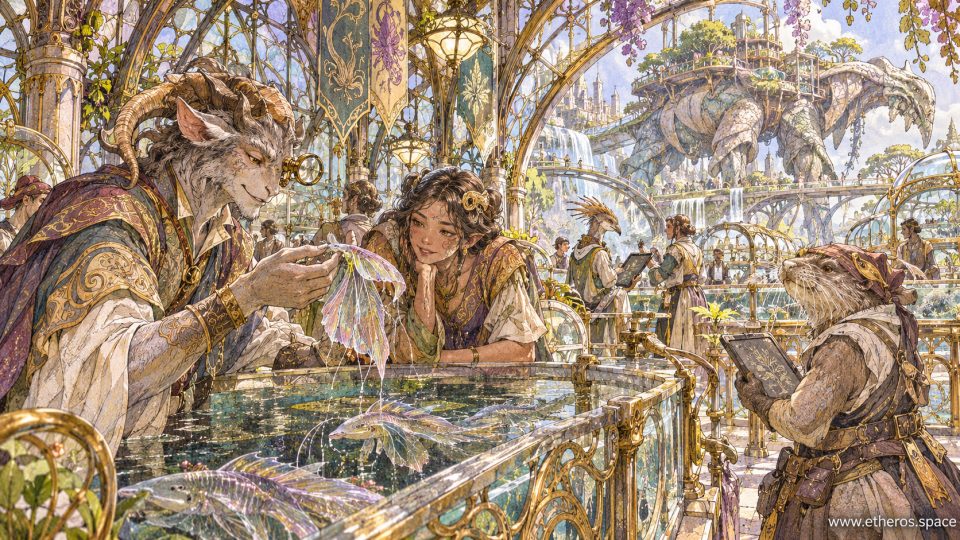
At the Glass-Tide Conservatory, the long transparent tanks ran beneath arches of brass and living vine. They held the river's smallest navigators, silver-bodied driftfish whose translucent fins unfolded like pieces of stained glass. Every dawn the school followed a current too slight for the city's gauges to measure. When a waterway changed, the fish knew before anyone standing on its banks.
This morning the school had gathered against the western pane. Their fins flashed a faint violet, though the mineral lamps had not yet been lit.
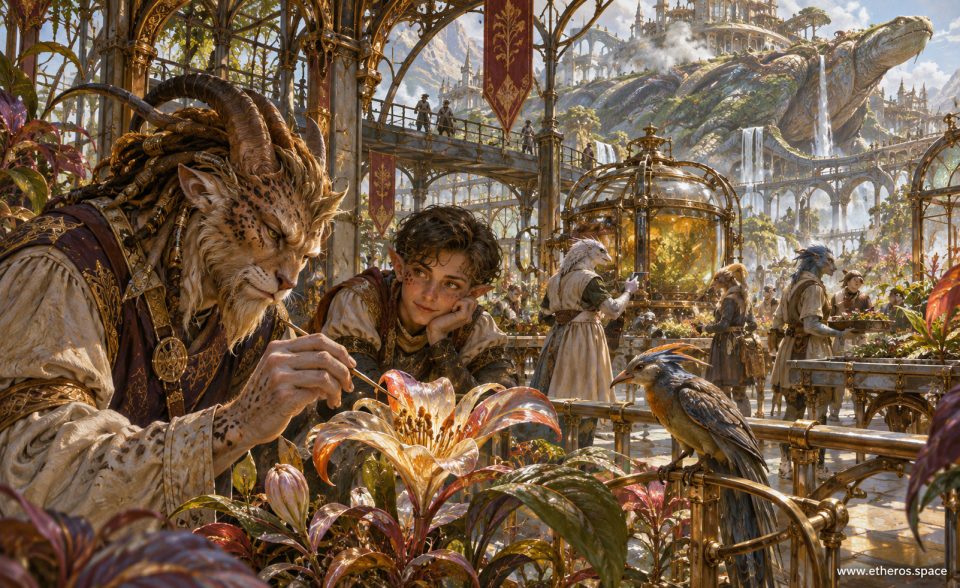
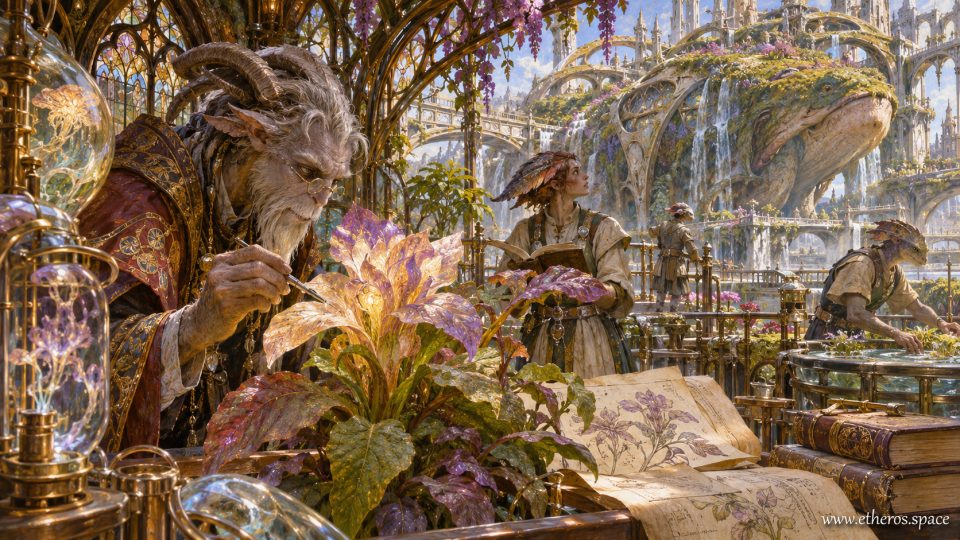
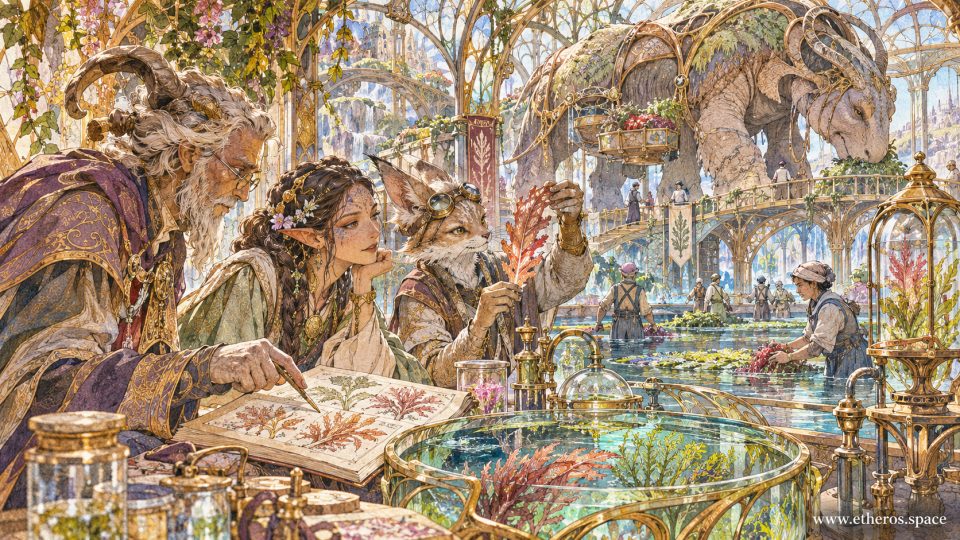
Professor Orveth Vaal, an aging ram-horned river biologist, leaned above the tank and raised a delicate, iridescent membrane between his fingers. It was a shed gill-sail, discarded naturally during the driftfish's nightly molt. Water ran from its luminous ribs into the basin below. There was no blood or wound, only a fabric of living pores finer than the gold engraving on Orveth's cuff.
Across the glass, apprentice Amira Sen bent close, chin resting in her palm. She had come to the Conservatory expecting the ordinary work of tallying eggs, rinsing filters, and arguing politely with the gardeners over the amount of light a waterflower needed. Instead she saw a color she could not find on any of the academy's plates.
"That is not the lamp," she said.
"No," Orveth answered. "It is the river answering something upstream."
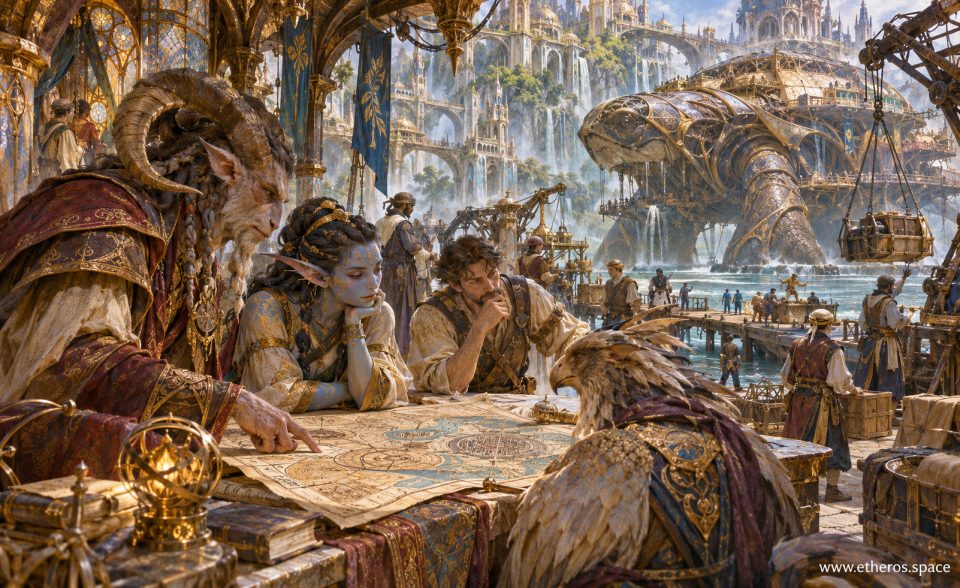
At the right side of the tank, Kesh, an otter-folk registrar in a practical wrapped coat and red work kerchief, steadied a slate. He had grown up among the floodgates and trusted numbers more than explanations. For six mornings he had recorded a decline in dissolved shell-salt in the southern channel. The fish had continued to eat. The water had remained clear. No official alarm had sounded, because the gauges were built to measure the things the city already understood.
Kesh turned the slate so the others could see his columns. "The change begins after the upper terraces take their share. It ends before the nursery reach. The amount missing is small. The number of days is not."
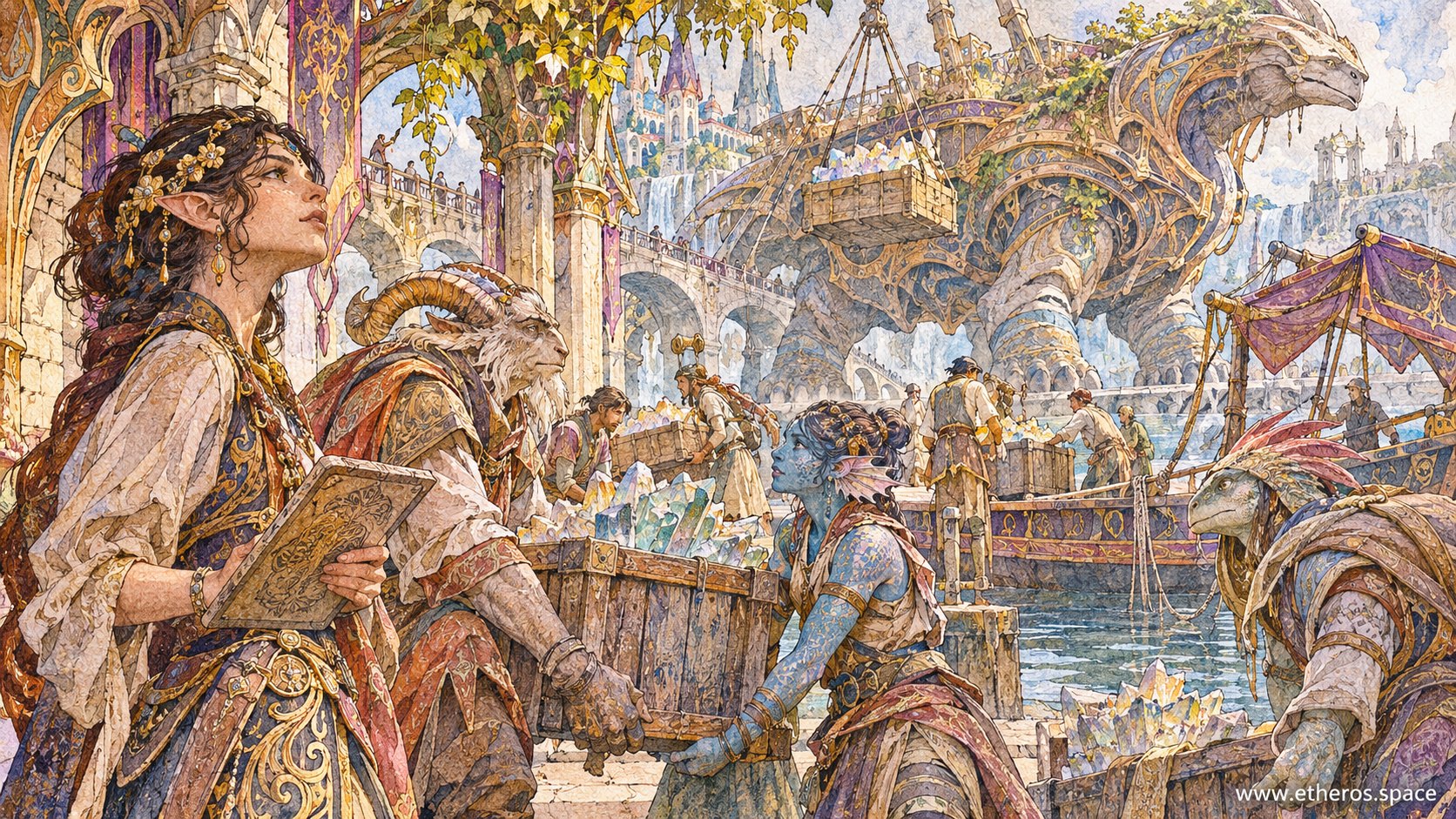
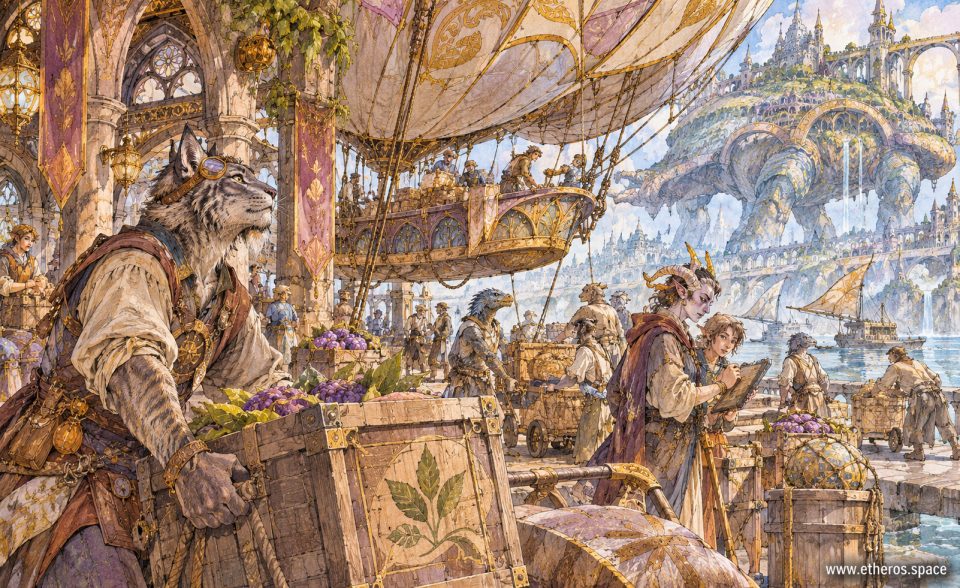
Beyond the glasshouse, sun flooded the white bridges and green hanging galleries of Vell Iskar. Water slipped from elevated channels into garden basins and passed through roots, ceramic valves, and the braided capillaries of Etheros's living infrastructure. Far across the terraces, a vast four-legged bearer moved under a crown of planted walkways. Its carapace carried cisterns and young trees. Narrow falls streamed from its flank to the aqueducts below. The city called it Maruun. It did not belong to the city; the gardens belonged, for a while, to its patient traveling back.
The missing shell-salt had not vanished. It had accumulated in Maruun's newest roof gardens, where a generation of bright thirsty vines had been planted to cool the crowded upper homes. The plants did their job. The residents slept better. The lower driftfish, meanwhile, had begun shaping thinner gill-sails to draw from the altered current. Their beautiful violet sheen was the visible consequence of a quiet bargain no one had intended to make.
Orveth lowered the membrane until one edge touched the water. Its fine veins opened and closed against the glass, showing where the living tissue held minerals and where it let them go. Amira sketched the branching pattern. Kesh traced the supply route backward on his slate: reservoir, roof garden, bearer, bridge drain, wetland, nursery. What had looked like separate institutions was one long organ with many hands upon it.
"We can close the rooftop feed," Kesh said. He sounded as though he disliked the answer.
"Then the upper courtyards will overheat," Amira replied. "Children live there."
"We can make the fish tolerate it," Orveth said, examining the fin's thin rim. "For a season. They will spend their bodies doing the work our pipes should do."
They listened to the water cross the narrow mouth of the tank. Somewhere in the halls behind them, a caretaker turned a valve; somewhere beyond the bridges, another worker was feeding a family and thinking nothing of hydrology. Etheros was full of ordinary kindness, and ordinary damage done by kindness that had never met its consequence.
Kesh found the unused return conduit in a maintenance drawing. It ran beneath the conservatory's violet-flowered colonnade, a relic from the years before Maruun was old enough to carry terraces. The pipe had been abandoned because its flow was gentle. Gentleness, Orveth reminded them, was sometimes exactly the correct amount of force.
By midday they had written a request for the roof gardeners rather than an order. They proposed an exchange: direct the mineral-rich rinse from the new beds into the old return conduit, filter the excess organics through the conservatory's root chambers, and release the recovered shell-salt slowly into the southern reach. The gardens would keep their cooling water. The fish would keep the minerals needed to grow the next generation of gill-sails. Maruun would no longer be asked to compensate for every shortfall with the strength of its own circulatory pumps.
Their proposal needed three signatures and more labor than the city could spare that week. Kesh went to find the third signature. Amira stayed to copy the membrane's branching veins onto the conservatory chart. Orveth returned the small translucent sail to the water, where it drifted beside its living makers before sinking gently among the reeds.
No bells rang. No emergency fleet lifted from the towers. The gardeners kept tending their leaves. Across the aqueduct, the great bearer continued its slow work, carrying water and people and the weight of decisions made elsewhere.
That evening the fish still faced the western pane. But one of them turned. Then another. The school did not suddenly become silver again; rivers are less obedient than stories. Yet the faint movement was enough for Orveth to record a new line beneath Kesh's careful numbers:
*The current has begun to remember its way home.*