The Red Branch and the Water That Was Owed — Morning at the Glassroot Nursery
Story
The Red Branch and the Water That Was Owed — Morning at the Glassroot Nursery
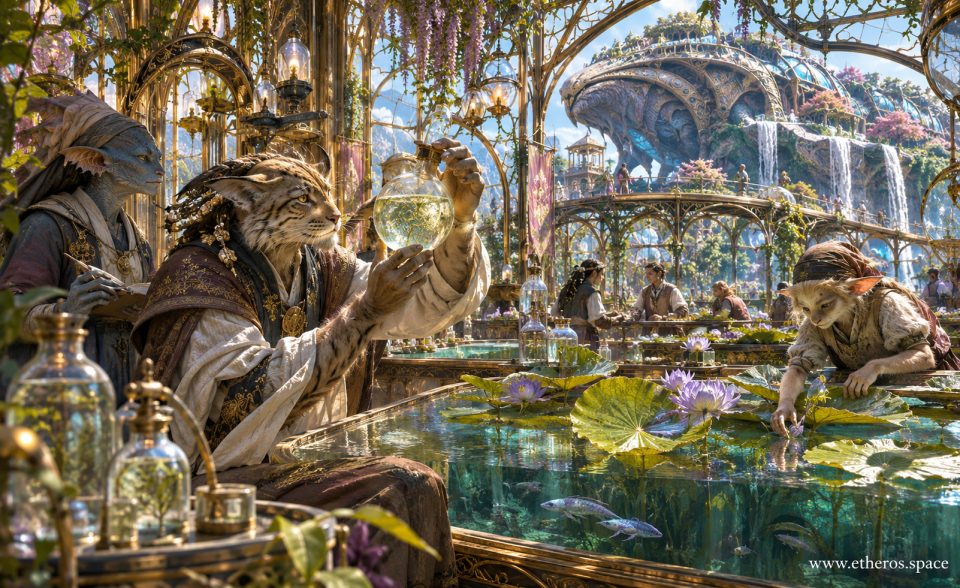
Morning light entered the Glassroot Nursery in long, pale bars, breaking across every gold-ribbed arch and shallow sheet of water. The terraces were already crowded. Gardeners stood ankle-deep among floating crops; a cart of cuttings creaked over the eastern walkway; beneath the high glazing, the slow animal warmth of a colossal service-bearer mingled with the cool vapor of the tanks. The whole place smelled of brass, wet leaves, and the faint mineral sweetness of fresh rain.
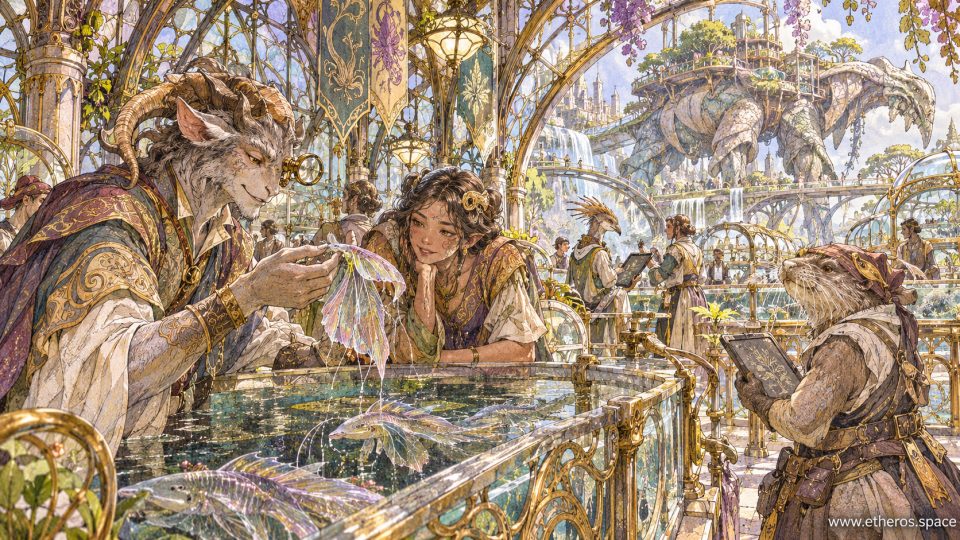
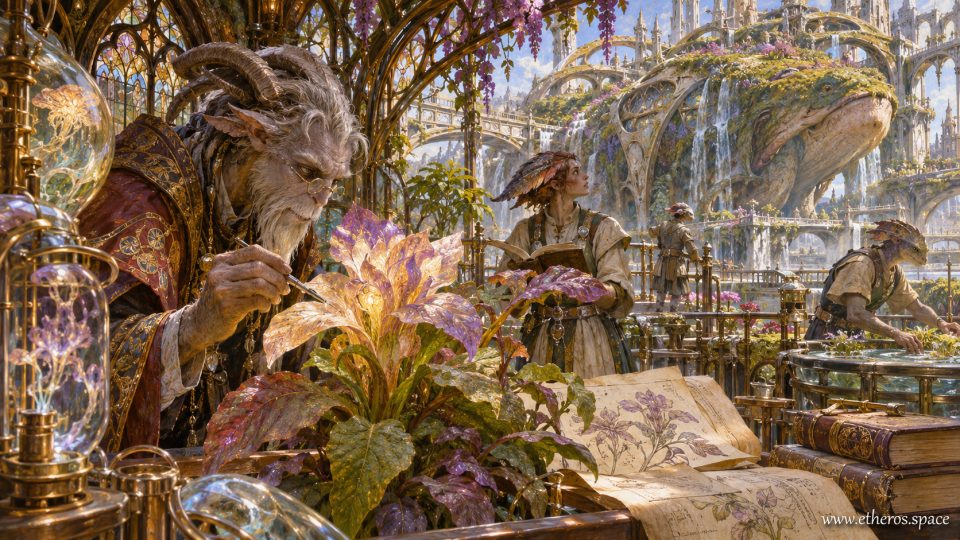
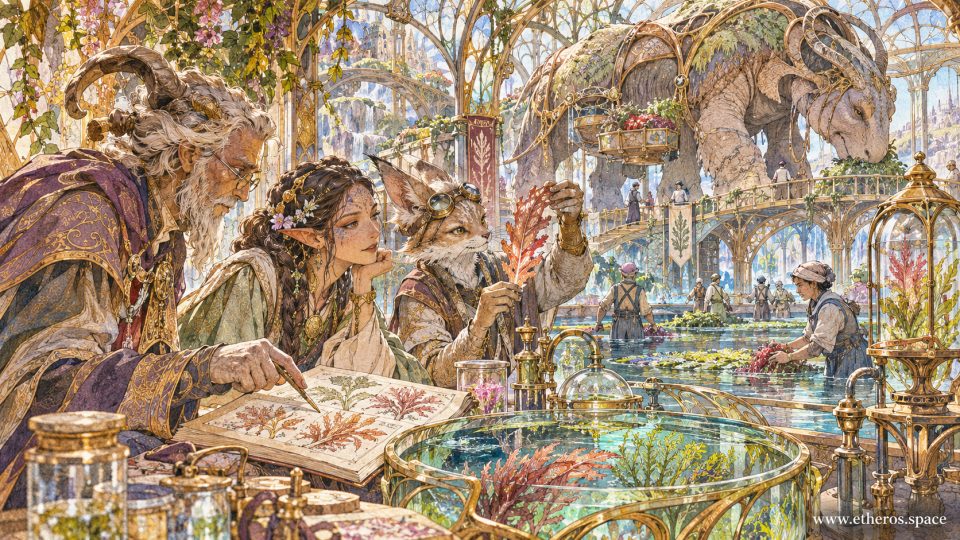
At the examination bench, three people had forgotten the hour. Master Orven, whose heavy horns and white beard made him look as old as the vaulted garden itself, had opened his botany atlas and was pointing at an illustration of a red branching weed. Beside him, the leaf-eared trainee Lysa supported her cheek on one hand, following his notes with the patient suspicion of someone who had found the master wrong before. Across the table, a fox-eared glasswright named Venn held the living specimen against the light. A pair of small lenses rested above Venn's brow; the delicate coral-red fronds shone between careful fingers like a net of tiny veins.
There was no ceremony scheduled for this morning. There was a problem. The northern nursery beds had begun to yellow two days ahead of the ordinary cold-water cycle. The leaffish were not dying, and the rootlets were still anchored; nevertheless, the water returned from the outer gardens dull and strangely light. The main cistern gauge remained full. That was what worried Lysa. A full cistern could hide a hungry field.
'Orven,' she said, 'your book says the red branch gathers what the pumps cannot see.'
'Or rather what the pumpkeepers choose not to measure,' he replied, adjusting his spectacles. He was too tired to make his old joke about the book being younger than he was.
Venn rotated the frond, allowing the sun to pass through its branches. The tips were pale, but the lower forks glimmered amber. 'It's caught the missing salts. Not poisoned; overfed. The lower canal has been taking them before the water reaches the planting beds.' Venn put one claw against the glass of a sample tube. 'The lower canal has more mouths than it had last season.'
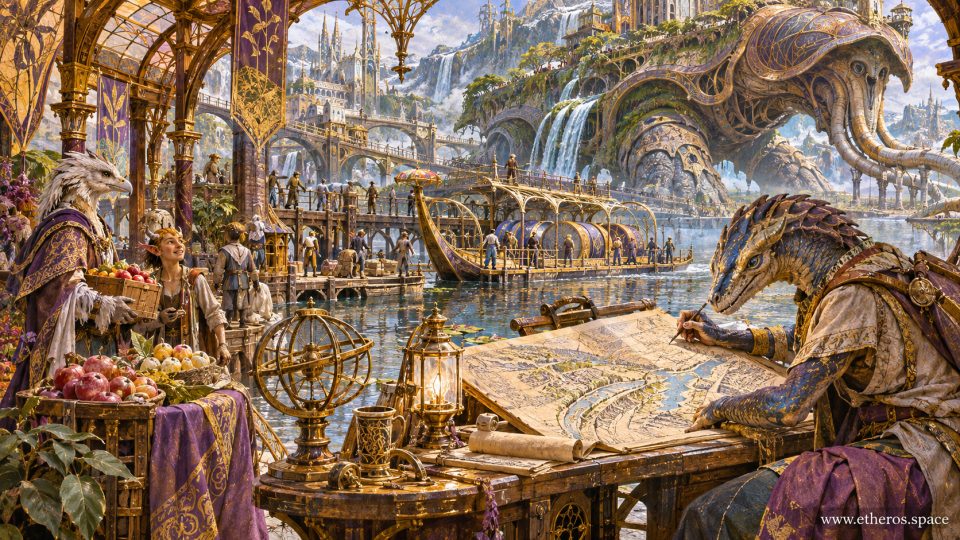
Across the flooded floor, workers bent to the floating mats and lifted baskets of living shoots. A narrow bridge connected the nursery basin to the filtration arcades. The high arches supported a second web of paths, and above those paths walked Halun, the great root-borne bearer. Halun's back carried curved trelliswork and hanging gardens; under the trellises the maintenance crew stored fresh cuttings and nutrient loam. The creature's broad legs transferred the load to reinforced stone footings rather than the delicate glasshouse flooring. Its slow progress kept the nursery supplied without hauling heavy carts along the narrow plant channels. It was born of Etheros, neither merely beast nor merely machine, and its service was a relationship negotiated through feed, repair, and rest.
Lysa looked up just as a gardener on the far bank raised a hand to Halun's keeper. A suspended tray of seedlings shifted gently, then settled. She had watched the bearer's circuits for months. Fresh loam came in across the upper bridge; exhausted medium left by the lower canal and was sifted at the compost vault. Water flowed from the cistern through the beds, carrying dissolving minerals in careful quantities; what the roots did not take was meant to return. The cycle was almost closed, but no living cycle is perfectly closed. Even a garden that gives generously must be fed.
The new residents in the eastern dwellings had been offered extra growth beds after the autumn storms. Those beds were not on the old diagrams. Nobody had stolen the salts. Nobody had broken the pumps. The city had simply kept a promise to its newest neighbors without revising the arithmetic of its water.
Orven studied the frond again. 'If we increase the pumping, the far beds will get their share.'
'And the terrace fish will lose their current,' Lysa answered. Her quiet objection brought the others still. The youngest person at the table had named the cost that the older two had nearly overlooked.
Venn touched a branch with a copper probe. 'We can make the red growth do a little more work. Give it a shallow side channel, direct the depleted return water through its roots, then release the gathered salts slowly into the feed reservoir. We don't need to take more water. We need to stop throwing away the value already in it.'
They tested the idea before anyone made a declaration. Orven sketched the channel with a worn brass pointer. Lysa marked its height against the cistern wall, leaving a handspan of freeboard for the day's excess flow. Venn measured the frond's response beneath the glass and calculated how much could be recovered in each pass. A sluice gate would keep the small water creatures out of the high-salinity settling compartment; an overflow would bypass the filter during cloudbursts. The plan had to keep moving water breathable, not simply make the numbers on a page look good.
When the breakfast whistle sounded, a worker in the far shallows laughed at someone behind her. Someone else passed a basin of cuttings across the water. Halun lowered its enormous head toward a patch of new green leaves, and the keeper, who knew its appetite better than the civic engineers did, made a note to replenish its afternoon meal. No one looking down from the high city would have guessed that a little red weed had detained the plans of half the nursery.
Orven closed the atlas only after Lysa had added the eastern dwelling beds to its map. He turned the book so that she could sign her correction. Venn placed the living frond in clean water, its fine branches opening as though it had been holding its breath. The great gardens had not been saved by a miracle. They had been attended to by people who noticed where the water went, and by a city willing to account for every life along its path.
By noon, if the new channel held, the eastern neighbors would keep their beds, the northern seedlings would green again, and the fish would still have a current to swim against. Orven thought that was enough for one morning. Lysa, still examining the diagram, was already thinking of tomorrow.