The Third Bell of Auravale — A Bloom for the Lower Terraces
Story
THE THIRD BELL OF AURAVALE — A BLOOM FOR THE LOWER TERRACES
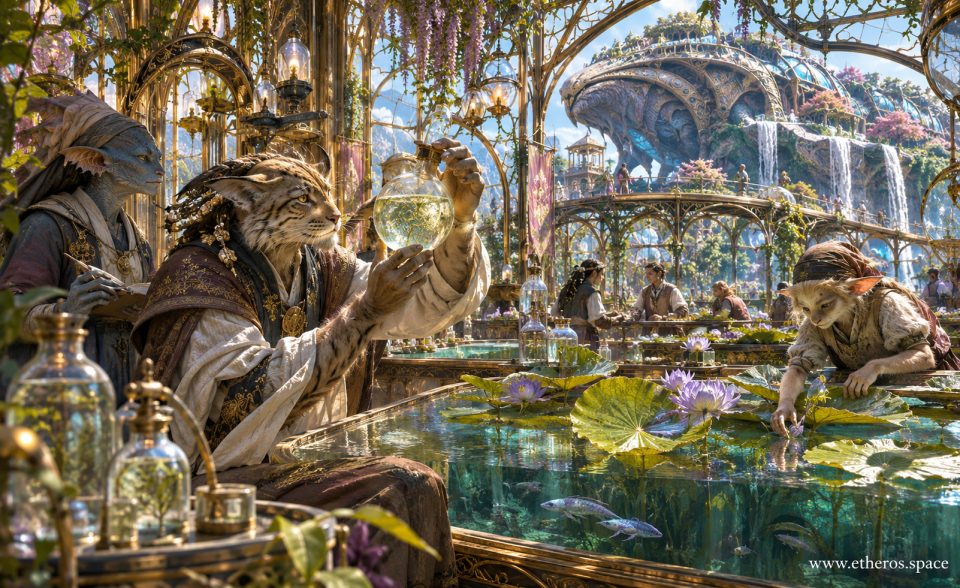
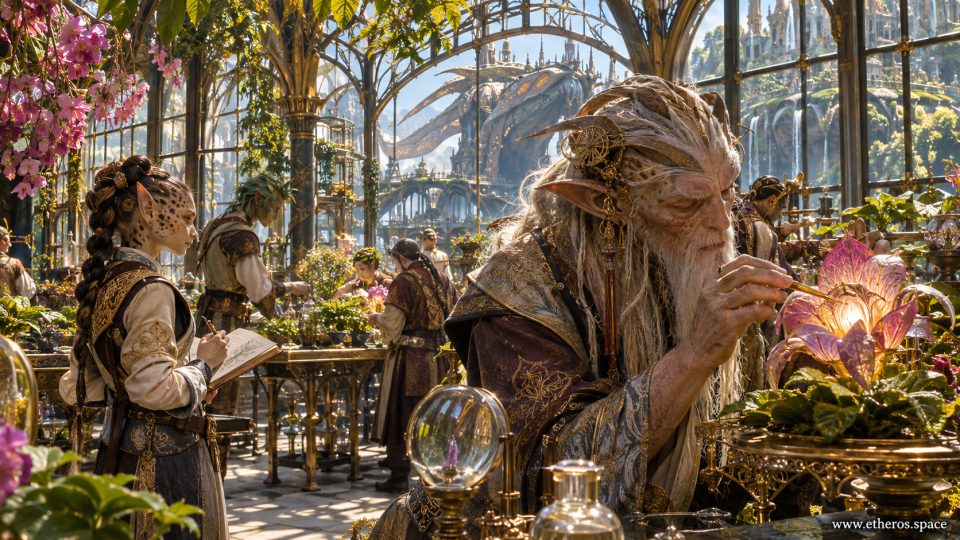
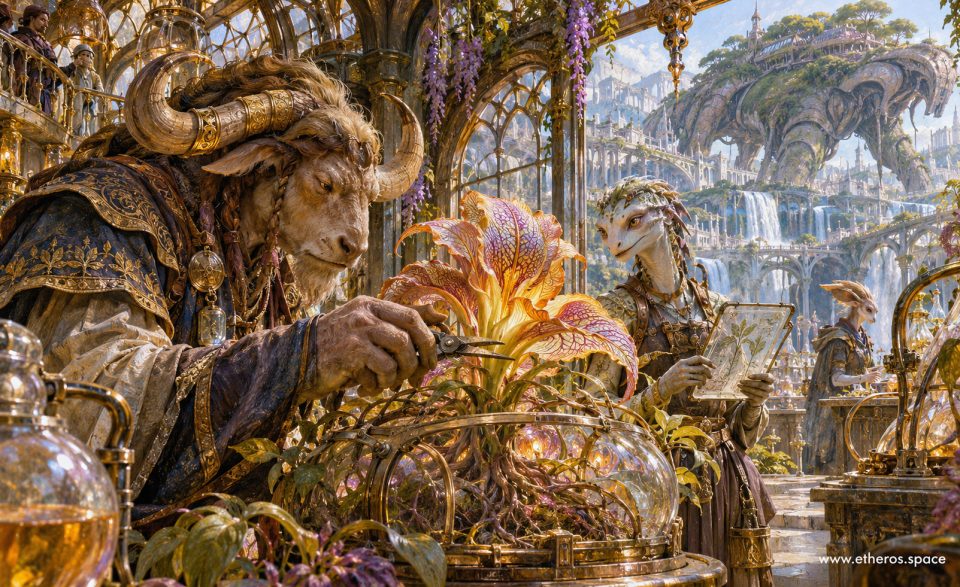
At the hour when the aqueduct bells sounded across Auravale, a single flower opened in the upper conservatory. Its translucent petals curved outward in the color of embers, veined with crimson and amber, gathering the sunlight into a warm glow. Beneath the petals, living filaments wound through a transparent vessel of brass and glass. The mechanism was neither cage nor ornament: its delicate struts supported the plant while its roots drew carefully measured nutrient water from a small circulating reservoir.
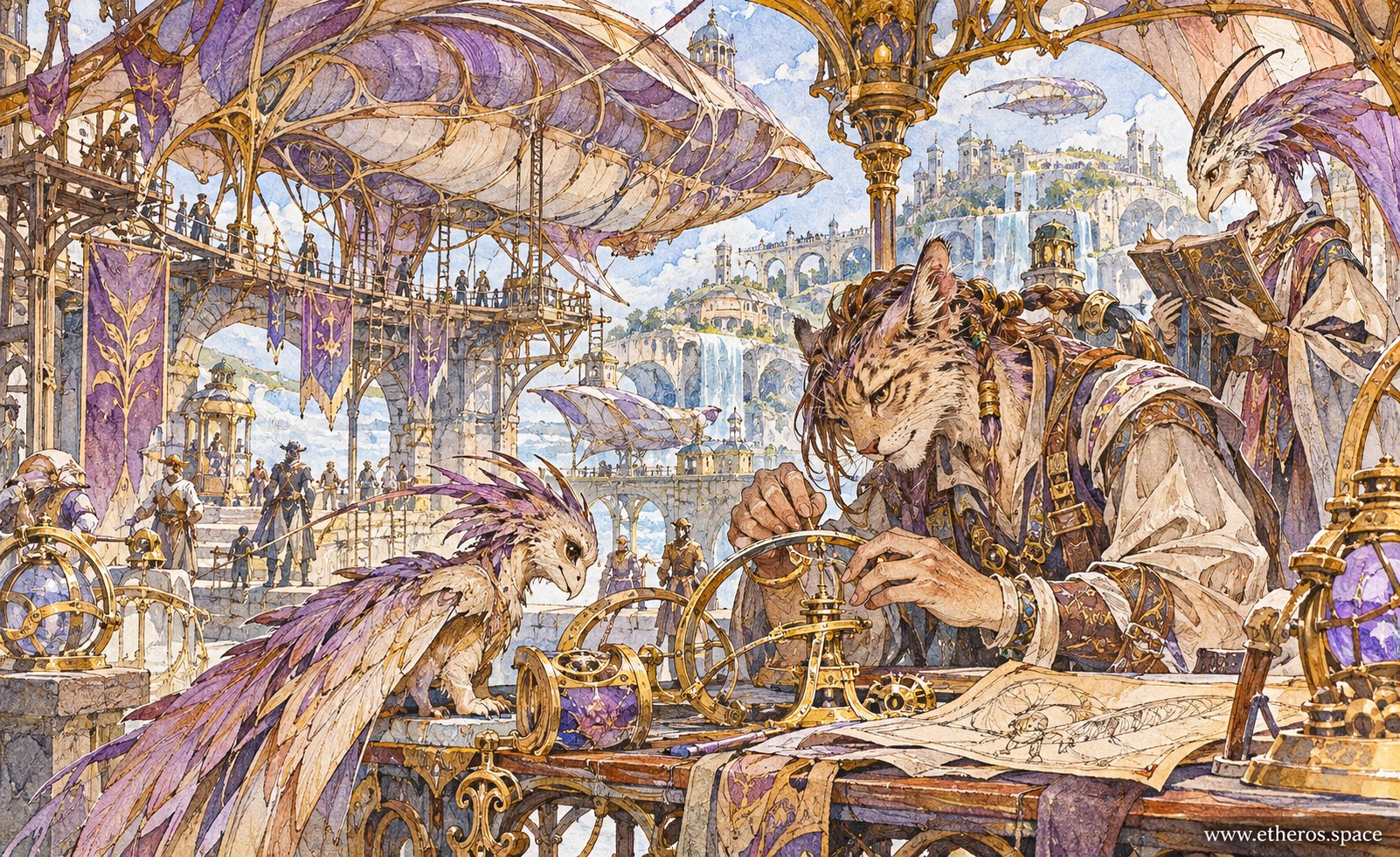
Old Korran Fels, a horned keeper of the Vesper Gardens, held his pruning shears steady against one golden leaf. His thick fingers had spent forty seasons tending plants that could not survive the abrupt changes in pressure between the city's highest balconies and its flooded lower districts. He watched the flower's veins brighten before making the smallest cut. Across the bench, his scaled apprentice, Ila Venn, recorded the opening of each new petal on a botanical chart. The glass face of her tablet reflected orange light across her pale hands.
'It is early,' Ila said.
'Only if you trust the calendar more than the roots,' Korran replied.
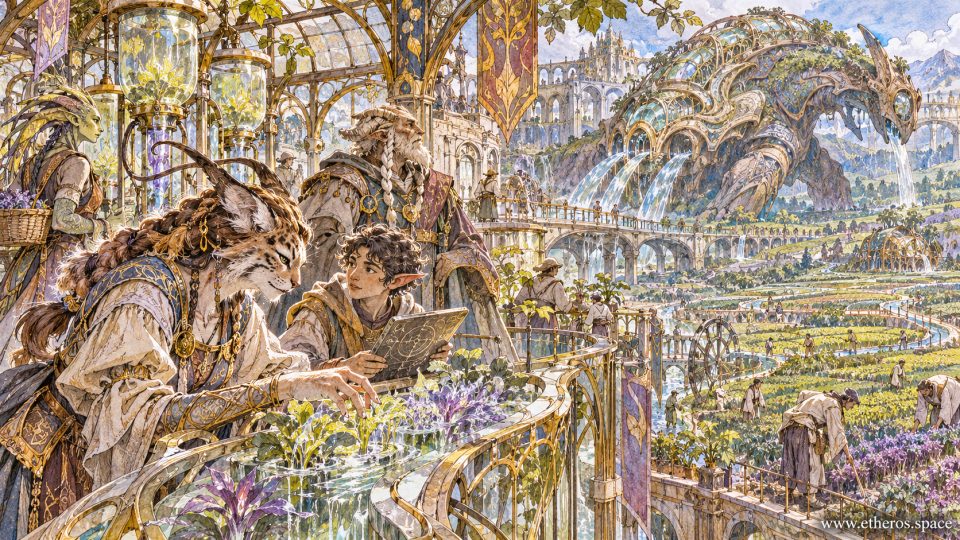
The conservatory smelled of damp stone, copper polish, and the purple climbing blossoms that draped its Gothic arches. Two visitors stood along an upper gallery, speaking softly. Beyond the windows, the city descended in bridges and inhabited terraces. Waterfalls broke into white ribbons between workshops and apartments; their mist rose into hanging gardens where children grew narrow-leaved herbs in old ceramic cups.
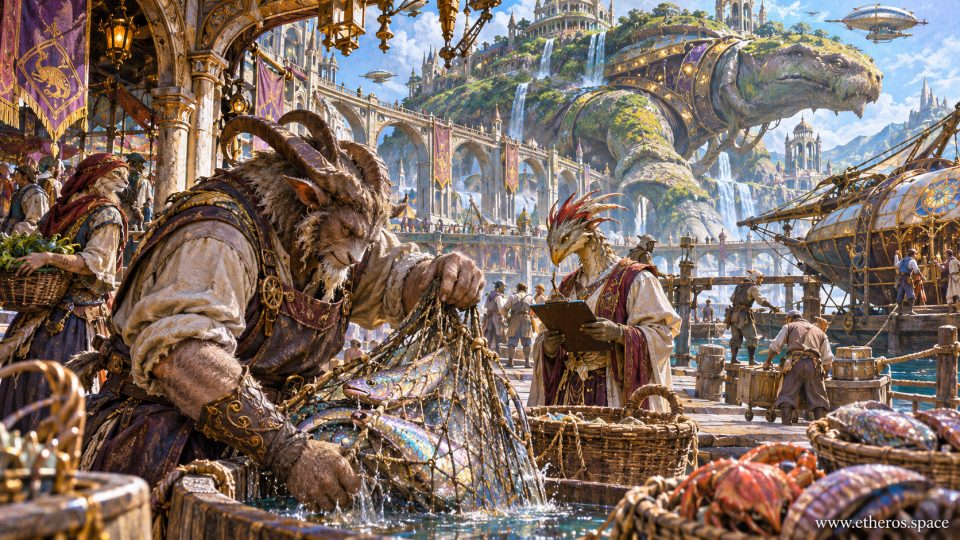
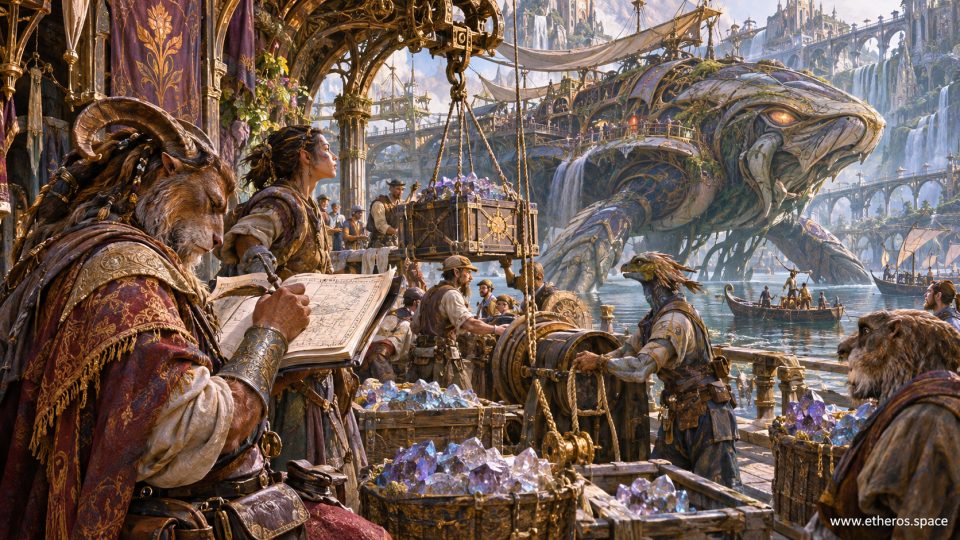
Across the valley an enormous planet-born carrier moved along a high viaduct. Its back supported a green, inhabited platform, and moss lay in the seams of its immense living armor. From this distance Korran could see only its steady movement and the silhouettes of the bridges beneath it. The creature was not the subject of today's work. It belonged to the city's longer circulation of soil, water, building materials, and food: a laboring presence large enough to be mistaken for landscape.
The flower had a smaller duty. Its species, the ember-throat, was cultivated for the porous membranes that formed beneath its petals after its third opening. Once mature, those membranes could be grafted into the city's lower-terrace water filters. The membranes caught dissolved mineral impurities without stopping the passage of useful salts. Their work was quiet; few of the thousands of households supplied by the filters ever saw a flower alive.
A small, long-eared courier stood at the right-hand workbench, studying a delivery tag. Tavi had come from the lower terraces before dawn. Their neighborhood's oldest filter had begun to stiffen after an unusually hot week, leaving the communal water tasting faintly of iron. No one was ill and no emergency had been declared. The residents had simply sent their courier uphill with a precise request and a little jar of their water, trusting that the gardeners would know what to do.
Ila compared the jar's mineral stain with the drawing on her tablet. A deep red trace marked the sediment's path. She had expected Korran to cut a mature membrane from the specimen and send it downhill immediately. Instead, the keeper loosened a slender support ring and examined a pale filament twisting around the glass interior.
'Why this one?' she asked. 'There are six other plants ready.'
Korran adjusted the ring. 'Because this one knows the lower water. Its parent grew beside the East Spill, where the iron taste first appeared. A filter graft remembers what fed it.'
This was not magic, although visitors sometimes called it that. The plant's root systems altered their microscopic channels according to the minerals around them. Generations of patient cultivation had encouraged the ember-throat to develop living membranes that could tolerate Auravale's changing water. The brass vessel gave the roots a stable pressure; the transparent walls let gardeners watch the color of the nutrient flow; the shears removed growth that would otherwise strain the new membrane.
Ila set down her tablet and held the vessel's narrow valve while Korran made the cut. The flower trembled, then steadied. Amber light flowed through the veins, not in a theatrical flash but in a slow, measurable pulse. Beneath the surface, one filament uncurled into the shape they had hoped to see.
Tavi moved nearer. 'Can I take it now?'
'Not until evening,' Korran said. 'The membrane must find its balance. You can have the first good piece after the fourth bell.'
Tavi glanced toward the city, counting in their head the steps down to the water stair and the families who would ask what had happened. Korran noticed the worry but did not offer a comforting promise. His job was to send a living filter that would continue working after he had forgotten the hour of its departure.
Ila drew a fresh line in the chart. The curve of the new filament matched the old diagrams only imperfectly. She recorded that difference, too. It would matter to someone years later, when the same water changed again.
Outside, the behemoth continued its slow crossing. Somewhere below, a pump began its regular cycle, a child's cup filled at a public tap, and mist gathered against the conservatory's high windows. The great work of Etheros carried on through bodies and machines of every size, most of them too ordinary to enter a monument's history.
At the third bell the ember-throat opened one more petal. Korran lowered his shears. Ila wrote down the time. Tavi took a seat beside the window, where the lower terraces could be seen through the moving haze, and waited for a flower to finish making clean water possible.
— An original fictional account of life on Etheros. Names, motivations, ecological specifications and events beyond the directly observable frame are narrative inventions; the painting shows the botanical work, the attendants, the conservatory and the distant planet-born carrier.