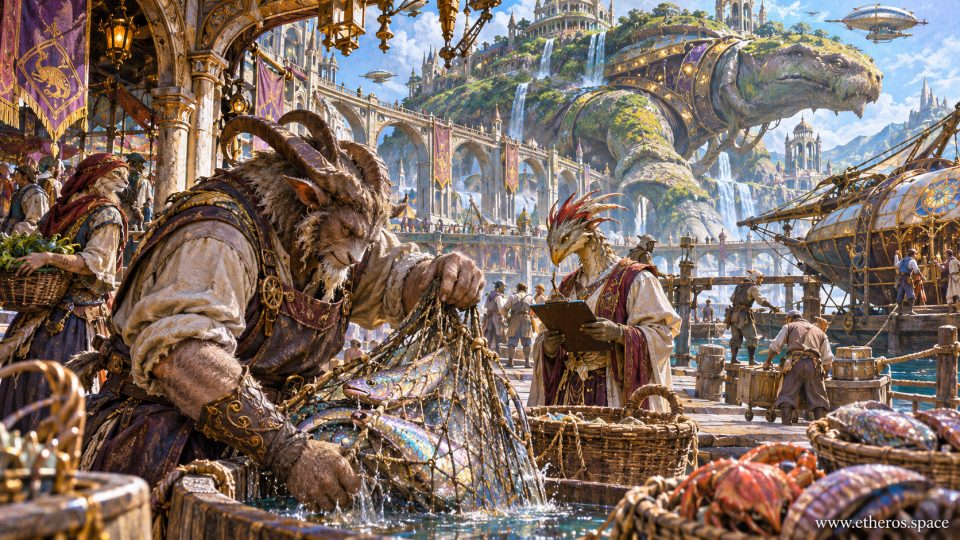
The Bend the Maps Had Not Learned
Story
THE BEND THE MAPS HAD NOT LEARNED
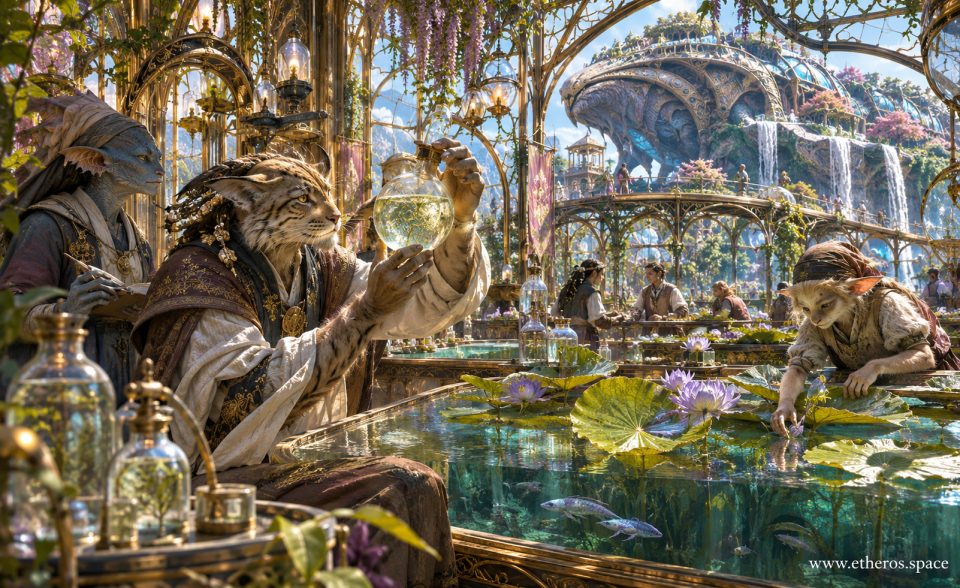
At the western fruit quay of Meiral, where the high bridges shade the lower river, everybody knew the sound of the morning ferry. First came the shiver of her brass ribs against the current, then the crew calling a berth, then the brief disorder of ropes, baskets, open hands and people making room for one another. Even the vendors who had never crossed the river could tell from the sound how heavily the ferry was loaded.
That morning the ferry made almost no sound at all. She floated into view as though she had caught a breath of wind rather than a current. To the traders gathering beneath the gold-worked arches it seemed an ordinary gift of calm water. To Keshran, who had mapped these docks for eleven years, it was a mistake the river should not have been able to make.
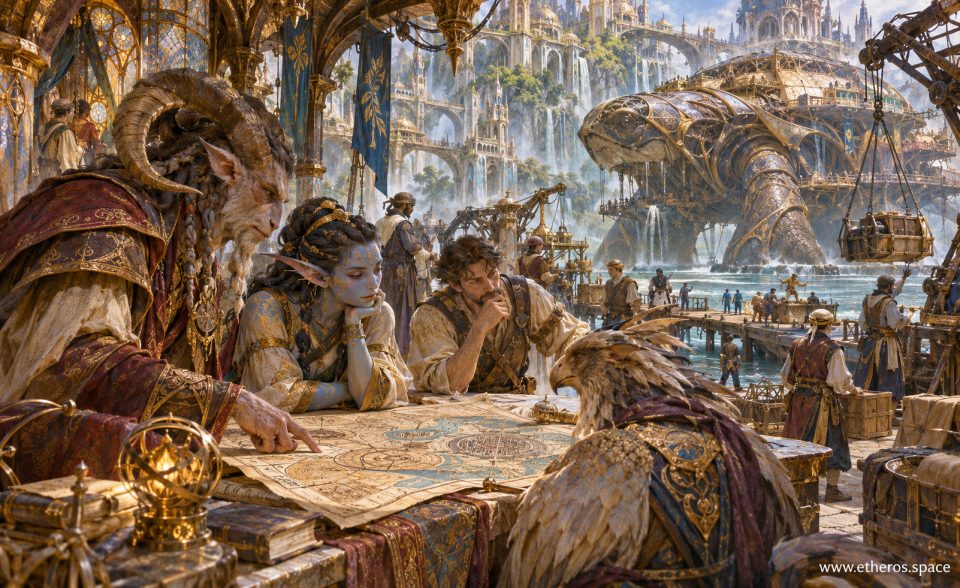
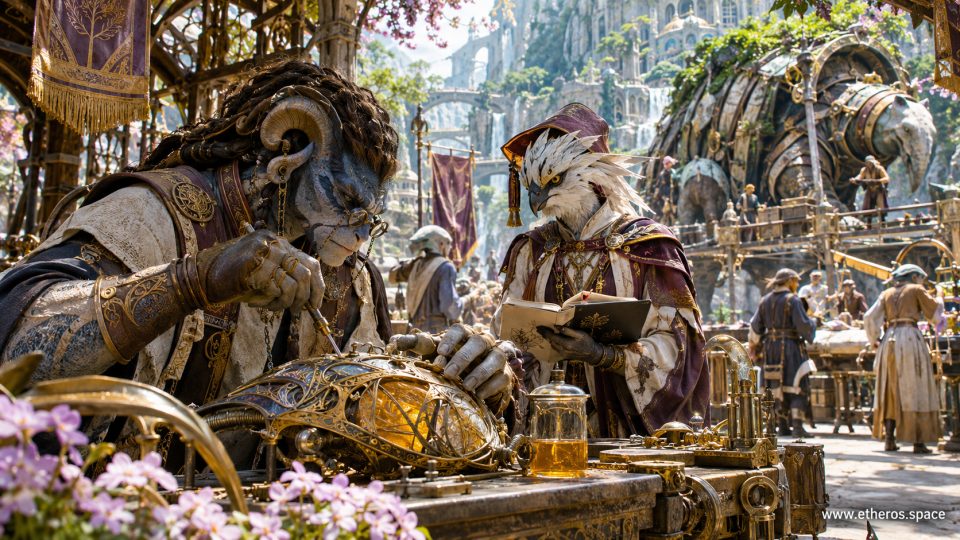
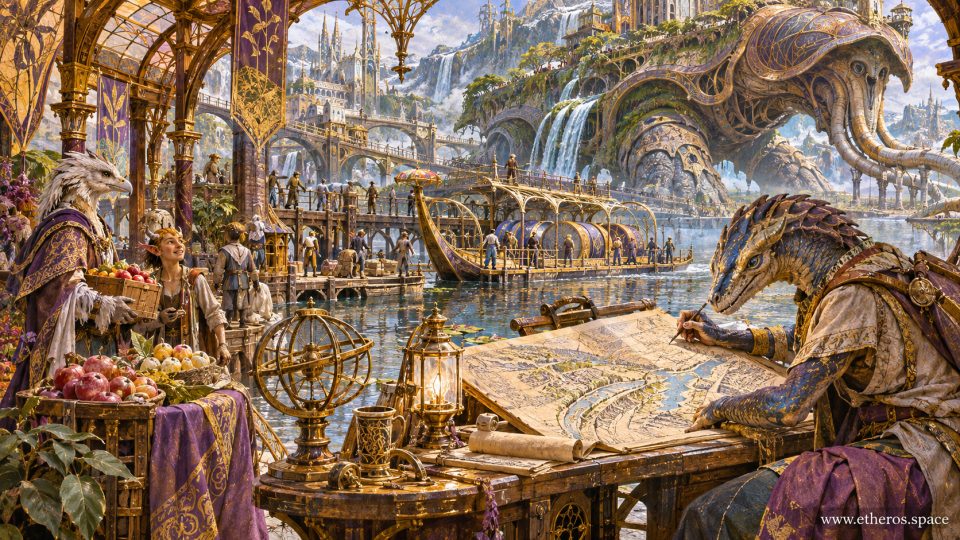
Keshran was an old blue-scaled drafter with a broken horn hidden under his indigo collar. His worktable stood on the eastern side of the quay beneath a lantern, surrounded by rolled surveys, an armillary instrument and one enormous sheet of parchment. He had inherited the table from his father, who had insisted that a good map must always show where somebody could sit and repair a broken shoe. Keshran had never quite forgiven his father for the sentiment, and had spent his adult life proving him right.
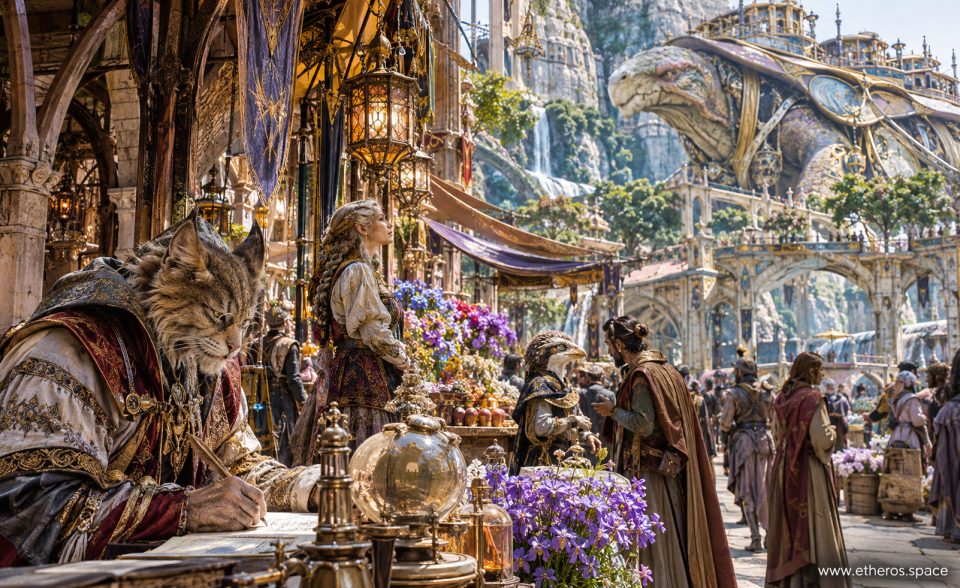
Across the open market, a white-feathered merchant named Orvi lifted a crate of red fruit from her stall. Beside her, Tam, a young horned porter, laughed at something said by a passenger coming off the ferry. Neither of them noticed Keshran scratching a narrow line across the parchment with a reed pen. The line ran through a wharf that had not moved in fifty years.
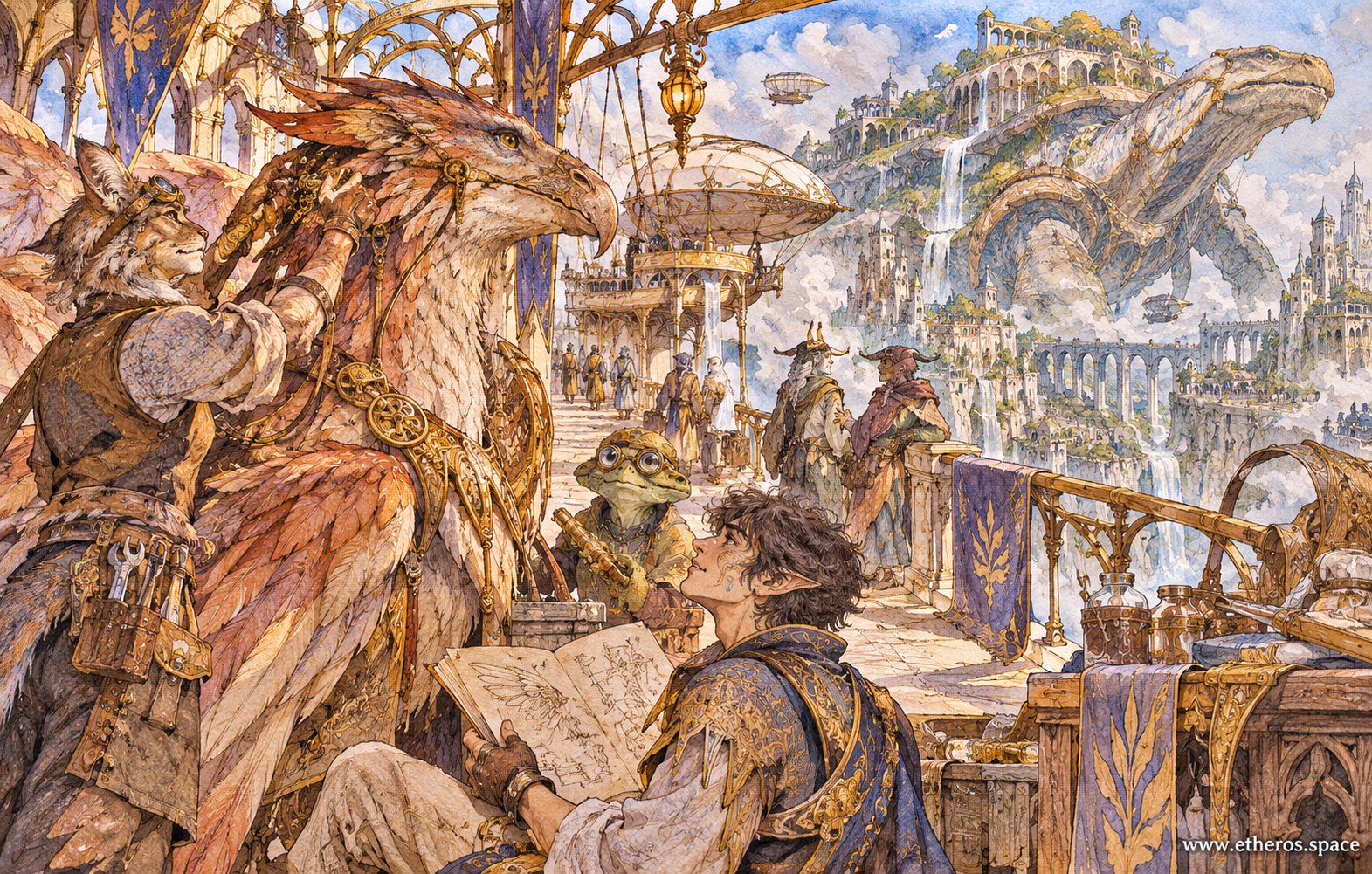
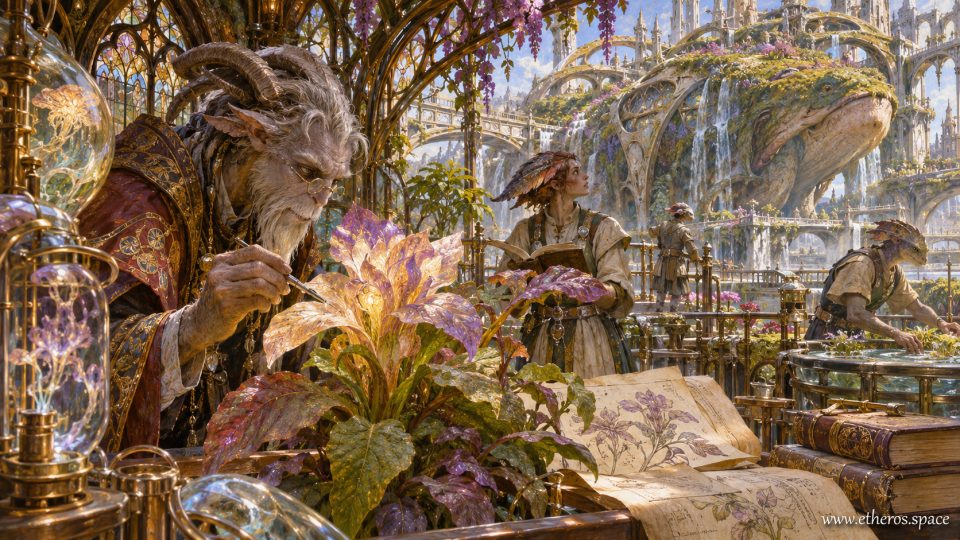
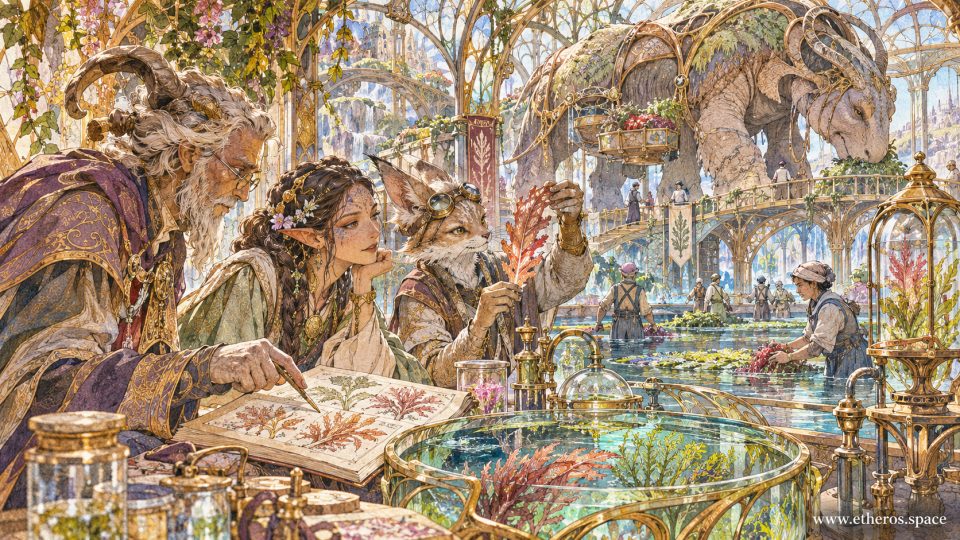
Past the ferry, immense terraces rose on arches of gilded stone and living bone. Water poured in bright sheets down the flanks of Rhuvon, the elephant-headed carrier who bore orchards, walkways and reservoir chambers on its armored back. On Etheros the word 'machine' explained only half of such a being. Rhuvon was a working citizen of the watershed: soil and orchard roots lay over its shoulders, filtration chambers occupied its inner structure, and a branching hydraulic network descended to the neighborhood sluices. Its labor was neither miracle nor spectacle to those who depended on it. It was breakfast, drinking water and the continued possibility of markets.
For three mornings the lower ferry had entered Meiral more quietly than it ought. Now Keshran could see why. A small suspended jetty had shifted its position in the eddy below the center bridge. The jetty was there to moor passengers, not to redirect a river, but the unexpected shift was forcing more water beneath the eastern arcade. The draft along the fruit quay had changed by the width of one hand. Another week would put that change into the foundation seams. The handrail would tilt. The carts would break their axles. Eventually the quay would become a beautiful, useless place.
Keshran dipped his pen and wrote three figures in the margin. He could have sent them to the upper water office, where a reply would arrive in a week. Instead he folded a small copy of the survey and crossed toward Orvi's baskets.
'Who knows the boats here best?' he asked.
Orvi gave him a look she reserved for people asking the price of fruit after eating it. 'Who carries the produce down when the ferry is late?' she said, and pointed to Tam.
Tam was younger than the bridge, younger than the paper, and worried that he would be blamed for something. Keshran showed him the narrow alteration on the chart and asked whether he had seen the little floating jetty move. Tam had seen it move twice. He had helped a ferryman retie the mooring three days earlier; the new rope had looked stronger. It was also shorter. That small fact, overlooked by every grand office in the city, was the first useful answer anyone had given Keshran all week.
They walked to the wharf together. Orvi sent two workers to hold back the morning baskets so no one would mistake the delay for a quarrel. She did not call herself an engineer, but she knew the weight of every crate and the hour by which each fruit must reach the higher kitchens. Her part in restoring the current was to keep the quay from filling with impatient carts before a rope could be safely moved.
On the opposite bank the terraced carrier flexed one massive forelimb. A little more water fell through its side channels, catching the sun. Keshran watched the falling sheets and realized that Rhuvon was compensating for the misplaced jetty already: the carrier had increased flow downstream so the lower gardens would not go dry. It had not caused the disturbance; it had borne its consequences. One short rope had turned the careful labor of a gigantic organism into an unnecessary expenditure of water and force.
By midday the ferrymen would be asked to loosen their line, and a maintenance crew would reset the jetty toward its old mark. That would take the afternoon, and there would be grumbling. But the little correction would return the current to its familiar course. Keshran would redraw one bend in his survey, and the people whose names never appeared on official plans would keep their places along the river.
For now the ferry slid past the crowded piers, with its blue-and-gold canopy bright among the bridges. Orvi pressed a ripe red fruit into Tam's hand and told him to eat before his shift grew difficult. Keshran left the new line on the parchment visible rather than scraping it away. A map that remembered its errors, he had decided, was more useful than one that claimed the river had never changed.