The Quiet Weight of a Sunseed

Story
The Quiet Weight of a Sunseed
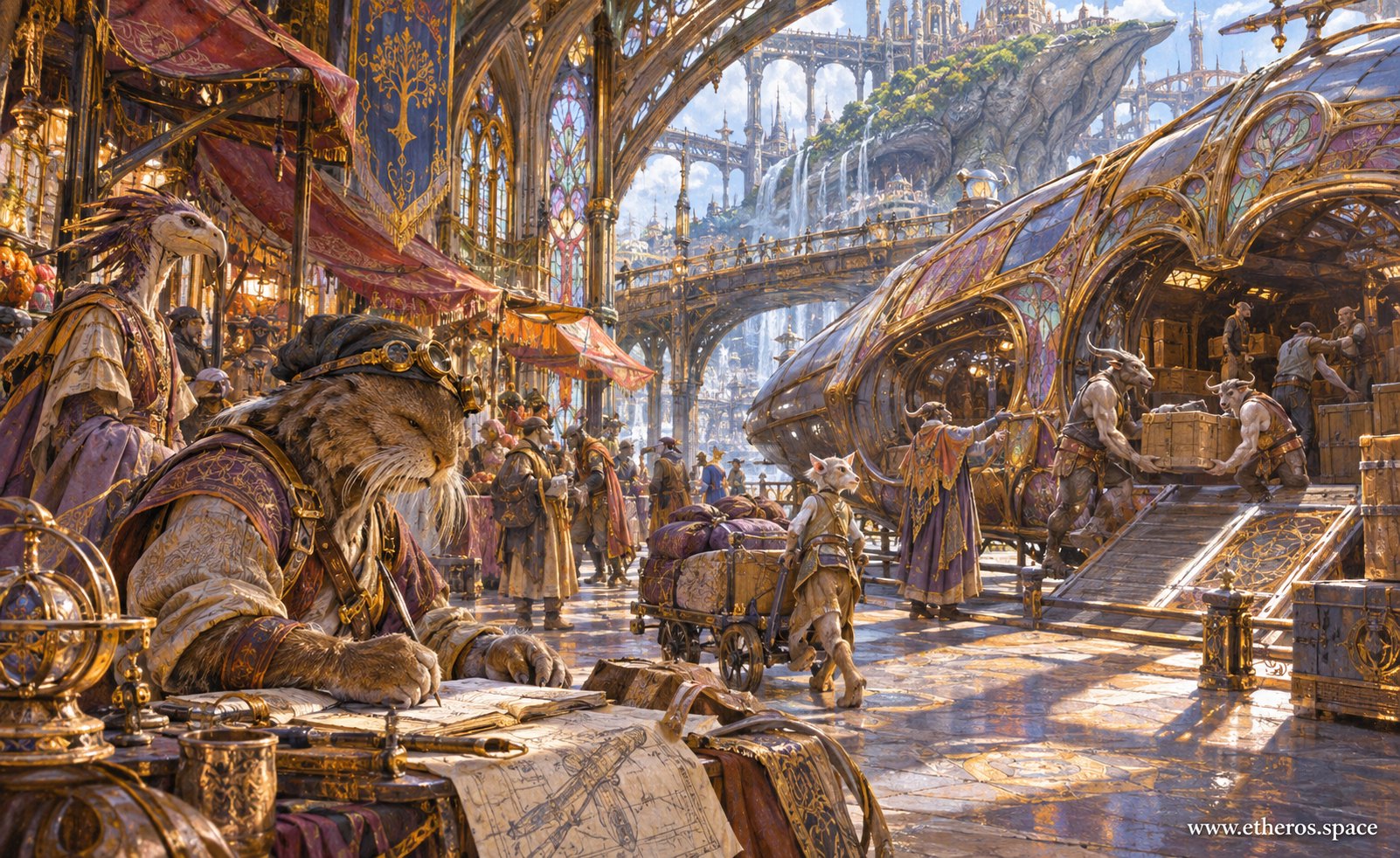
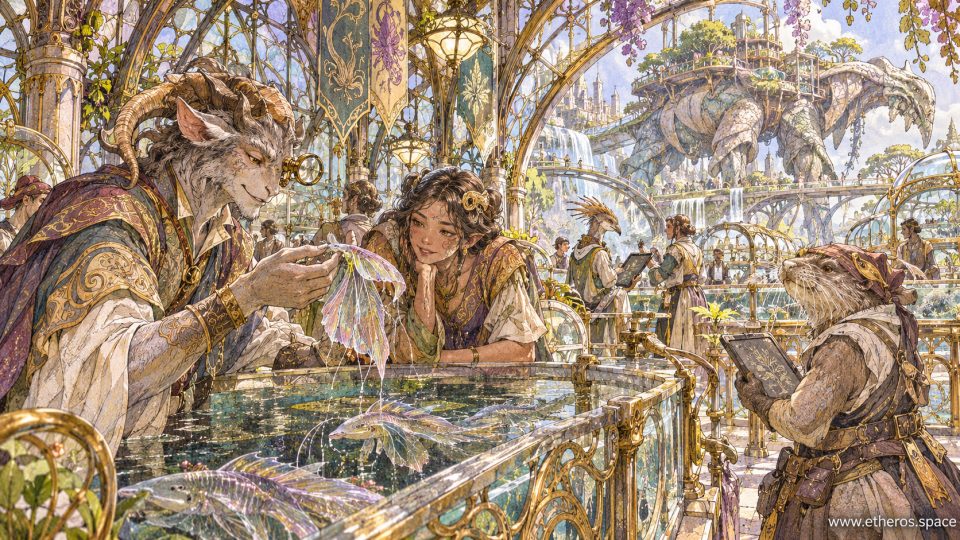
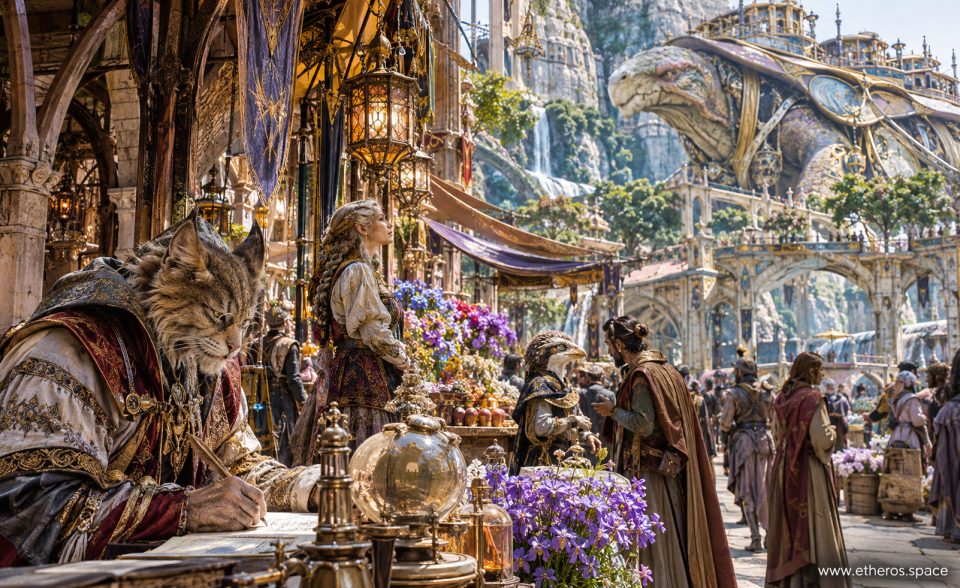
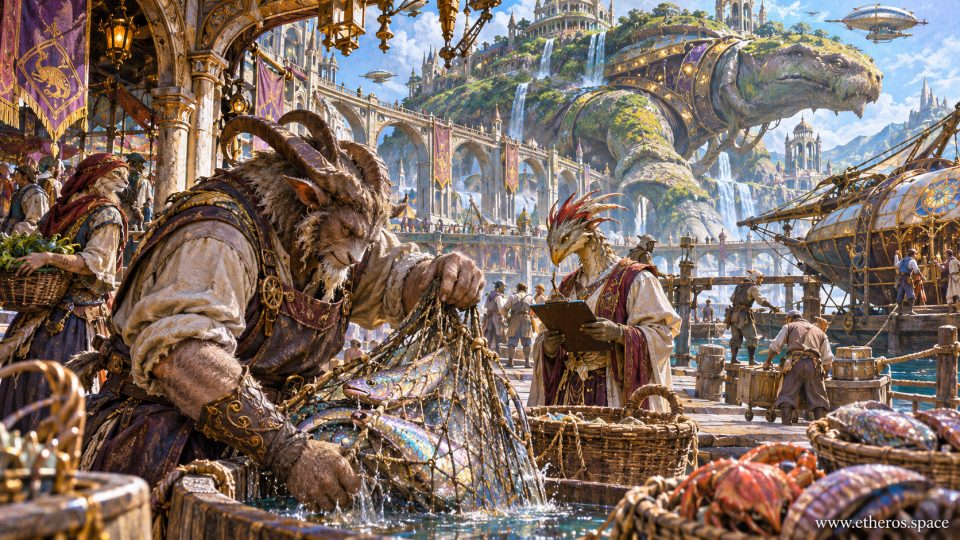
At the lower market of Vellorin, where the river dropped through three inhabited terraces and the pale bridges carried more footsteps than the city could count, the repair tables opened before the food stalls. This was not a festival. The purple banners hung there every day, their frayed gold stitches marking a corridor reserved for work that could not safely wait for the upper foundries. A sick lamp, a cracked irrigation rib, a ruptured courier gland—each arrived in a basket, and by evening someone had to carry it home alive.
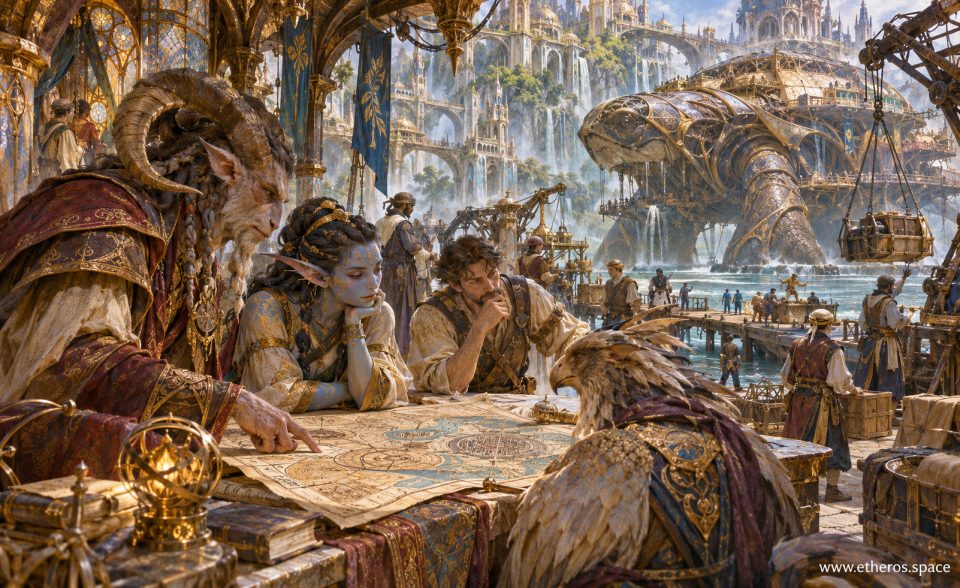
Orven of the Blue Sill bent over a golden capsule enclosed in a cage of branching brass. He was a broad-shouldered, horned mechanic with slate-blue skin, an aging magnifier fixed before one eye and a careful habit of holding his breath when a tool met a fragile seam. On the table sat a small vessel of amber fluid and an instrument whose fine tips disappeared into the lattice. The capsule glowed through its translucent center, but not as steadily as it should. It had begun to flicker at dawn, just as the main carrier passed the east bridge.
Across the bench stood Sereth, a white-feathered avian registrar, the dark plum edge of a formal hood framing sharp attentive eyes. One gloved hand supported an open notebook. The other held down a page that the wind from the market threatened to turn. Sereth was responsible for recording whether a repaired device could be returned to public service, a duty that had made them unpopular with mechanics who preferred applause to measurements. Orven, who had once failed an inspection and been grateful for it years afterward, liked having the registrar nearby.
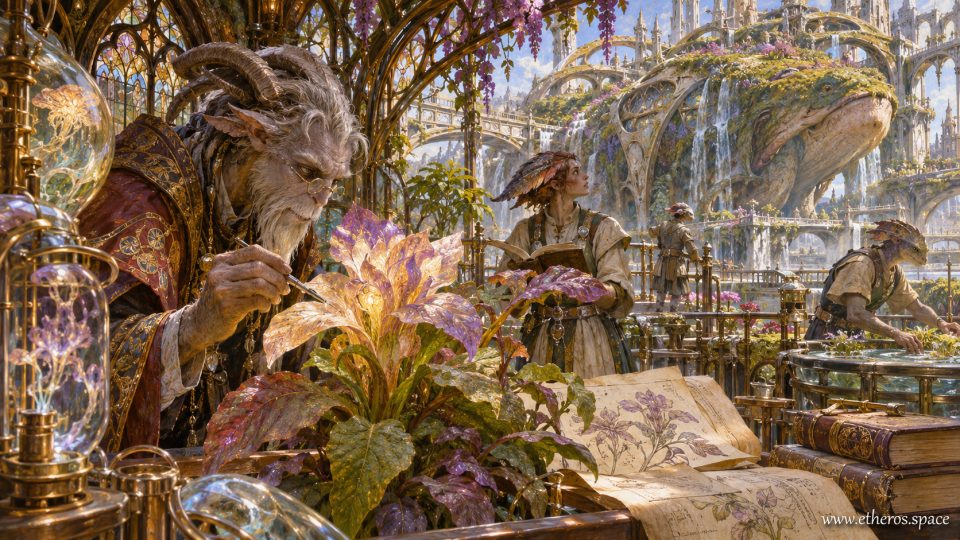
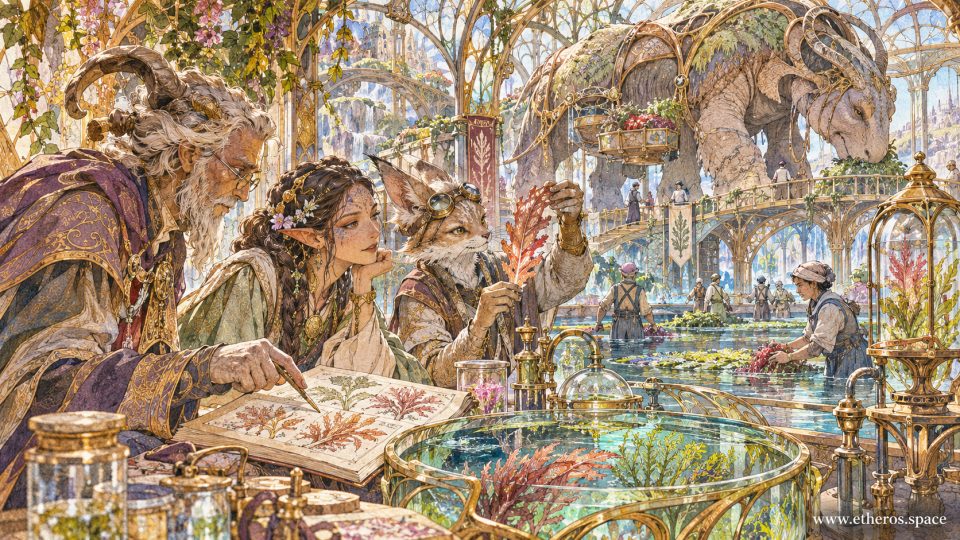
They called this object a sunseed, though no one imagined it grew in earth. It belonged to the enormous carrier visible beyond the market, a many-jointed animal-machine with a pale plated head and a cultivated back of living green. The carrier spent its mornings moving stone and food between terraces; by noon its hydraulic roots were connected to municipal pipes, returning filtered water to kitchens farther uphill. Its internal pumps could do the lifting. The sunseed's task was smaller and more exacting: it read the variations in that flow and sent a harmless pulse along the harness, telling the carrier when the uphill reservoirs had enough.
Yesterday the old seed had reported a full cistern too early. Nothing had exploded; the river was still the river and the carrier had rested when asked. But the kitchens of the north stair received half their customary water, and an old baker was obliged to wash flour from her hands with rain caught in a cup. Such failures did not make public songs. They simply made ordinary lives a little harder.
Orven set the probe against one of the gold tendrils. A thin reflected line moved over his goggles. Sereth watched the hand rather than the glow. "Not the heart," they observed. "The path out of it."
"The heart is trying," Orven answered. "The path keeps making it repeat itself."
The inscription on the outer ring had been cut by an artisan from a marsh province two generations before. The elegant swirls were not decoration applied afterward. Each curve carried a conductive filament, each little window gave room for a membrane to swell when the warm amber electrolyte expanded. The mechanism was fine enough that an impatient repair could bridge two circuits and make the gauge lie beautifully. Orven's old teacher had called that the cruelest kind of error: one that looked like reassurance.
Behind them, the market was busy in ways that had nothing to do with their work. A woman carried a basket through the archway. A vendor negotiated over a crate. Distant riggers stood on platforms beside the carrier while two children stopped to look up at its vast, slow head. They could not know that an almost invisible strand of metal on a small table was one of the things that made the creature's labor gentle. Orven did not feel insulted by their ignorance. He had come here because most work worth doing was invisible when done correctly.
Sereth turned a page and read the last three pressure readings aloud. The cadence was uneven, with a longer interval before each third pulse. Orven removed a tiny retaining pin, eased the cage open by the width of a fingernail, and found a filament darkened where the gold turned beneath an ornamental arch. A current had followed the shortest route instead of the intended one. He laid in a fresh strand made of flexible estuary alloy, no thicker than a hair, and cleaned the adjoining membrane with a drop from the amber bottle.
They waited for the seed to settle. The market kept moving. Water fell somewhere beyond the bridges, the sound traveling between old stone and living shell. The repaired capsule brightened once, dimmed, and then began to pulse with a regularity that could be checked against a real gauge. Sereth wrote down the observed interval, the damaged part, the replacement material and the name of the hand that had made the repair. There was no space on the form for hope, although both of them felt it.
When the carrier's foreman arrived, Orven refused to hand over the seed until the reservoir clerk had confirmed the new reading from uphill. This cost them another quarter hour. Sereth approved of the delay, although they said nothing. At last the message came back: the needle and the actual water agreed. A sleeve of pressure would again climb the north stair without forcing the animal to labor beyond its natural rhythm.
Orven closed his case. Sereth pressed a small, practical mark beside the final line. The sunseed would go back into the great carrier, the carrier would go back to its unremarked tasks, and tomorrow the old baker could use all the water she needed to wash flour from her fingers. For a city suspended between stone, root and living machinery, that quiet result was as close to triumph as anyone required.