The Bell of the Low Steps — Afternoon in Cinderward
Story
THE BELL OF THE LOW STEPS — AFTERNOON IN CINDERWARD
The heat arrived at Cinderward before the light. The people who lived in the lower terraces knew it by the taste of hot stone; the upper balconies knew it by the brightening of their copper gutters. Neither had ever agreed upon the moment when a warm afternoon became a dangerous one.
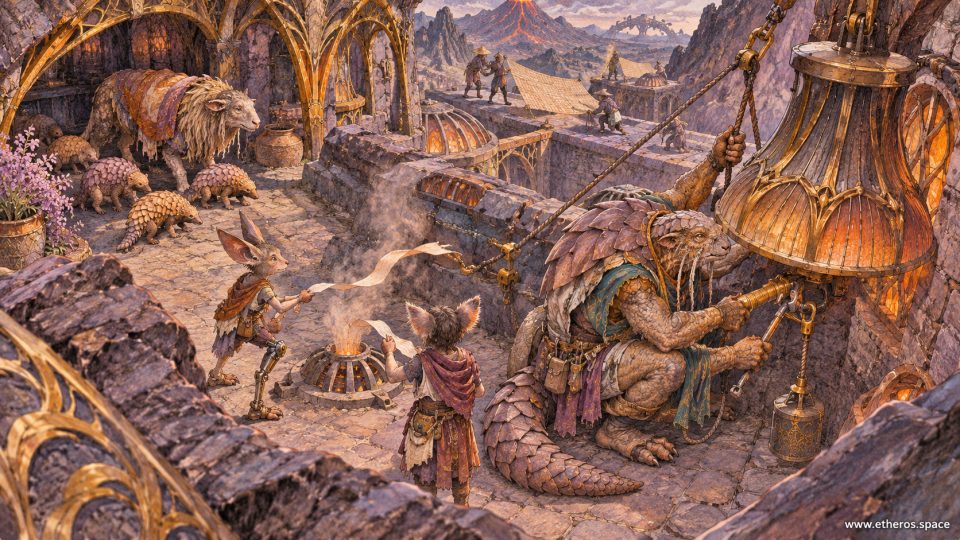
Between the two neighborhoods, in an open yard cut into the mountain's black rock, hung the great warning bell. It was not a temple bell or a monument. Its ribs were made to flex, its suspension to share weight across the arched beams, and the little brass striker beneath it to answer a change in heat-pressure before anybody on the far steps could smell the vents.
That was the design, at least.
Keth Oru, the bell's oldest keeper, crouched beneath its glowing housing. His body had grown broad and low with age; scaled plates covered his back, and his long heavy tail lay on the paving where it helped steady his weight. One hand kept a rope taut while another adjusted the small wrench at the striker coupling. The bell's iron chain led into stonework above, where generations of workers had replaced old anchors with new ones without ever quite trusting the repairs of the generations before them.
A pale streamer curled upward from a grated vent beside the children. Neri, whose long ears heard changes in the bell before anyone else, held the end of a second strip away from the grate. Salo stood with their back to the lane, watching the warmer air lift their own strip and pull it towards the open roof.
"It still goes uphill," Neri said.
"Warm air does," Keth answered without looking up. "Sound is a little less obedient."
Above them, two roof workers spread a woven shade mat across an upper passage. A third balanced near a domed vent, calling distances to the others. Across the yard a shaggy pack animal rested in an archway while three small plated foragers followed the cool edge of the paving. No one in the lower yard stopped ordinary work for the bell. They had learned that waiting for perfect safety could cost as much as a season of bad heat.
The old warning system had once been praised because its sound traveled beautifully toward the governor's terraces. People living on the lower steps heard little more than a dull vibration through their floors. The difference had been excused as a matter of stone and wind. It was also a matter of whose homes the architects had stood in when they tested their invention.
Keth was not prepared to blame the original designers. They had built with the measurements available. But he could not forgive the council for using an old measurement as a reason never to make a new one.
Last week a heat pulse had come through the eastern cracks. It had not killed anyone. That fact appeared prominently in the council's record. Less prominently recorded were the hours a child spent dizzy on a stair, the food spoiled in a shuttered bakery, and the elderly gatherer who had remained outside because the warning sounded too faintly to wake her.
The council had offered enough bronze to replace the bell's cracked rim. Not enough to rebuild every warning tower in the settlement. The merchants above argued that an alarm too sensitive would shut the work roads every afternoon. The workers below replied that an alarm nobody heard was hardly an alarm at all. Both worries were real, which made the argument last longer.
"Try the low passage," Salo said, pointing not to a mark on a drawing but to the dark turn where the pack animal rested.
Keth shifted the coupling one notch. The suspended bell took the new strain through its upper chain; the small counterweight beneath moved without scraping its housing. He gave the striker rope a measured pull.
The note entered the stone yard, struck the arch on the left, and returned deeper than before. The little plated animals lifted their heads. In the passage above, one worker stopped with the shade mat half-unrolled. Neri's ears turned sharply toward the lower steps.
"I heard it at my feet," Neri said.
Keth listened to the dying vibration. "We have moved the answer. We haven't proved it arrives everywhere."
Salo drew a small line in the dust at the edge of the vent. Tomorrow, the children and the bell keeper would carry chimes into the homes farthest below and compare what each household could hear. They would record the false alarms as carefully as the missed ones. If the lower passages remained silent, the council would have to face another cost, not a comforting story about repaired bronze.
By the time Keth tightened the final nut, a gust had lifted both paper streamers together. The warning bell shone in the mountain light. Smoke crossed the roofline without becoming a catastrophe. Work resumed on the shade mat, and the little plated foragers went about their mysterious business.
Neri stayed beside Keth after the others drifted towards supper.
"Will it ring for us now?"
"I don't know," the old keeper said. He was tired enough to offer a simpler answer, and loved the child enough not to. "We will go down and listen."
They gathered their strips, their tools, and the rough record of the afternoon's measurements. Behind them the mountain kept its own counsel, neither cruel nor kind. Cinderward's task was not to make the living planet harmless. It was to pay attention to one another before the next signal came.