The Floor Kept the Tune — An Evening in the Copperstep Music Rooms
Story
THE FLOOR KEPT THE TUNE
An Evening in the Copperstep Music Rooms
Most of the residents of Copperstep heard the music through the shutters. Neris felt it through her hands.
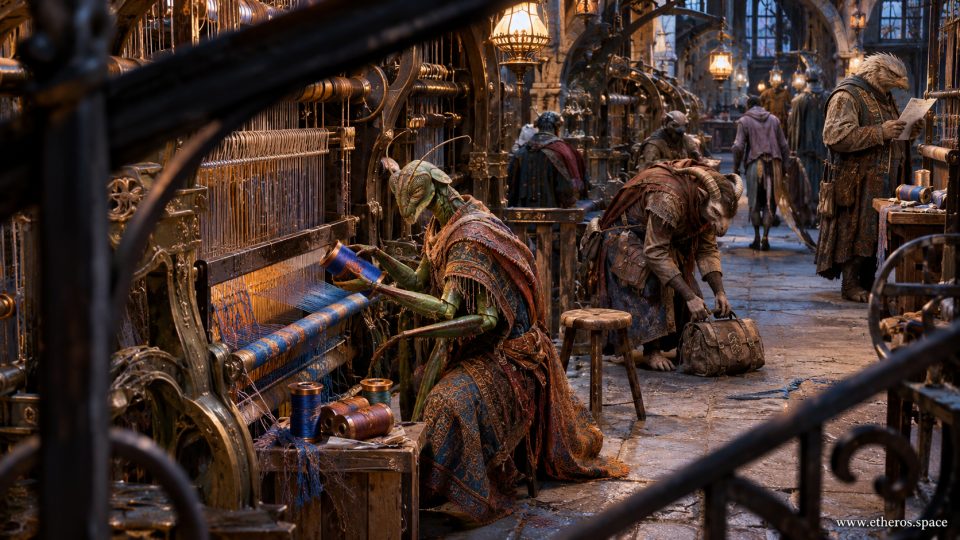
The little room stood above an ironmonger's workshop, between a staircase that never quite dried and an alley whose lanterns were lit long before sunset. It had once been a counting office. Its wooden floor was warped, its brass pipes older than anyone remembered, and its shutters looked onto a narrow procession of Gothic roofs. Yet on certain evenings it belonged to the neighborhood.
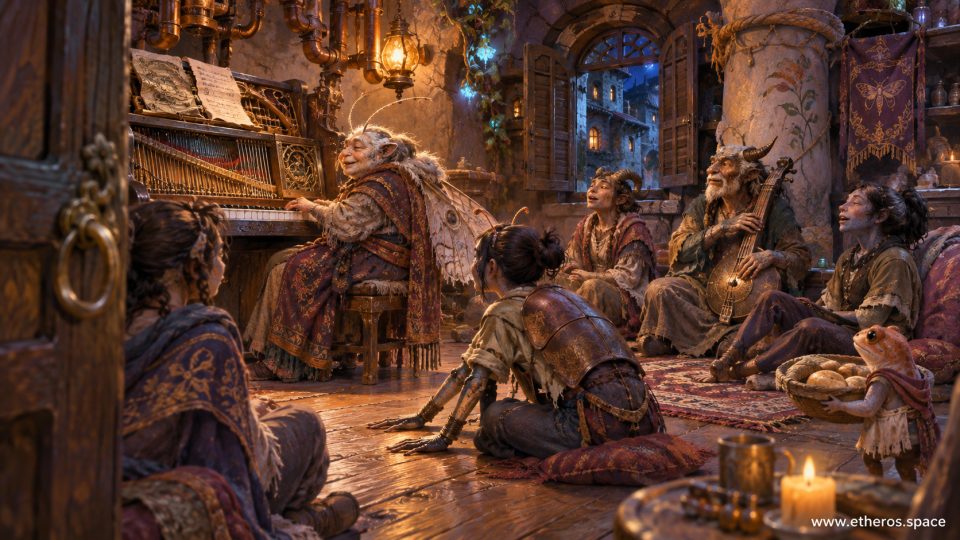
Avel Orin, whose pale wings had grown ragged at the edges with age, sat at the great keyboard beneath the hanging lamps. The instrument answered her fingers with a thousand small movements of wire, wood, brass, and air. The open casing revealed a bed of taut strings and a procession of slender hammers. Avel kept one hinge oiled with the same substance the local smith used to tend living copper conduits. No one knew which came first, the instrument's design or the ear of the person who had built it.
Beside the painted pillar, Roon Vessar held a long-necked string instrument against his chest. Two younger neighbors sang. Little Tebb appeared at the edge of the room with a basket of bread, as the baker downstairs had requested. And in the space of floor between the candles and the musicians, Neris knelt with her back to the half-open door.
Her arms were built for delicate manipulation and sensitive pressure. Their hard external plates transmitted small tremors with exceptional clarity. But many of the high tones her neighbors described so effortlessly registered only faintly in her own hearing. For years, music had been something people spoke about as though it lived entirely between two ears.
Then Avel had asked her to touch the boards.
The first time, Neris thought the building was breathing.
Tonight the melody passed from the keyboard's frame into its heavy stool, through the floor beams and outward under the cushions. The room did not resonate equally everywhere. A narrow strip of old wood near the entrance carried the low notes beautifully; beside the window the vibrations diminished almost to nothing. At noon Neris had drawn a chart of those differences in chalk. Roon had laughed at her method; Avel had wanted to keep the chart.
The ironmonger below had complained that morning. His apprentices rose before the first bell, and the late rehearsal sometimes shook dust loose from their ceiling. The singers said the music belonged to the neighborhood. He replied that his employees did, too. Avel could not accuse either side of selfishness.
She had considered laying thick felt beneath the entire floor. It would quiet the downstairs workshop. It would also swallow the tremors through which Neris could participate. The cheapest repair would have made one neighbor's experience invisible.
When Roon finished a passage, Avel stopped playing.
'Tell me what you heard,' she said.
'The lower strings,' answered a singer. 'The melody above them,' said another. Neris lifted her hands from the floor. 'I felt the part you stopped playing.'
Avel had stopped pressing the keys, but the strings continued to resonate. They waited in silence until even Neris's palms could no longer detect their fading movement. Then Roon plucked a single low string, and, across the room, Neris raised first two fingers and then three. The string was still moving.
An experiment began without anyone naming it one. Avel tried shorter phrases. Roon moved his instrument away from the load-bearing pillar, then leaned its wooden back against the stone again. A singer slid one of the cushions toward the doorway. Neris shifted her knees between the beams and drew a new line in chalk along the boards. The smallest change in contact made a different kind of music available to a different body.
They talked of a removable resonant platform, assembled from the old springwood stored beneath the ironmonger's bench. Its frame could make the music legible to Neris without transmitting so much sound through the rest of the structure. She could build the mounts herself; she knew how to join a flexible material to a rigid one without forcing either to break. The cost would be several evenings of work and a promise not to take unpaid time from the shop's apprentices.
There was no perfect arrangement. Some instruments needed air. Others depended on touch. Different bodies listened differently, and no single wall or law could make them equivalent. But the neighbors could alter the room without deciding whose experience mattered least.
By the time Tebb distributed the last pieces of bread, an agreement had begun to form. The louder practice would end before the second night bell. Later gatherings could use softer instruments and the new floating platform. The ironmonger would be invited to inspect the connections, and his apprentices would be welcome to sit upstairs when their work was done.
Avel promised to teach Neris the instrument's lower harmonics. Neris promised to show Avel how much the old floor already knew. Roon, who had laughed at the chalk marks, knelt to add the first careful measurement of his own.
Outside, blue night gathered between the roofs. Inside, the lamps warmed the plaster, the musicians settled themselves again and Tebb curled beside an empty bread basket. Nobody called the gathering a council, and no grand invention was unveiled. There was an old musician, a roomful of neighbors, a few imperfect instruments and a young apprentice whose experience had changed how the others understood listening.
When the melody began once more, Neris put both palms to the boards. The others watched the floor as well as the player. The building answered. And this time the answer belonged to more than one kind of ear.