The Bread Before the Questions
Story
THE BREAD BEFORE THE QUESTIONS
At the southern bread arcade of Ashalin, the loaves were counted twice: once before the ovens opened, and once when the market bells made it impossible for anyone to pretend they had not heard the hour. Between those reckonings came all the untidy business of being alive.
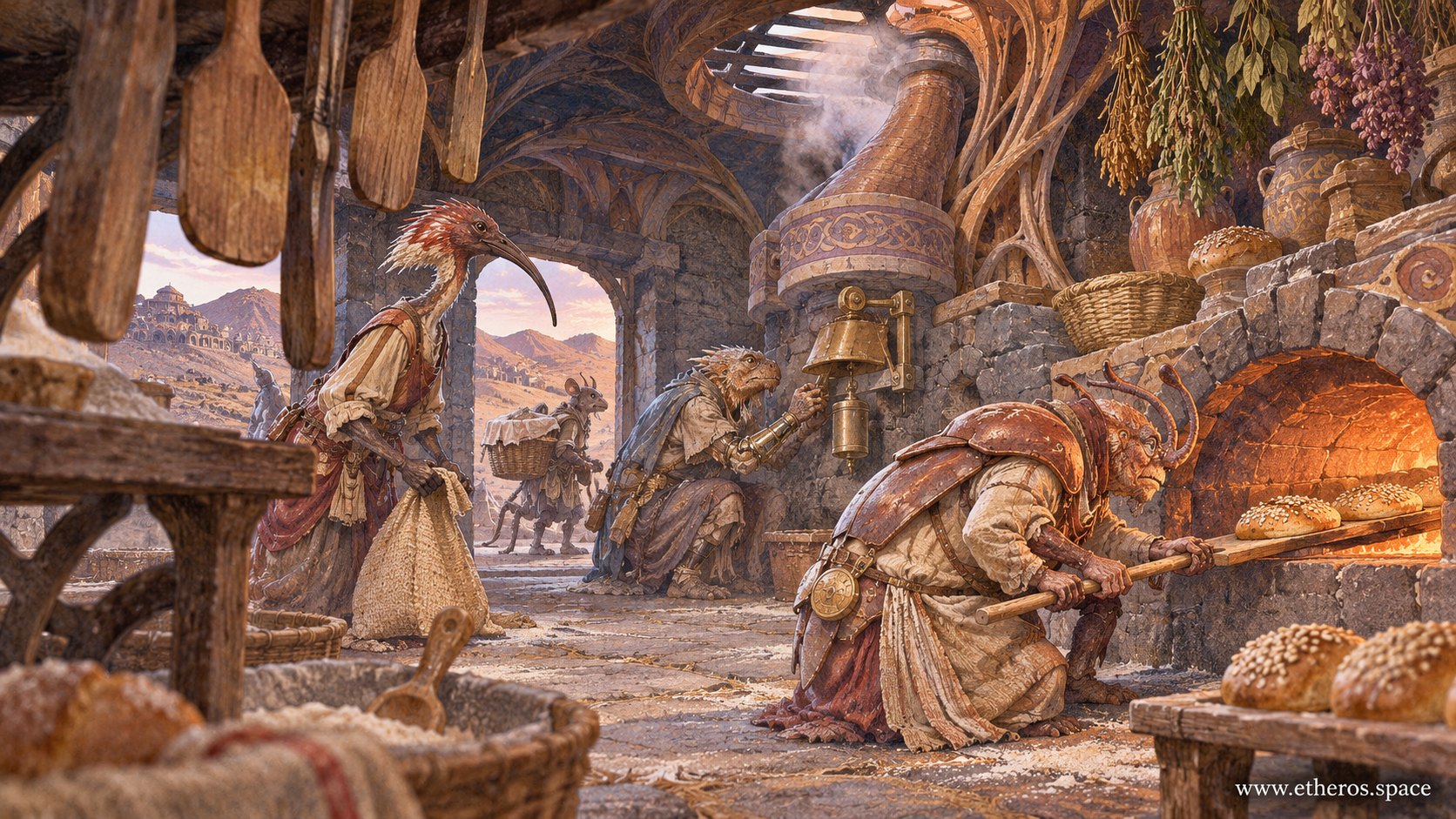
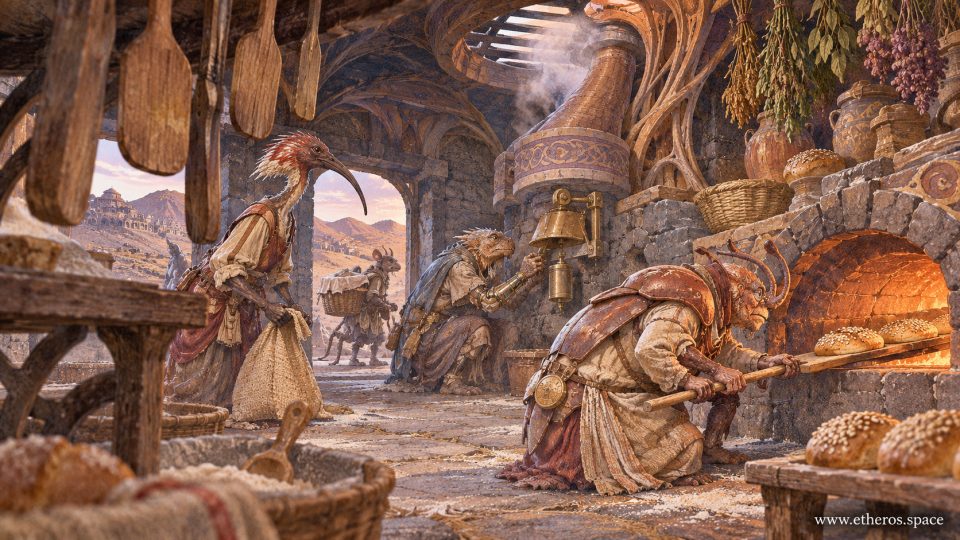
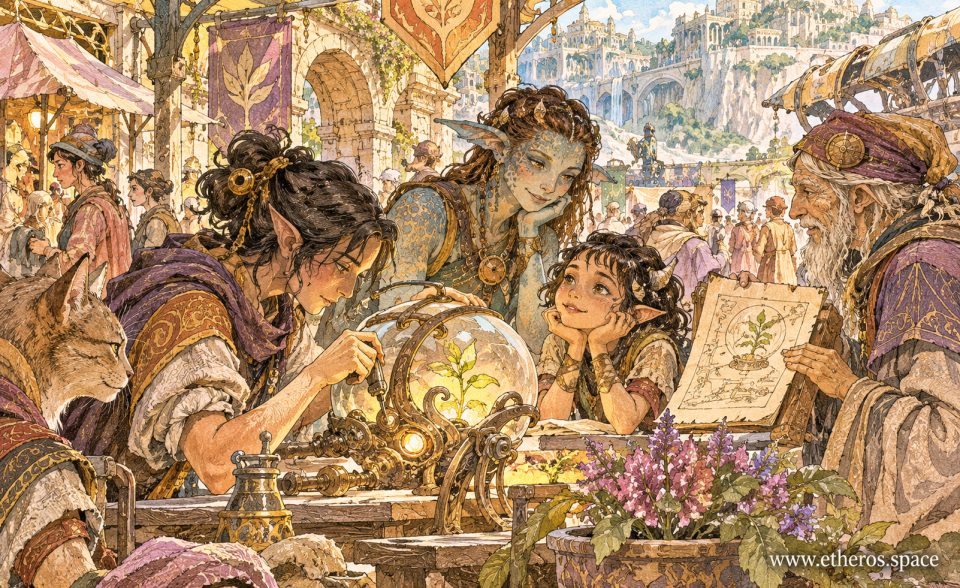
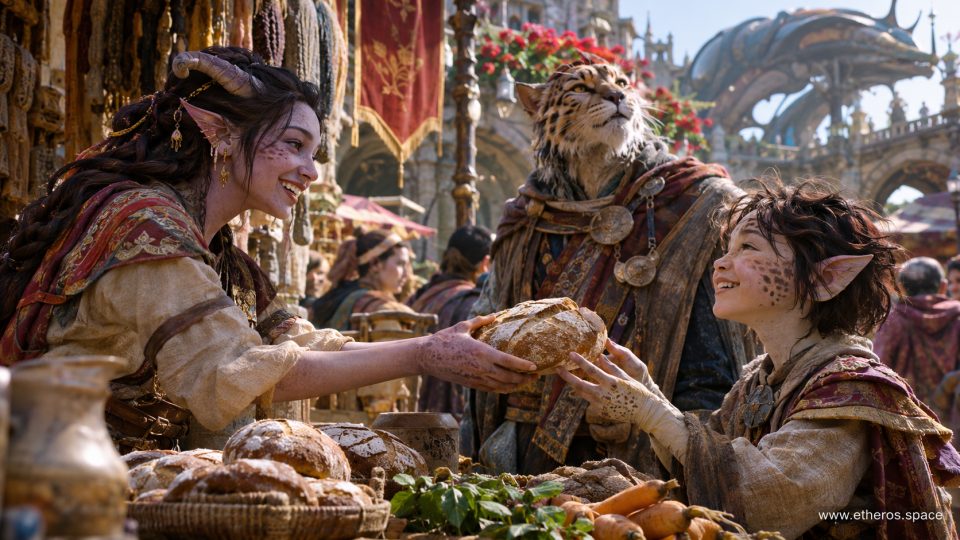
The awnings cast warm strips of shade across shelves of round crusts. Carrots, greens, and bundled roots lay beside the baskets, not because the baker sold them all, but because everyone on this street borrowed a few inches of counter when their own stalls grew crowded. The city's old stone arches held balconies full of pots and travelers. Far above them, a vast curved structure crossed the skyline like the spine of some sleeping animal. Its age, function, and ownership were matters for engineers, not for the children trying to get breakfast.
Marev had been turning bread since before sunrise. A shallow pair of horns followed the sweep of her braided hair; fine gold ornaments caught in the dark strands whenever she reached for another loaf. She wore a red and cream work wrap embroidered with patterns that the bakery guild insisted were ceremonial, though in practice its sleeves were chosen because they stayed well clear of the oven mouth.
The child on the far side of her counter was called Issel. He had an untidy fringe, pointed ears and a constellation of darker markings over his cheeks. He was smiling at the bread with the fierce concentration of someone who expected it to disappear if he blinked.
Behind him stood Tarek, a tall spotted feline traveler with a broad travel mantle and the patient stillness of a creature accustomed to carrying responsibility. He was looking over the crowd toward the upper passage, listening for a familiar signal in the market noise. He did not reach to take the loaf for Issel. That mattered more than either of them could yet explain.
They had arrived three mornings earlier from a dry eastern hamlet whose footbridge foundation had shifted after a season of ground tremors. Most of the houses still stood. Some remained safe. But the footpath to the communal learning room crossed the damaged support, and families with children had taken temporary rooms wherever the road would accept them. No one called it an exile; it was simply a journey with no certain return date.
At first the city registry had treated Issel as a visitor. Visitors could buy food, rent blankets, and ask for directions. The learning halls, however, kept their own rolls. A child without a fixed street had to wait while adults decided which hall should count him.
That morning Tarek had walked him to the entrance of the western lessons. They were turned away only long enough for a clerk to find a blank slate, but Issel carried the hesitation like a much heavier thing. He had grown quiet, then stopped speaking altogether. By the time they reached the bread arcade he had forgotten, or claimed to have forgotten, that he was hungry.
Marev understood the difference. She took the roundest loaf from the cooling shelf and placed it between his hands rather than in Tarek's. The crust was still warm. The child's fingers met hers around its edge; one thumb pressed a pale crescent into the flour. He laughed, startled that the bread was real and that no one had asked him for proof of an address.
'He has a meal token,' Tarek said, returning his attention from the passage. He had learned the habit of explaining first, before anybody could mistake his presence for a demand.
'I know,' Marev replied. 'The noon ledger is under the jars. He may use it after he has tasted the bread.'
It was not a gift from an inexhaustible store. The bakery joined a neighborhood fund in which travelers, shopkeepers, and permanent residents left small sums to cover ordinary meals for people moving between districts. Its shelves had limits; flour came by cart, fuel cost labor, and a day of bad trade could close an oven. Marev kept the account carefully because kindness that never examined its costs could become a promise someone else was forced to keep.
Issel tore off a corner and offered it upward to Tarek. The feline guardian's eyes softened, though he still watched the elevated arch beyond the market. Somewhere past it lay a room full of unfamiliar faces and lessons Issel was afraid he would not understand.
'At the learning hall,' Marev told the child, 'tell them how your village counts the wind turns. Their scholars love methods they haven't invented.'
'They have all the answers already,' Issel said around the bread.
'Perhaps. But they don't have yours.'
A carrier brushed past with a wooden crate; a vendor shifted a basket away from his path. Voices rose and fell. The city remained too busy to notice it had witnessed a private change. Issel had not yet found friends. His family's bridge had not been repaired. The registry still had to decide how to keep his lessons continuous if another move became necessary. No great machine bent down to solve these things. People would have to do them, one ledger, route and conversation at a time.
Later, when the market books were closed, Marev entered the meal token properly beneath the day's flour tally. Tarek returned to the learning hall with Issel, who had wrapped the unfinished half loaf in a clean cloth for a child he might meet there. The city did not suddenly become home because someone shared a breakfast. But it ceased, for a moment, to be a place where they were required to prove they deserved one.
And in the warm bread still pressed between two small hands, the difficult questions of belonging could wait just long enough for a child to begin answering them himself.