The Ring That Could Not Be Won Alone
ETHEROS_20261104T200153470901Z_100percent.png
Story
THE RING THAT COULD NOT BE WON ALONE
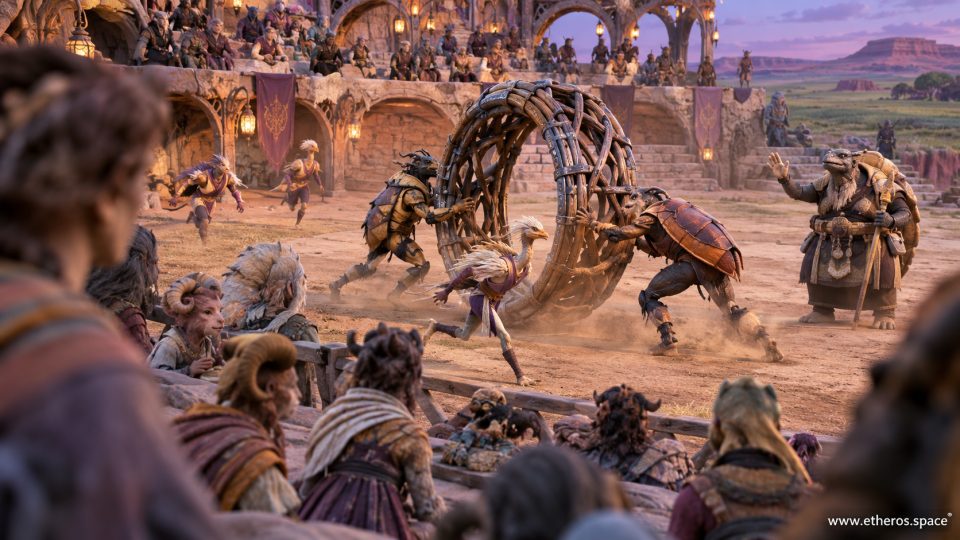
By the time the lanterns were lit in Kareth’s old bowl, the day's heat had finally begun to leave the stones. Dry grass beyond the amphitheater turned purple in the failing light. People were still taking their places beneath the open Gothic galleries: traders who had come late from the upland road, children whose feet could not quite reach the step below, armored players whose hands still bore the dust of ordinary work. A small ram-horned spectator leaned forward from a low bench and forgot the sweet root she was chewing.
The woven ring stood taller than the feather-crested runner Liri. Its wooden ribs were bound in curved metal plates, and its weight belonged to everyone assigned to move it. Two opposing ring-handlers, Sova in ocher armor and Branek beneath a darker shell, had each learned to shift their shoulders against a different part of that weight. The rules of the old turning game sounded simple when recited: keep the ring rolling between the marked gates while runners change sides without being caught beneath it. That explanation omitted years of bruises, arguments and small acts of trust.
At the third crossing the ring leaned too far. Liri was already moving, wings and feathers swept behind her, when Branek felt the upper binding drag against his palms. Sova saw his rival’s knees change angle before anyone in the stands understood what was happening. He could have pushed hard and made the score. Instead he took one step toward Branek, set his shoulder against the lattice and shared the load.
From the outer boundary Durok, the broad-backed elder serving as referee, raised his hand. The signal meant stop. It was not a judgment of who had won the point. Branek braced his feet, Sova steadied the wooden ribs, and Liri slid across the open lane before the structure could roll into her. The crowd’s roar broke apart into anxious voices. Behind the two handlers, other players ran in—not to celebrate, but to carry the temporary weight until the ring stood straight.
Durok knew the sound of a failed fastening. At his age he could not run the long lanes, but he could recognize a strain that had begun traveling through a joint. He walked to the ring and pointed to the place where the metal band had lifted from the wood. Someone in the crowd shouted that the point should count. Another shouted that a contest stopped for danger was no contest at all. Durok let both voices pass over him. He asked only whether the players could still feel their fingers.
The games had been shifted to twilight that season. Three afternoons had grown so hot that even the stone benches held their heat after sunset. The merchants disliked the change: evening sales competed with the last freight carts, and the hired lamplighters wanted payment for an extra hour. Parents argued that their youngest children might stay up too late. But the players could work their regular daytime shifts without risking collapse in the open bowl, and the older spectators could descend the steps without the white glare striking their eyes. Kareth had not solved its weather by changing a bell. It had only accepted that a cherished custom could not demand the same cost from every body.
When the loose band was examined, Sova proposed binding it again before the crowd dispersed. Branek proposed that the ring remain unused until morning. Neither trusted the other with the score, yet both remembered the strain in their arms. Liri, whose task was to pass between the rolling ribs, asked the question they had overlooked: who would inspect the inside of the ring after a repair, and how could a small runner escape if the next fastening failed? The two handlers looked through its open circle, imagining for the first time the view from her height.
Durok spoke of a copied set of path tiles said to have come from the school at Hadrin's Upper Steps. The children there had argued that a passage safe for one kind of body could trap another. Kareth's builders had not seen those children at work, and the story might already have traveled farther than its evidence. Still, the idea was useful. The ring would not return to play until the smallest and widest runners could demonstrate a clear route through it. A good custom was allowed to learn.
The crowd began to descend, though some stayed to watch the workers set the ring on supporting blocks. The small horned child in the front row asked her neighbor which team had won. He said he did not know. She looked down at the dusty arena where the two opponents now worked on the same fastening. Beyond the stone arches, the last light drained out of the dry country, and the lanterns held their modest circles against the dark. For one evening, the point remained unclaimed. The people of Kareth would remember the unfinished game much longer than an ordinary victory.