The Green Room Small Enough to Carry — Noon at the Lumecrest Seed Arcade
ETHEROS_20261104T201646492430Z_033percent.png
Story
THE GREEN ROOM SMALL ENOUGH TO CARRY — NOON AT THE LUMECREST SEED ARCADE
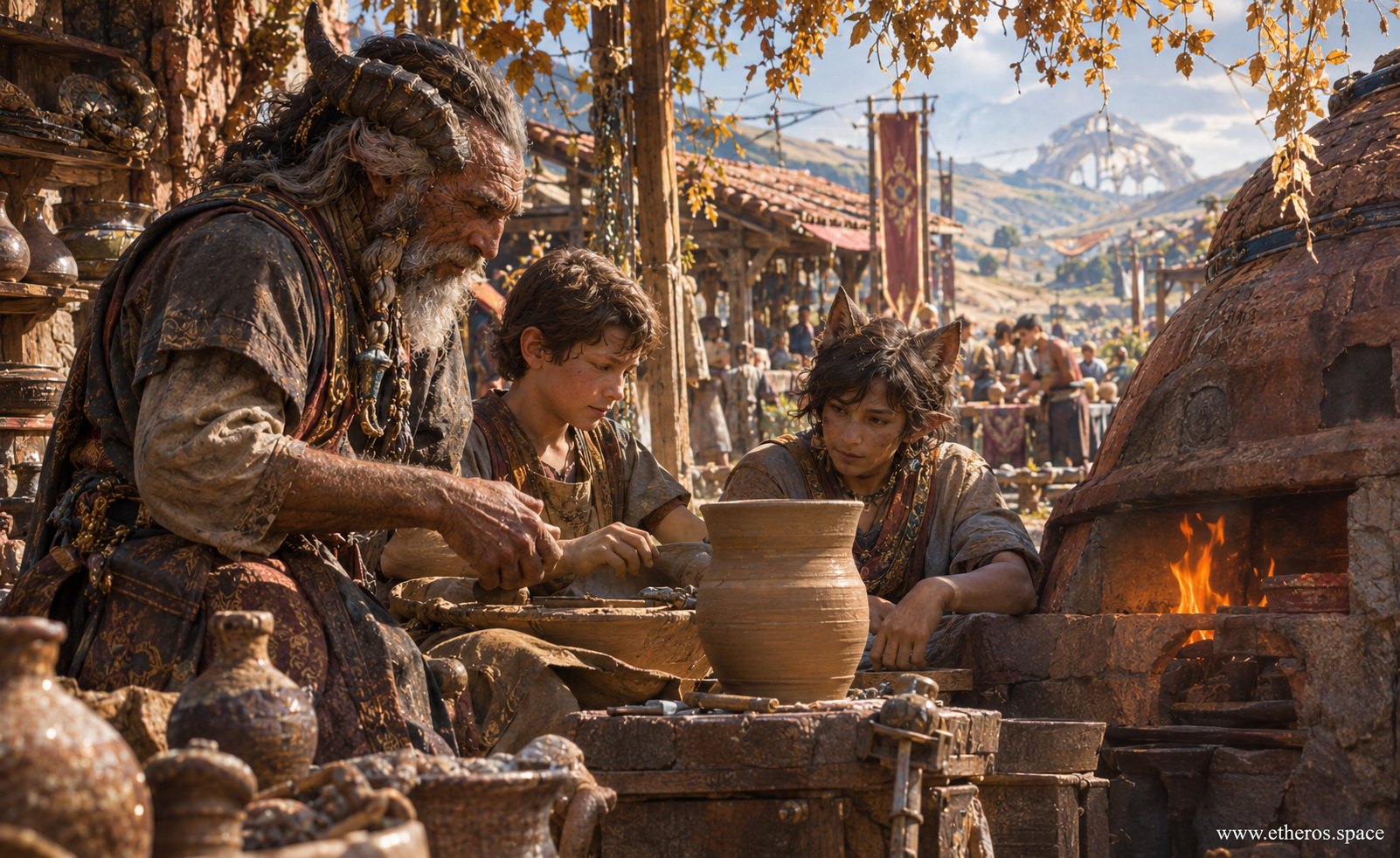
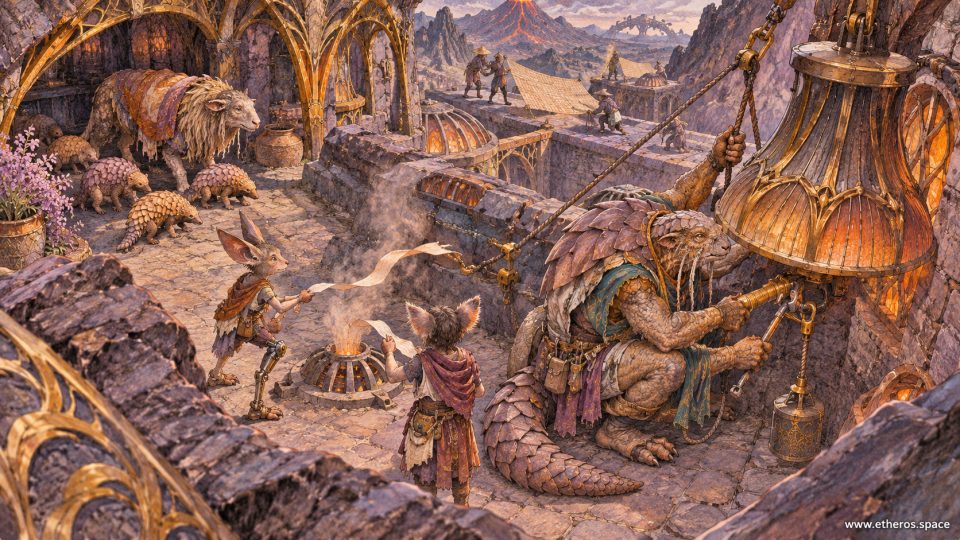
By noon the plant traders of Lumecrest had opened every colored awning they owned. Warm light entered the arcade between stone arches, and the crowds folded themselves around the stalls as they always did: parcels passing from hand to hand, carts slowing for children, little disagreements over prices made quiet by the promise of an afternoon meal. Beyond the far balconies, the white terraces climbed a hill too steep for ordinary roads.
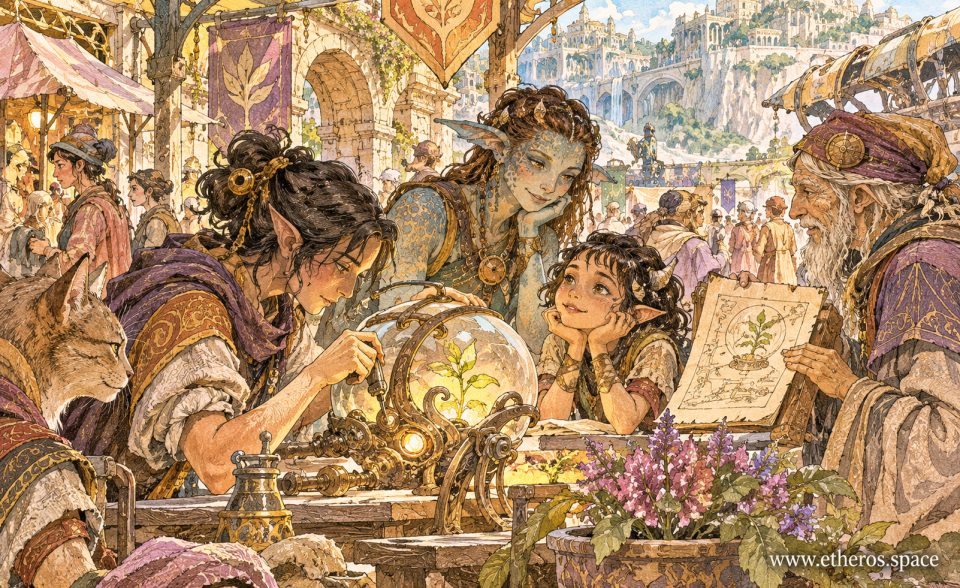
At the bench beneath the leaf banner, Tesha Mirren did not look up when the public bell sounded. She had a thin tool braced against the lower fitting of a transparent sphere, and a pale-green seedling stood inside it as though the entire world had shrunk to one protected patch of soil. Brass ribs curved around the glass. A warm lamp glowed beneath its root tray; a fine valve let the inner air change without exposing the leaves to the midday dust.
The valve was sticking again.
Tesha had opened the device twice before lunch, each time thinking the fault was at the hinge. It was not. The glass was sound, the ring was true, and the small plant had put out a new leaf. Something in the little machine was trying to do two things at once: keep the growing chamber warm and permit it to breathe. When she tightened the seal, the leaves clouded the glass. When she loosened it, the careful warmth escaped.
Delya, a blue-speckled courier in a green bodice, leaned over the bench and watched her work. Beside Delya sat Eri, her younger cousin, a short, bright-eyed child whose elbows had been resting under her chin for nearly an hour. At the far end, old Ornin held a drawing of the globe in both hands. His spectacles were somewhere under the papers, and he was pretending he did not need them. Fesh, a russet-faced feline neighbor, watched from the edge of the table, unhurried by the market noise.
“Why does it need a room?” Eri asked.
“Because this seedling grew far below the warmer terraces,” Ornin said, pointing to the drawing. “A little too much cold on its first night and its youngest leaves fold. A little too much trapped heat and the fine roots fail.”
“That is what the makers say,” Tesha replied. She did not mean to sound cross. “They built a chamber that keeps the right temperature only when someone remembers to open it. A market stall is not the best place to remember anything.”
Ornin smiled at that. He had designed the first brass supports for the chamber, and the accusation was fair.
Near the flower pots, a vendor came to ask when the next six globes would be ready. His cooperative needed them before the ridge season changed. He offered to pay half in advance, which would be enough to cover glass, rivets, fuel stones, and the wages Tesha had deferred for three weeks. His argument was practical: if the first batch failed, families on the higher terraces would lose their starting plants. Small agricultural experiments did not survive on generosity alone.
Tesha knew he was right about the costs. She also knew the lower households had been told to join the waiting list, where no one seemed to know whose turn came first.
Eri, listening, asked whether a plant could be kept alive without owning a glass globe.
“Sometimes,” Tesha said. “But then someone must share a place that already keeps warm.”
She lifted the tool and gently moved the valve a fraction. Delya held the rim still. For an instant the lamp reflected twice in the curved glass. The seedling's new leaf trembled as air moved through the narrow channel, then settled again.
“There,” Delya said.
“Not yet.” Tesha watched the damp on the inside of the dome. The film thinned instead of gathering. She touched the lower housing and found the heat steady. “Now.”
Ornin lowered his drawing to the table. He could see the change from the way the light passed through the glass. Eri could see it from Tesha's shoulders: the tightness there had finally eased.
Fesh nudged a stool nearer the bench. “If the ridge growers buy six chambers,” he said, “could one of them live here? A common growing shelf, perhaps. Families could take turns bringing their seedlings rather than buying a whole machine.”
The vendor frowned. A shared chamber would need a keeper, fuel, glass cleaning and a record of who had brought what. There would be arguments. It would be slower than private sale. He was not wrong about any of this.
“We can give it a trial,” Ornin said. “One chamber for the stall, paid for by the six. A different valve on the common one, so the keeper can open it without a special tool. We will record what fails as carefully as what grows.”
Tesha made a small note on the bottom of the drawing. She did not promise seven perfect machines or a future without disagreements. She promised a working prototype and a place where people could bring questions when it broke.
By the time the bell rang again, the globe was still breathing. Eri had been allowed to turn the easy brass handle once, and she was trying to explain its motion to a passing child in gestures because they did not share the same language.
Above the seedling, the leaf banner stirred in the arcade breeze. Across Lumecrest, hundreds of ordinary rooms continued holding hundreds of ordinary lives, each dependent upon work that another household might not be able to see. The little green chamber was not a cure for inequality and did not contain a miracle. It contained one living plant and a valve that had finally been made simple enough to share.
Tesha kept the tool on the table in case the hinge stuck again.