The Night the Observatory Learned to Let Go
20261104T185322739788Z_100percent.png
Story
THE NIGHT THE OBSERVATORY LEARNED TO LET GO
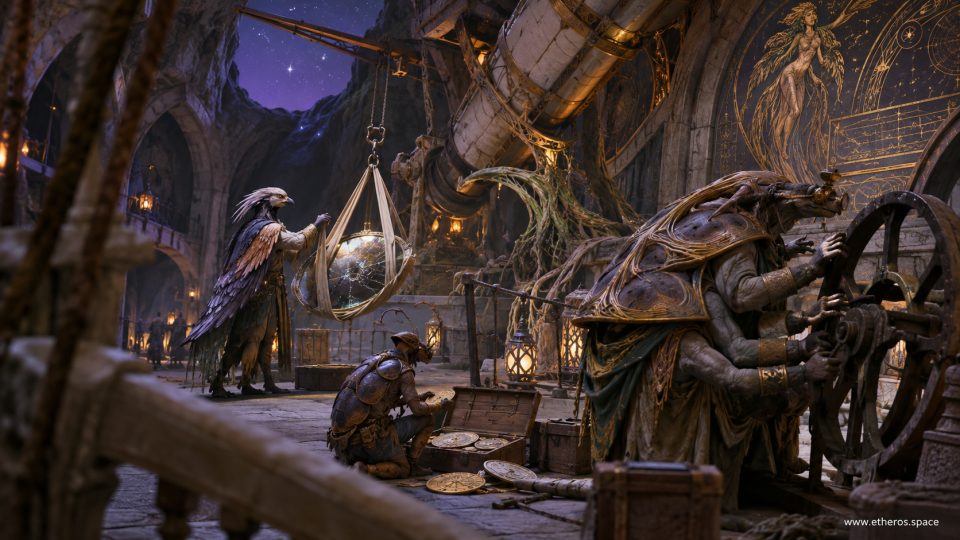
When the stars became visible through the cleft above Asterfold, three workers were still inside the old observatory. The night shift should have ended before the lamps were lit. Nothing in their schedule mentioned the problem that had kept them there: the great blue-silver viewing sphere, suspended in a web of pale straps, had developed a branching fracture through its lower surface.
Rhess stood to its left, her pale feather crest turned toward the dark sky. She kept one arm lifted near the lifting sling, as though a gesture could steady something that already weighed too much for one person's hands. A line of iridescent feathers ran from her shoulders down her cloak. The cloth did not hide the worn leather gripping her boots or the dust caught between the quills.
Across the chamber, Iltar turned the outer handwheel of the dome's old tracking assembly. His broad, layered carapace nearly touched the wall, and four of his smaller arms worked the rim and locking spokes while his weight remained planted on the stone. The wheel moved only a fraction before the tension in the canvas cradle changed. Its load passed through the hook above, through the chain, into the masonry arch, not into the delicate sphere itself.
Below them, Paku knelt by a wooden chest. He had unrolled the oldest brass discs from their padding and was arranging them on the floor in order of observation. The plates recorded where stars had been seen through the instrument when earlier generations took shifts in this same cavern. A sudden gust from the open throat of the roof lifted one corner of his coat. He pressed it down without looking up.
"If we lock the scope there," Rhess said, "the night will be over before we can read the low arc."
"If we don't lock it," answered Iltar, "the sling will take the whole weight when the cracked edge turns. And then we may lose more than one night."
Paku had heard them repeat the argument twice. He was young enough to believe that the oldest objects in a working place had always been there, and old enough to know that this belief made people careless. He found a disc engraved with three close-set marks, another with a scratched correction, and laid them beside the floor lamp.
The observatory's viewing sphere had served five generations. No one agreed about its first maker. Its outer skin held a hundred tiny distortions where polishing had been repaired over the years. To an inexperienced eye the star-speckled glass looked like a captured piece of night. To Rhess it was an imperfect lens that could still tell the truth if the observer understood the imperfections.
Iltar wanted to take it out before the crack widened. He had watched an apparently harmless flaw in a load-bearing strut become an injury that ended a friend's trade. The cracked sphere was not the same kind of structure, but the lesson had settled deeply in him: a long history of service could never excuse an unsafe present.
Rhess feared something different. Once the sphere was lowered into storage, the younger observers would inherit charts without the living experience of seeing how those charts had been made. The instrument was not merely a beautiful thing. It was a sequence of patient errors, corrections, disagreements, and discoveries held together in glass and careful hands.
Paku raised one of the discs.
"This mark," he said. "It is different in each of the three records."
Rhess crossed toward him. She recognized the small scored notch: an old measurement of a wandering light beyond the southern shoulder of the cavern. For decades the variation had been blamed on the sphere's uneven polish. Paku had arranged the plates by the dates on their rims, and the marks changed in a direction rather than randomly. None of them could know from those plates alone whether the distant light had moved or the instrument had shifted. It was evidence of a question, not an answer.
Iltar released the wheel. The great tube overhead held its angle. The lantern flames steadied.
"We will make one more reading with the secondary aperture," he said. "Then we lower the sphere."
"And the records?" asked Rhess.
"All of them. Even the wrong ones."
So they began a different kind of observation. The next measurements would be made through a smaller auxiliary opening while the cracked sphere remained isolated in its sling. The old plates would be copied, their differences preserved, and a new instrument would eventually be fitted to the load-bearing frame. Its drawings would include every correction they understood, and a blank space for the ones they did not.
Far above the cave, faint stars were appearing between the jagged lips of stone. The golden figure engraved on the right wall was only an ancient decoration, one of the many ways the town had imagined the sky. Nobody in the room took it for a visitor or a prophecy. There was work enough without inventing an omen.
Paku returned the oldest disc to the chest, but kept his copy of its three tiny marks. Rhess raised her eyes to the opening. Iltar held the wheel still.
They had not repaired the sphere, and they had not solved the mystery of the wandering light. But the observatory would open again tomorrow, and its youngest keeper now understood that a scientific instrument could finish its working life without its observations coming to an end.