The Stair That Learned to Be Gentle
20261105T233031816546Z_066percent.png
Story
THE STAIR THAT LEARNED TO BE GENTLE
The Afternoon in Orun Hollow's Old Lift Hall
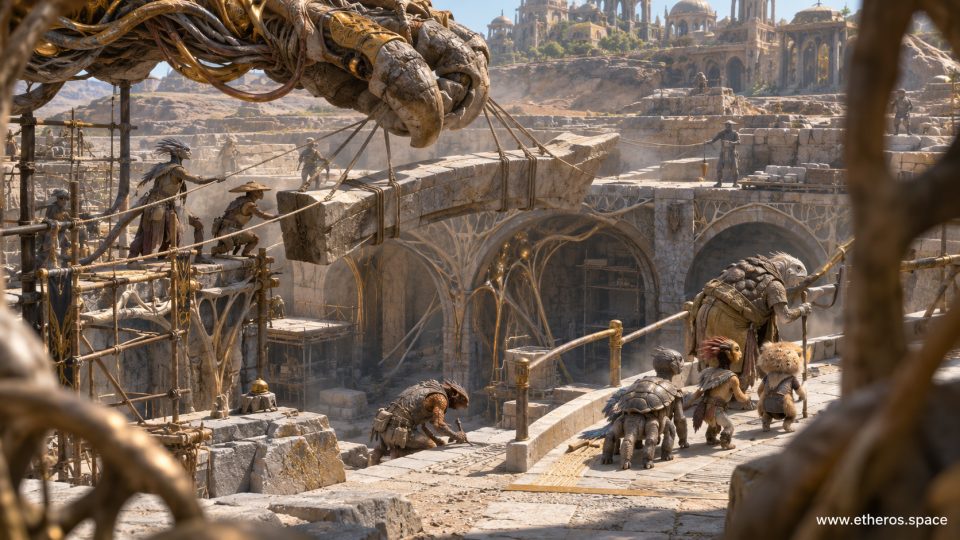
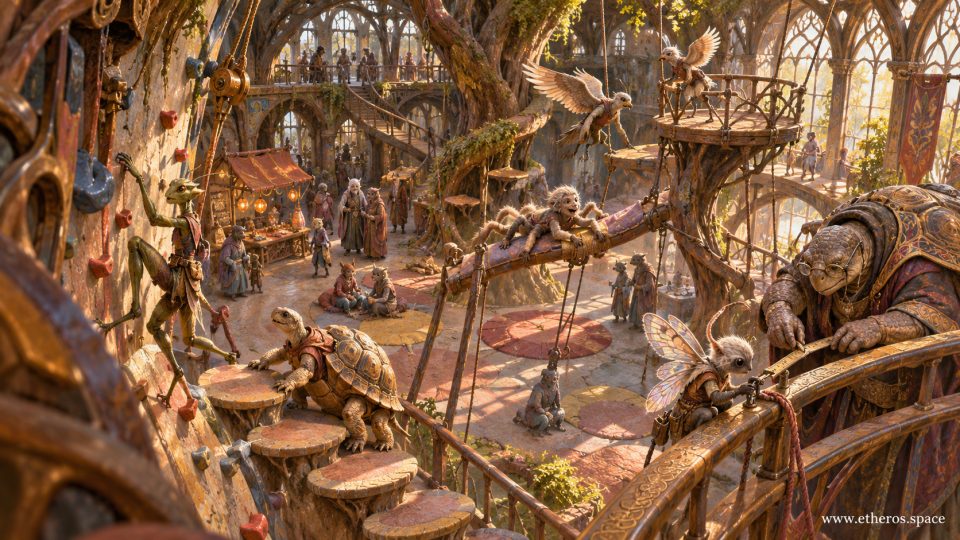
Once, the citizens of Orun Hollow had brought everything into this building by rope: grain sacks from the high farms, kiln bricks from the undercity, even enormous baskets of sleeping winged livestock. The lifting wheels still hung over the galleries, though the larger gears had long ago been uncoupled from the freight shafts. Trees had rooted through the masonry. Traders laid their cloths along the lower passages. And when the last loading crews moved away, a generation of children discovered the old structure's most astonishing feature: it had been built for bodies that were very different from one another.
The tall wall had iron holds for slender climbing limbs. A spiral of stone dishes rose gradually toward the mezzanine for the heavy shelled porters who could not use ladders. Across the open center a thick, wrapped timber had once steadied cargo; now it made a narrow bridge. Higher still, wooden perches stood at intervals between balconies, broad enough for a winged youngster to land but too widely spaced for most ground-dwellers to cross.
For years the children had played there without anyone officially permitting them to do so.
Then Rheven came to measure the railing.
He was an old shell-backed inspector, powerful through the shoulders and slow through the knees. Beneath the dense pattern of his carapace he wore the brass spectacles of his profession, and in his broad hands he held a narrow rule. Beside him perched Miri, a pale-winged junior maintainer whose small tools were arranged carefully along the worn guardrail.
Their work was not to close the place. The residents had voted to make the lift hall a public play court. Their work was to discover what that promise would actually cost.
On the left wall, Zeth, a slim green chitin-kin adolescent, was ascending red grips with such elegant patience that every contact seemed deliberate. Below, little Ulren had climbed the first three circular stone steps. His young shell was broad, and he needed all four feet to settle his balance between one dish and the next. In the middle of the hall, woolly Pavi sprawled across the suspended timber, several small limbs wrapped around it as friends shouted encouragement from the floor. Overhead, two pale avian siblings moved toward adjacent perches with their wings held open for balance.
There were no teams, no finishing bell, and no prize beyond reaching a place one had not reached yesterday.
Rheven ran his rule along a damaged rail bracket.
"The upper perches need a second anchor," he told Miri. "And the bridge must be shortened before another large crowd gathers underneath."
"They'll say we're taking the best part away," Miri replied.
"Then we must make a better part."
At first Ulren heard only the word shortened. His family had once carried loads up these same slow stone dishes. They were the one route he could attempt without being lifted by somebody else. If the inspector removed half the structure, Ulren feared the old hall would belong only to children born with wings or narrow gripping hands.
He descended a single dish and sat there, looking toward the floor.
Miri noticed. Rather than promise that everything would remain unchanged, she flew down to the lowest platform and asked him to show her which route he trusted. He placed his forefeet carefully. From the first dish he could reach the second, but the gap to the third forced his neck forward until his weight shifted uncomfortably past his front claws. He had been concealing that difficulty from his friends.
Rheven watched from the railing. In the geometry of the old freight hall he recognized a mistake made by builders who had designed the dish stair for fully grown porters, not children.
"That step isn't yours to conquer," he called. "It's ours to fix."
The market below remained busy while the inspectors worked. Voices rose beneath the arches. Somebody carried a bundle of rugs across the open floor. A family bought warm fruit cakes from a stall tucked against a root-grown column. Nothing heroic happened. Miri moved a fastening. Rheven checked the depth of a bracket and marked the safer handhold. They agreed to lower one platform, add a secondary rail, and leave the little alcove beneath the spiral open for children who wanted to watch before they joined.
A merchant asked who would pay for the new timber. An older resident complained that the hall's original carved rail was being covered with hardware. Both concerns mattered. Wood came from living groves that had to be replenished; skilled labor took time; the old ornament belonged to the community's memory. Rheven proposed removable fittings, a public account of materials, and a seasonal inspection made with the children present. No one would be required to pretend that play was free of cost.
By the afternoon's last warm light, no repair had been finished. Pavi still hung from the timber, Zeth still considered the next grip, and the avian siblings were descending toward their lower perch. Yet Ulren had climbed once more to the second dish. He had also learned how to point out the third step without shame.
Miri wrote his observation beside Rheven's measurements.
Outside, the inhabited roofs of Orun Hollow caught the sinking sun. Inside, the ancient lift hall still bore the scars of a century of labor, and now, gradually, a new kind of purpose.
It would take more than a vote to make the building belong to everybody. It would take timber, repair, disagreement, and the patient willingness to change a stair.
Rheven put away his rule. Ulren looked down at the little stone dish under his feet, and for the first time that afternoon did not ask whether he had climbed high enough.