The Wings That Had to Wait
Story
THE WINGS THAT HAD TO WAIT
The High Atelier of Serelyn, Etheros
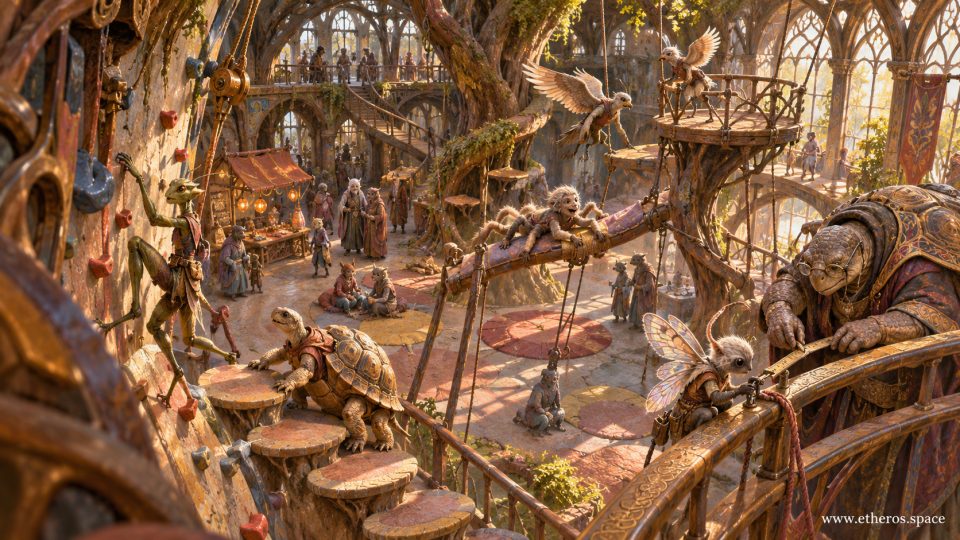
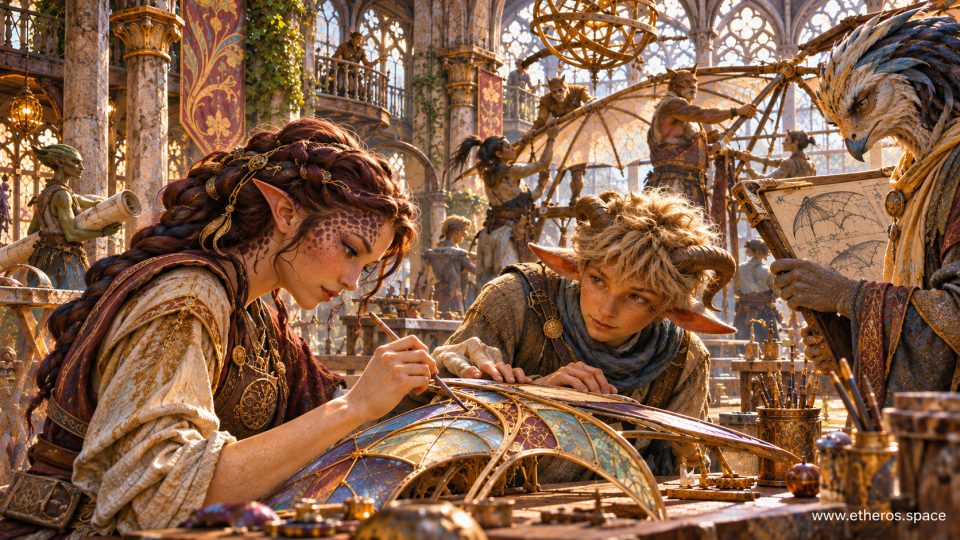
The great wing behind the workbenches had been raised three times that morning, and three times it had been lowered. Under the Gothic windows of Serelyn's makers' hall, carriers held its translucent skin taut over a lattice of rooted bronze. Across the upper galleries, the city went about its ordinary business. A green-skinned messenger waited with rolled instructions. Clerks leaned over the railing. Sun moved through the flower-patterned glass and climbed the carved pillars while no one announced that the new flying frame was ready.
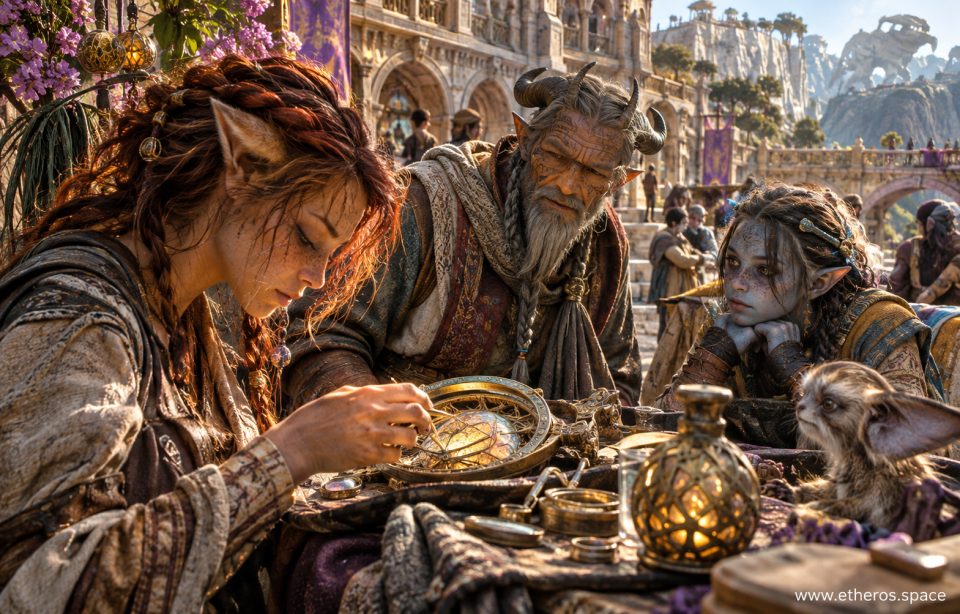
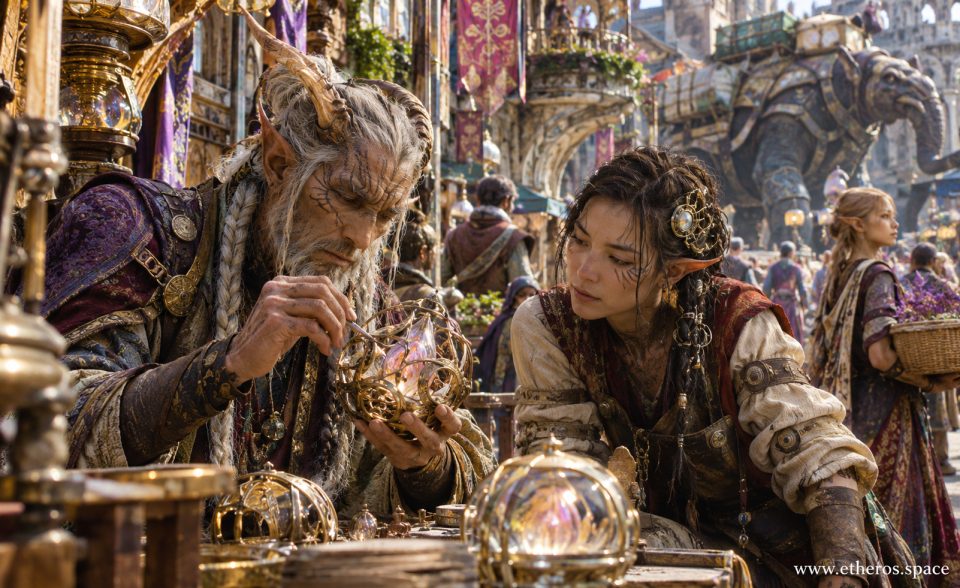
At the front bench, Mara Venn traced a narrow brush along a curved panel. Her dark hair was braided high to keep it from the tacky sealant; little spots crossed her forehead and pointed ears. From a distance, the inlaid surface resembled stained glass. Close to her hand, it was a marriage of fine translucent mineral leaves and flexible living filaments, each fastened to a rib that could bend without splintering. A dull violet line crossed the blue and amber plates. Mara stopped painting before her brush reached it.
Kell, the horned apprentice beside her, had been watching her wrist rather than the work. He was supposed to measure how far each rib moved when a cord was loaded. Instead, he asked the question everyone in the hall had been avoiding.
“Can it go across the pass tomorrow?”
On the other side of the room, two broad-backed workers eased the larger wing against a timber support. A rope tightened, a strut dipped, and the whole assembly made a long sound like a tree moving in a dry wind. Nothing broke. The workers looked up at one another, then waited for the next instruction.
Mara touched the violet line with the back of her fingernail. “The design can,” she said. “This particular wing has not yet told us.”
Kell thought that was an unnecessarily poetic answer for something that could be measured. A western settlement had been waiting for a faster route through the cliffs. For twelve seasons its households had paid carriers to move seed, tools and woven dressings along an uneven road. The new gliding frame promised to take modest cargo across the intervening gorge by using a predictable afternoon wind, returning with a guided line and no levitation at all. The guild had already accepted a deposit. A notice of the proposed demonstration had gone up at the market gate. Villagers were coming to watch.
At the edge of the bench stood Ishren, an older feather-crested drafter, studying a panel of wing sketches. He did not look up when Kell spoke. “The drawings show what should happen,” he said. “The workbench shows what did happen. We must not confuse them.”
Kell had been proud of his contribution to the design. On the smallest rib he had replaced a forged bronze spring with a grown tendon that was lighter and gentler under repeated bending. By his arithmetic, the substitution saved enough weight to carry a second seed crate. By his own careful observation, it had also pulled against the blue panel at an unfamiliar angle. The violet mark ran almost exactly where the stress would concentrate. To replace the tendon now would cost the guild another day; to cover the mark with more lacquer would be cheaper and might conceal the problem long enough for a demonstration.
Mara laid down the brush. “What did your last test show?”
“One bend held.”
“How many will it bear in a crossing?”
Kell did not answer. No one yet knew the number. In Serelyn the sky was not an empty promise; it was a force that lifted only what its moving air could support, and punished every imbalance in the ribs. A wing could be beautiful and still fold. A student could be brilliant and still be wrong. Those things did not make the student dishonest, unless someone asked him for the truth and he concealed it.
The large frame shifted again as the carriers took up its weight. Ishren lowered his drawing. He proposed a tethered load test in the abandoned quarry at first light, where an unmanned cradle could run along a guarded incline. Only after repeated bends, an inspected tendon anchorage and a measured glide would anyone carry goods over the gorge. The guild could use its deposit to pay the carriers and makers for another day's work, or return the coin to the settlement; there would be no unearned demonstration fee. The choice belonged to the people who had paid, once they understood the uncertainty.
Kell imagined the crowd at the gate and felt sick. His name had been spoken there as if he had already solved the valley's problem. Now he would have to tell them that his clever substitution might need to be undone. He expected Mara to take the brush from him and finish the panel herself.
Instead she slid the little measuring needle into his hand. “Mark the defect,” she said, “where every inspector can find it.”
“Even if the guild rejects my work?”
“Especially then.”
By late afternoon the great wing was still supported in the sunlit hall. Its vast ribs had neither flown nor failed. On the foreground table a smaller, iridescent panel lay open, its flaw circled rather than disguised. Kell recorded the angle, Mara prepared a second bond, and Ishren drew the extra brace he hoped would make the next experiment safer. Beyond them, other workers continued their labor, because a city could not live on promises and could not learn without trying.
The first visitors arrived early. They would have to be told the truth. The wing was not ready. But the young maker who once wished only to send it into the sky had begun to understand another kind of courage: leaving a beautiful thing on the ground until it could bear the weight entrusted to it.