The Gate That Waited for the Herd
Story
The Gate That Waited for the Herd
At the upper pass of Lyrn, the first sun came over the mountains before it reached the houses. The residents could see it on the distant ridges, a pale pink edge above the snow, while their own windows remained amber with lamps. On mornings like this, the cliff road belonged to the wintermantles.
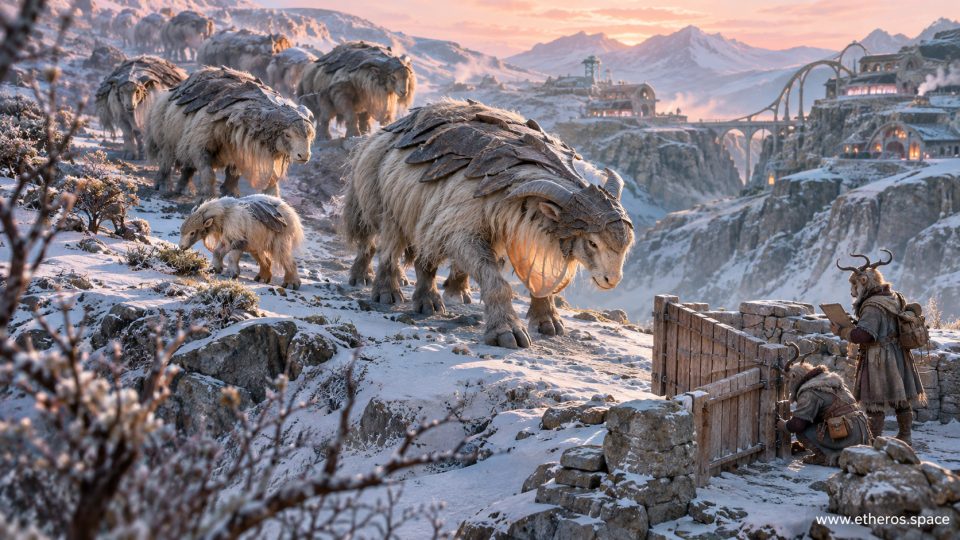
They arrived slowly, a long uneven procession from the high white slopes: enormous wool-bearing animals with broad, weathered plates along their backs and great soft folds beneath their throats. At the rear the older beasts descended in pairs, cautious of loose shale beneath the snow. Near the front, a young one stopped to investigate the exposed tips of a frost-burnt shrub. It nosed the brittle leaves as if there were something worth finding there.
The town had built its northern gate long before anyone alive remembered the first crossing. It was a practical wooden barrier, faced with flat stone and bolted against the wind. Behind it began the freight stair and the narrow paved road that connected Lyrn to the houses on the opposite rim. Before dawn, Yarna the gatekeeper stood beside the old stone pier with a tally slate in her hands. She was horned, thickly dressed, and had spent more cold mornings beside the crossing than she cared to count. Her younger colleague, Berek, crouched at the lower hinge, checking the pin with a gloved hand.
Neither keeper stood in the path of the herd. That much they had learned. The wintermantles were not aggressive, but a creature the size of a house could startle at the snap of a board. Better to let it choose its footing. The leading beast paused just uphill from the gate, one immense hoof pressed into powdery snow. Its throat folds caught the low sun like amber held against a fire. The keepers could see warmth beneath the pale membranes but could not agree whether their color was a warning, a greeting, or simply the season's light.
A decade earlier, the animals had passed below the freight road. Last winter they had come along the ridge. This year they followed the upper shoulder itself, where the road builders had set their new gate. The change might have been caused by weather, by a lost resting meadow, or by something no one had measured. The town had several confident explanations and very little evidence.
The freight committee wanted to strengthen the gate. Its members had good reasons. A loaded cart could not stop on the icy stair; the oil and food carried from the lowland farms were too necessary to leave unprotected. The herders feared the opposite mistake: that a reinforced barrier would close the last gentle slope available to the heavy mothers and their young. The town could spare neither its supplies nor the animals that had made these mountains fertile with their passage for generations.
Yarna opened her slate. Beside the morning's deliveries she had made a second column, marking each animal that crossed the exposed ridge. She counted the large ones first, then the calves, then the long gaps when nothing moved. Berek loosened the retaining chain rather than swinging the gate across the animals' path. A loosened chain would let the panel fold back against its stone pier; it would not let the wind tear the hinge free.
The young wintermantle pulled at its shrub again. From higher up the slope its mother turned, waited, and took another slow step. There was nothing theatrical in the movement. The huge beast simply refused to leave the smaller one behind. One by one the others made room for them, their hooves packing the snow into a path the village children would later be tempted to follow.
Berek wondered whether the freight road should be shifted several paces uphill. Yarna showed him the cliff: there was no secure foundation there, and the slope carried a ribbon of old living rootwork that warmed the houses beyond the bridge. Cut those roots and the road would gain width at the expense of the dwellings. A stone bridge could be moved by labor. A mountain's obligations could not be moved so easily.
They agreed on a trial instead. The gate would remain folded at the two dawn crossings when the wintermantles were most often seen. Freight would be staged farther down the stair before the first light, with a keeper stationed at both ends so no wagon was committed to the narrow passage during a crossing. Yarna would record the delays, Berek the wear on the pin and the pressure marks where heavy feet touched the ridge. The drivers would be asked for their own measurements rather than told that the problem had been solved.
It was a small arrangement, not a law. If the herd shifted again, or a sick calf remained on the road after sunrise, the trial would have to change. If supplies failed to arrive, the families waiting across the ravine would have a claim as real as the animals' need to pass. Nobody could promise the winter would be gentle.
But on that morning the hinge held. The first great beast moved forward, a gray mountain given wool and breath. The calf followed its mother, shaking frost from its jaw. Behind them came the rest of the procession, ungainly, patient, and strangely quiet, until their footprints made a dark line across the white slope.
Yarna wrote down the hour without calling it a victory. Berek stayed by the gate, holding the loosened chain clear. In the eastern houses the first chimneys had begun to smoke. A delivery wagon waited unseen below the turn, and its driver, for once, knew why.
The town had not made the mountain its own. It had merely learned to leave a little room while something older was passing through.