The Lantern That Asked Who Owned the Road
Story
THE LANTERN THAT ASKED WHO OWNED THE ROAD
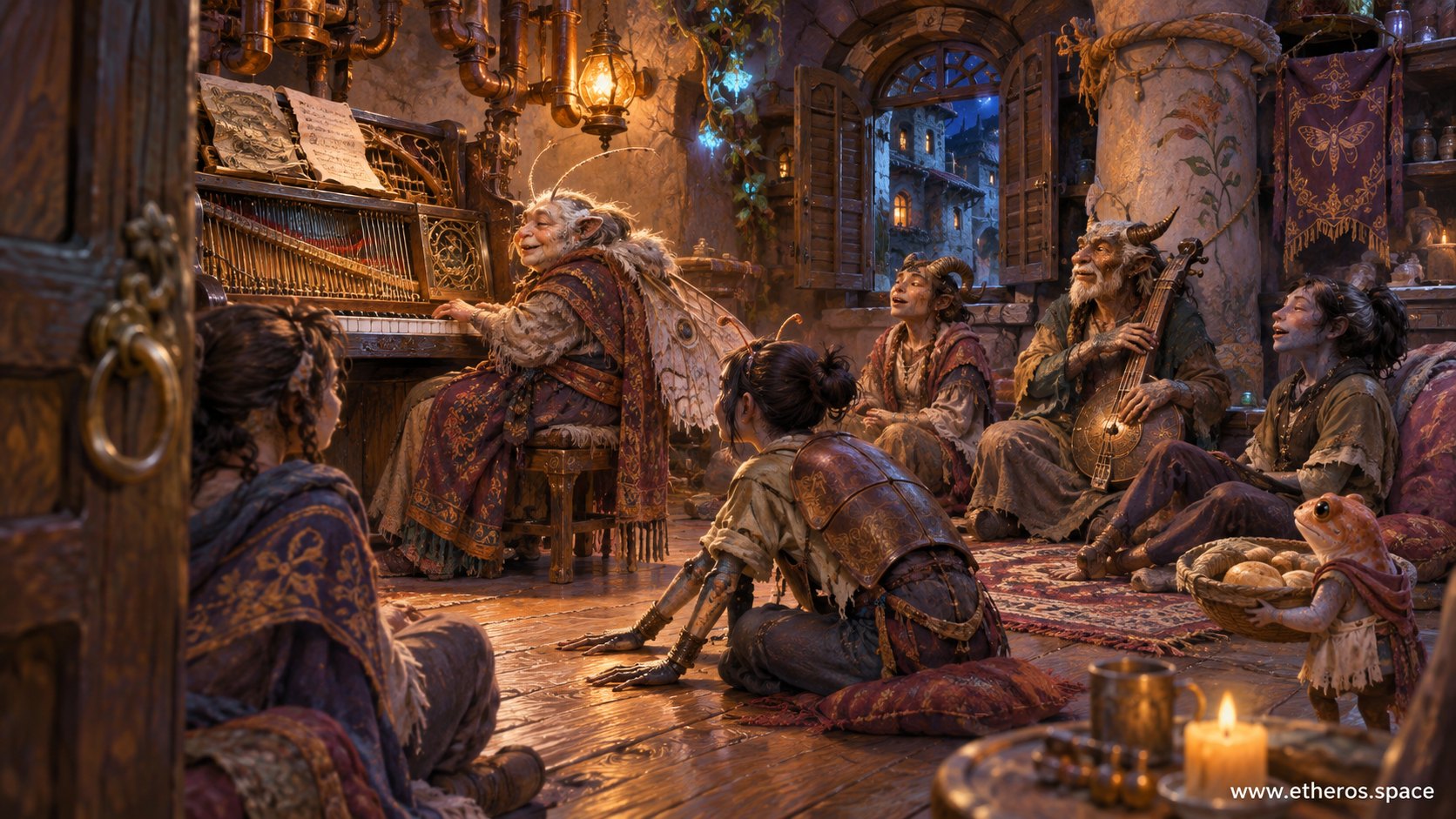
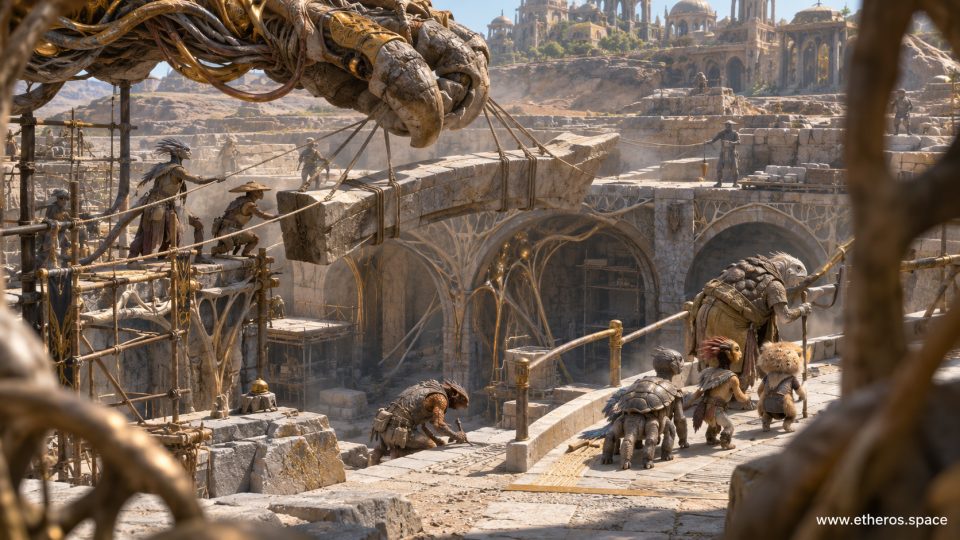
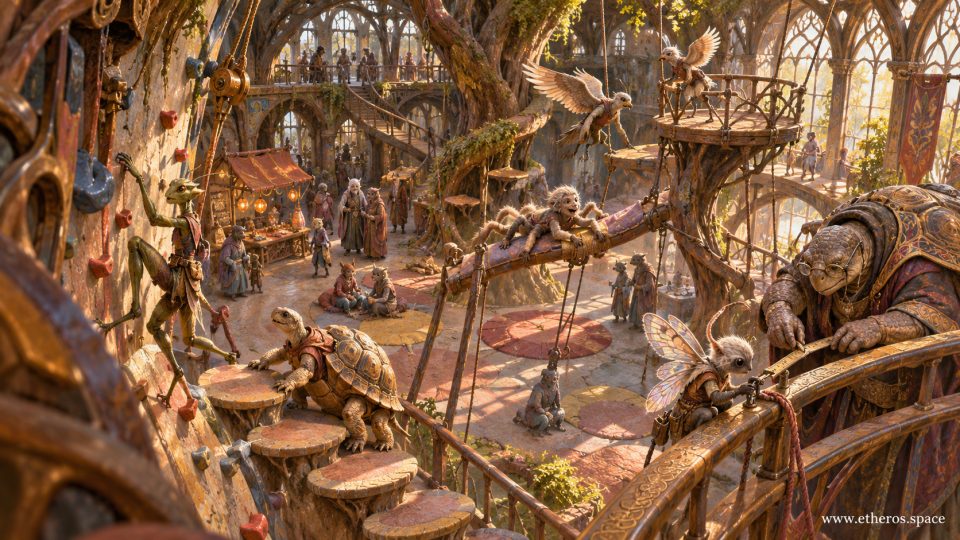
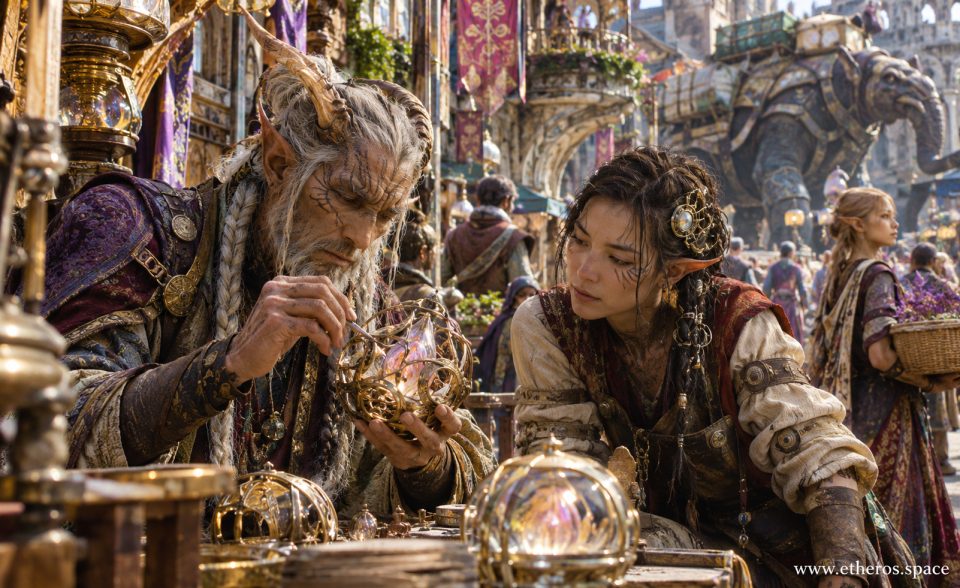
In Sarvareth's Lower Exchange, the delivery animals were large enough to cast their own weather. They came through the high stone arches with loads strapped above their armored backs, trailed by porters, children, merchants, and people who had no reason to hurry. Every arrival disturbed the light: first a tremor of shadows under the banners, then a bright sweep of sun across the market stalls as the great bodies passed.
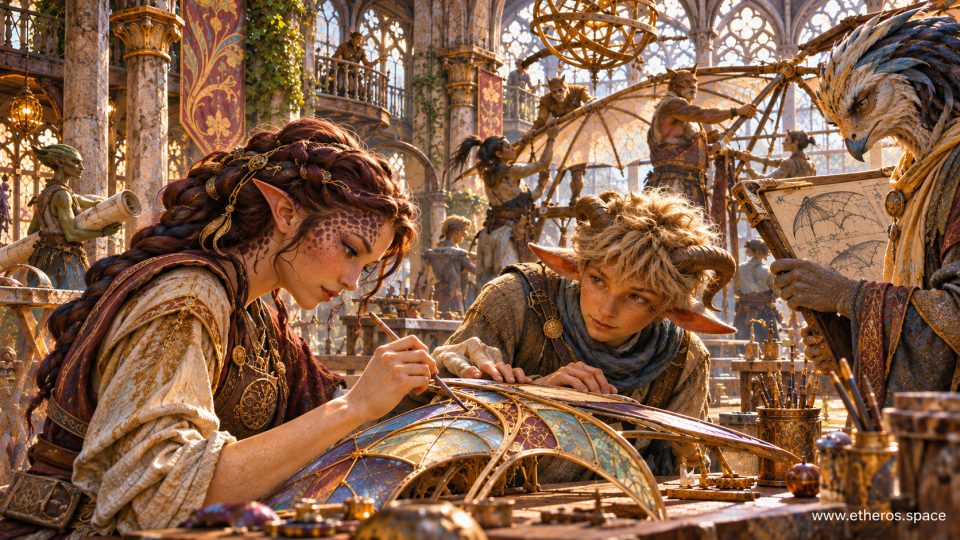
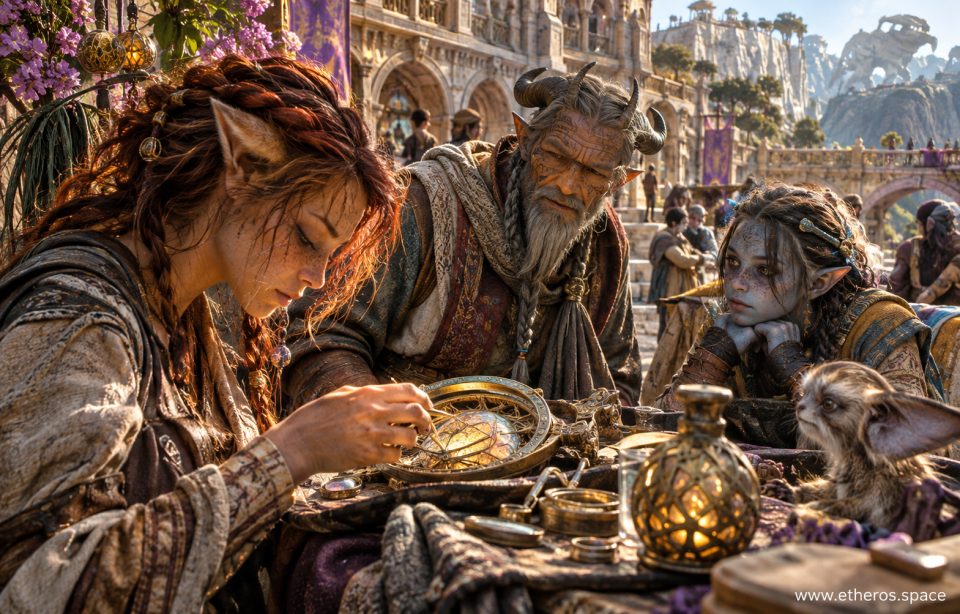
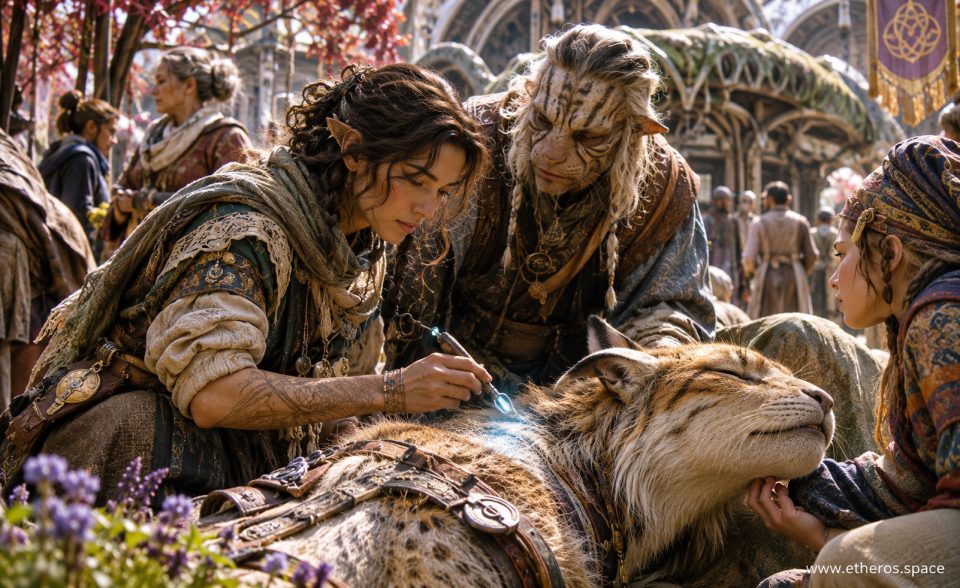
Aurem had been repairing route-lanterns here for forty seasons. His heavy ivory horns caught in the hanging tassels if he stood too quickly; his silver braids were held together by rings from instruments long past mending. He wore an indigo mantle sewn with dull bronze, more valuable for its innumerable patched pockets than for the ornament. He held a little sphere of gold ribs and glass in both hands, supporting its weight while drawing one thin metal probe through the lattice.
Inside the sphere, a rose-colored living crystal brightened and faded. Across the workbench lay three older lanterns, one dull, one cracked, one still warm. The market called this new one a *road-witness*. Its glass could register the rhythmic pressure of a heavy transport beast's stride when a route marker was brought close to its harness. That measure had a simple purpose: to warn a driver when a laden creature was compensating for a sore limb or when an uneven road had begun to damage its joints.
The young craftswoman Seli leaned over the table, dark hair falling beside a tiny bronze ear-disc. She could see what the old master could not: the crystal was remembering more than pressure. Each reading carried traces of the particular harness, the time of passage, the distinctive rhythm of the driver walking beside the beast. Given enough evenings, a merchant could learn who delivered whose goods, when a household was empty, and which guild preferred the poorer road to avoid a fee.
"It knows too much," she said.
Aurem adjusted the probe. "It knows what we taught it to notice. That is not the same thing."
Behind them, a great cargo-backed traveler moved through the crowd. Its thick curved trunk swept low beside a basket carrier, and the brass housings of its harness were scratched by years of work. It carried timber boxes into the northern avenue. Nobody at the bench could tell from this distance whether it was tired; that uncertainty had been the reason for building the lantern.
The council had offered to purchase every road-witness in the market. Its roadkeepers wanted to compare measurements across all the city gates, replacing broken stones before a transport beast stumbled. The merchant houses welcomed safer passages but objected to handing over their routes. The animal tenders feared that an official instrument might eventually be used to force tired creatures to work another shift, so long as its needle stayed below an arbitrary line.
Seli placed one finger on the lowest rib of the sphere. "Keep the warning," she said. "Let the lane remember the crack in its paving. But why must it remember the name of the creature that found it?"
Aurem had once believed that more precise knowledge always made better decisions. Years of market repairs had softened that certainty. A sharp reading could prevent injury. The very same reading, sold to the highest bidder, could also reveal the hours of a poor family whose living depended on a single cart. Neither possibility was imaginary. Neither erased the other.
From the Upper Loomhouse, master pattern-maker Avrel had sent a short request that morning. Her workshop wanted meters that could help multi-limbed workers avoid strain, but only if the measurements remained in the hands of those whose bodies they described. She had not seen this particular sphere. The message nevertheless sat folded under Aurem's tool tray, beside a small strip of cloth identifying the delivery route.
Seli proposed two memories instead of one. The glass could retain anonymous road pressure long enough for repair crews to find dangerous places. The harness keeper would hold a separate, short-lived record of the creature's health, readable by its tenders and extinguished after the necessary rest. The merchant's identity would never enter the public lantern. It was not a perfect design; someone might still infer a route from the hour or place of a rare passage. That risk belonged in the trial record too.
Aurem listened, then steadied the glowing core while Seli moved a slender inner ring. The sphere brightened. It did not answer them. It could not certify that its own workings were wise, or that a future council would honor their division. Only the rules of use, and the people willing to question those rules, could do that.
Outside, the bell for the western loading gate sounded once. A basket carrier stopped to let the enormous beast pass. The crowd folded around it without instruction. Seli watched the turn of its feet and wondered how often the city had been saved from an accident by someone stepping aside, someone resting a tired animal, someone simply paying attention before a number appeared.
They agreed to demonstrate the lantern to the roadkeepers with an empty harness and a weighted testing frame, not by following an unsuspecting traveler. They would invite a tender, a merchant, and a porter to see the records before any sale. For the first time in many years, Aurem left the shop's ledger open at the page headed *Questions Still Unanswered*.
The market grew loud again. Over the brass and glass on the table, a little gold light kept moving, never quite holding the same shape twice. The master could not tell whether they had made the road safer. He could only tell that, for one afternoon, they had refused to confuse the ability to measure with the right to possess what was measured.