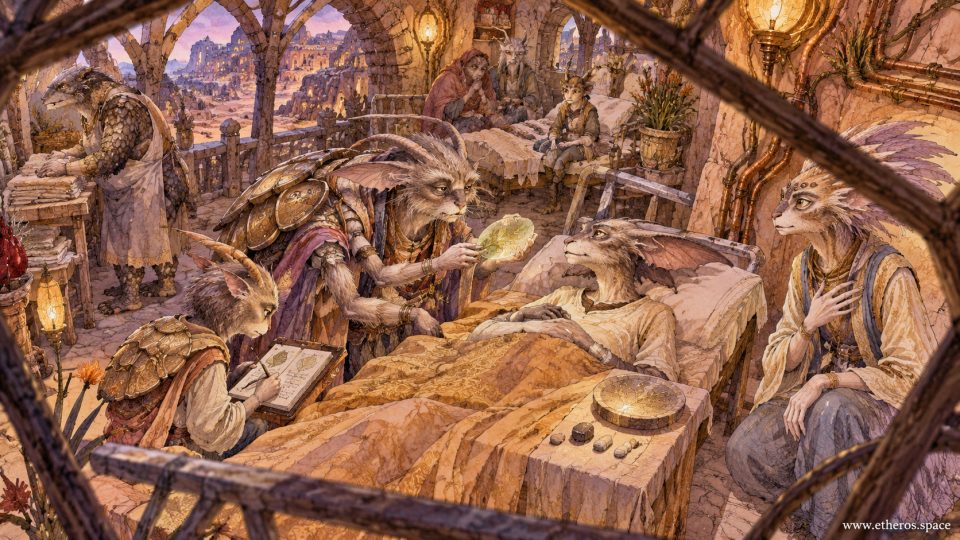
The Sky Refused to Hold Still
Story
THE SKY REFUSED TO HOLD STILL
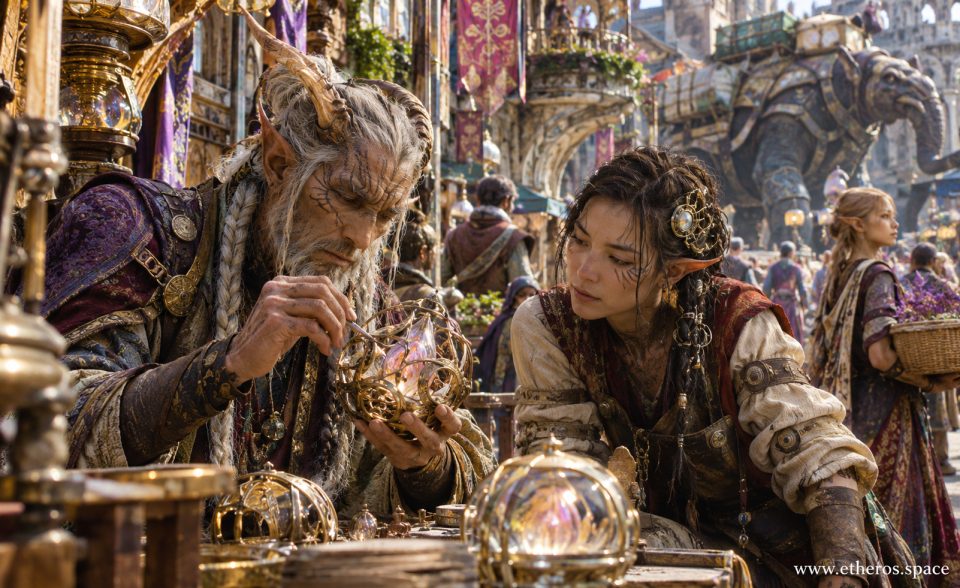
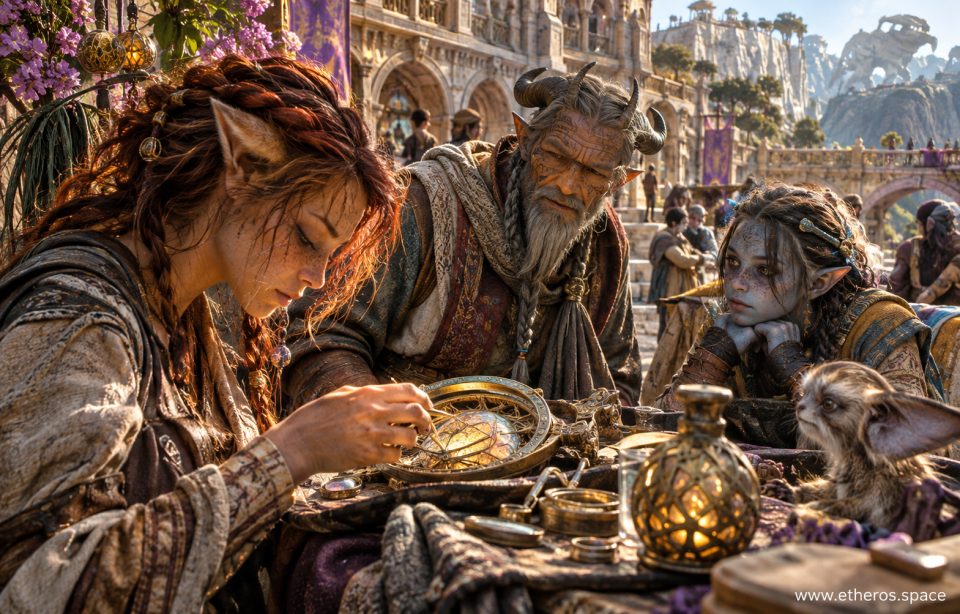
By the time the afternoon crowd reached the upper plaza of Velara, the sky-wheel had already been taken apart twice. Its brass rings lay in a nested circle on the worktable, their little glass windows catching sunlight from the archways. A pale living crystal glowed between the rings. Around it sat a miscellany of things that did not glow: a scratched measuring pin, two plain lenses, a folded strip of cloth and a shallow cup for catching screws.
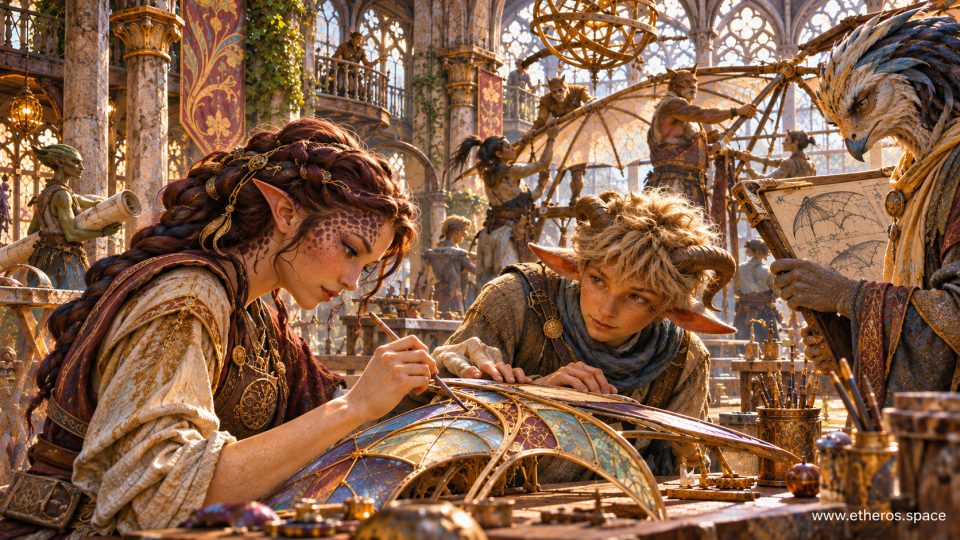
Liral had the finest hands in her mother's old shop, but the sky-wheel was testing her patience. She was young enough that her copper-red hair still escaped its work braid whenever she leaned too near the light. Her ears angled forward. She held a thin adjustment needle against the innermost rim, paused, and withdrew it without turning the screw.
“You're afraid of the wrong thing,” said Eram.
The elder had come from the hillside observatories carrying a notebook with corners softened by fifty years of handling. His horns were worn pale at their tips, his grey beard was tied into an uneven braid, and the marks on his brow were older than most of the buildings around the square. He did not reach for the instrument. That was his first rule as a teacher: if someone else was learning a difficult movement, the teacher must not borrow the student's hands.
“I'm afraid of breaking it,” Liral said.
“Then you've named the thing you can see. What is the thing you cannot?”
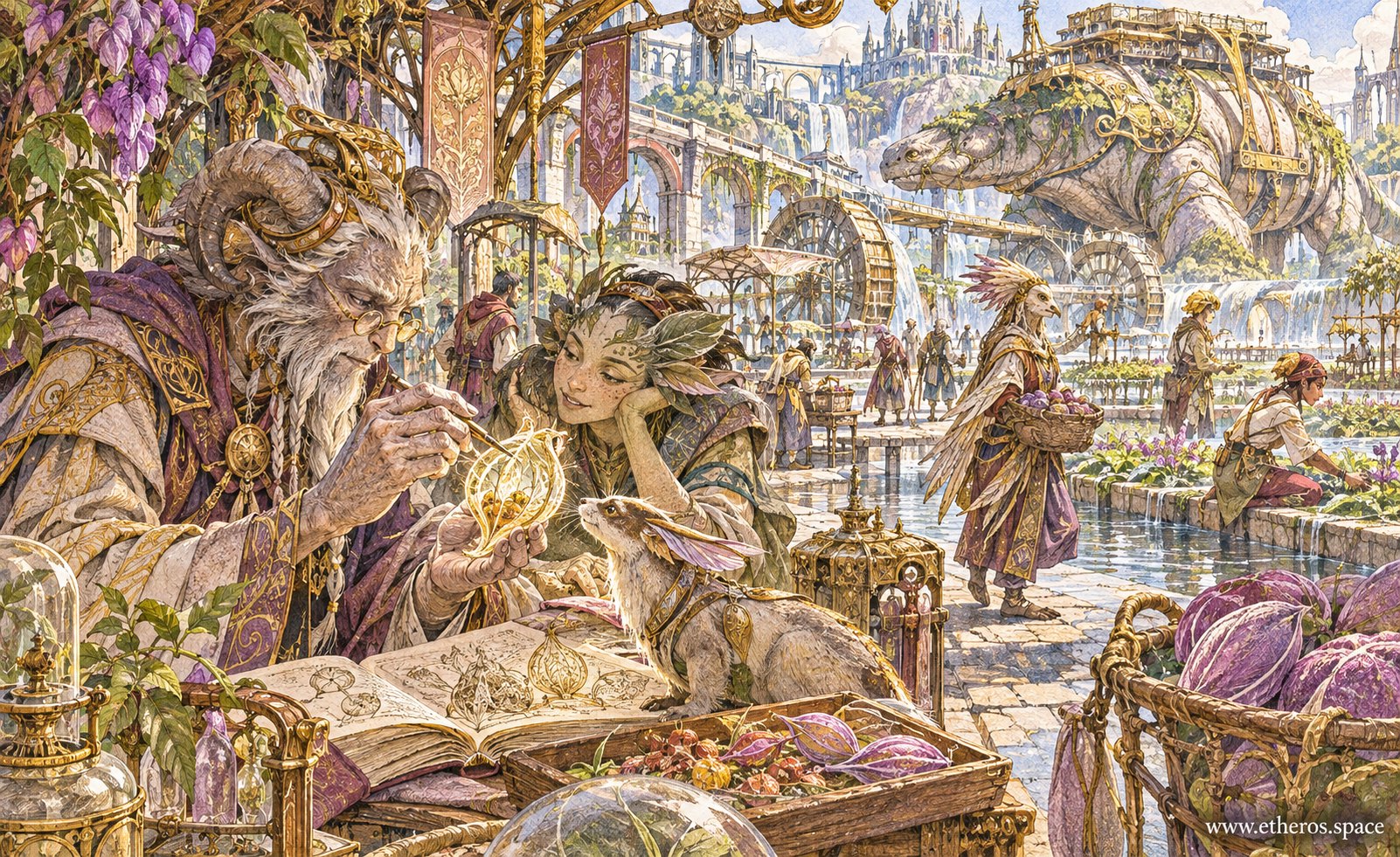
Across the table, Nivra rested her chin on her folded hands. Her blue-grey cheeks were scattered with pale freckles, and a little metal star was woven into her dark hair. She had never been to the upper observatory. She had persuaded her family to let her visit the public workshop because the city was preparing for a long, unusually bright evening sky. Beneath her elbow, the small furred creature Tiku watched the swinging needle with tremendous seriousness, as though it might prove edible.
“The thing we cannot see,” Nivra said, “is whether the wheel is lying.”
Eram smiled, but did not agree. The wheel was not a person. It could not choose to deceive. Its glass could expand in warmth, the inner hoop could slip on its bearing, and two observers could mistake one set of markings for another. A bad measurement was not a wicked measurement. Even a beautiful instrument needed to be questioned.
Velara had purchased the sky-wheel to help novices locate the same faint wandering points that the older pathfinders knew by memory. Its rings could be fixed against a known horizon, and the warm crystal made the fine divisions visible after sunset. With enough nights of observations, the workshop hoped to build public tables for travelers who could not afford a private guide. Those who lived by the old profession worried that the tables would offer confidence without judgment. Families whose children worked the long roads argued that guidance should not remain the property of a few wealthy houses.
Liral heard both arguments whenever she crossed the square. Her father had navigated by stars and old stories. He had been wrong twice, and had come home both times. She remembered the wrong turns more vividly than the safe journeys, perhaps because they had brought him back angry enough to speak honestly.
She turned the needle by less than the width of a hair. The crystal brightened. The outermost ring moved freely, but the inner ring hesitated at one point.
“There,” she said.
Eram crouched nearer. For a moment neither spoke. Behind them, carts rattled under the arches and people climbed the stone stairs with fruit, cloth and small animals. Purple flowers hung from a branch above the workstation. Out on the far ridge an immense armored silhouette leaned above the cliff, too distant to tell what task it was performing. The city kept going while three people stared at a barely perceptible flaw.
Nivra leaned closer. “Can I record that the wheel has been repaired?”
“Record that it turns,” Liral said. “We have not yet shown that it measures.”
The elder nodded. He unfolded his notebook and placed a clean page beside the cup. There were three ways to proceed. They could declare the device ready and hold the public demonstration promised for dusk. They could close the workshop and retest for a season, disappointing the travelers who had contributed to its cost. Or they could open it as an experiment, show their reference marks, invite independent observers, and keep uncertainty written beside every result.
Eram favored the last course, though not without fear. Some visitors would take any number carved on a public tablet as unquestionable truth. Others would see an admitted error and decide that all measurement was foolish. A truthful display required patience not only from its makers but from its audience.
“What if they laugh at us?” Nivra asked.
“Then they will have found something worth coming to see,” Liral said. She took the notebook and drew the faint offset she had observed, first as she saw it through the glass and then as it appeared on the brass scale. “If we hide this, someone will copy our mistake. If we show it, perhaps someone will find a better way.”
For the first time that afternoon, Nivra unfolded her arms. She drew a second line beneath Liral's. Her hand shook slightly, and the line was crooked. Eram placed the ruler near her fingers but let her make the correction herself.
They agreed to leave the instrument on the table until twilight. Anyone could look. Nobody would be asked to trust it for a night journey until several readings agreed with the old stone markers on the hillside. Liral would test the wheel in shadow and warmth. Eram would invite two pathfinders who disagreed with his charts. Nivra would keep the first public record, including every time they found themselves mistaken.
Tiku finally lost interest in the needle and curled up against the table leg. The crystal remained bright, the rings imperfect, and beyond the carved balconies the unseen stars continued on their ancient courses.
The city had expected a demonstration of certainty. It would receive, instead, a lesson in how carefully wonder must be measured.