The Hinge That Remembered — A Noon at the Veyra Goldsmiths’ Walk
ETHEROS_066_20261103T232520575022Z_066percent.png
Story
The Hinge That Remembered — A Noon at the Veyra Goldsmiths’ Walk
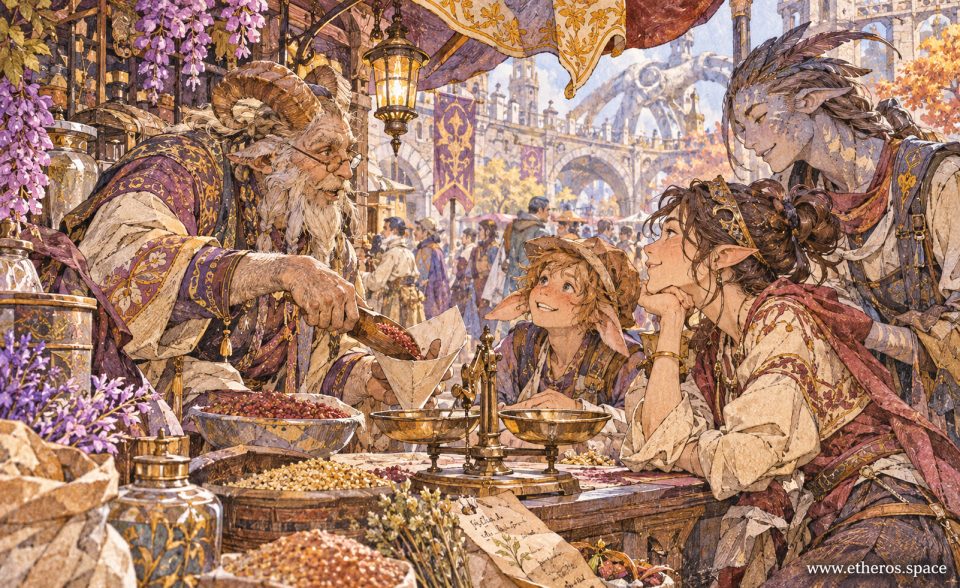
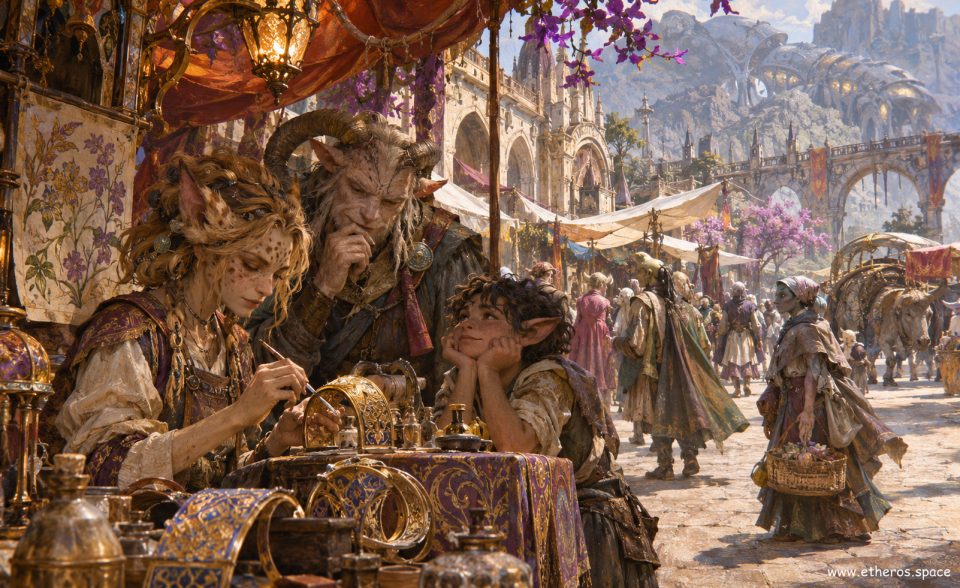
From behind the red awning, the morning crowds of Veyra looked like a river of cloth. Flower-sellers passed under the bridges; porters threaded between pack animals; someone had tied purple blossoms over the alley despite the dust drifting down from the high stone road. Yet at one goldsmith’s table, a girl kept both hands still, waiting for the smallest sound in the city.
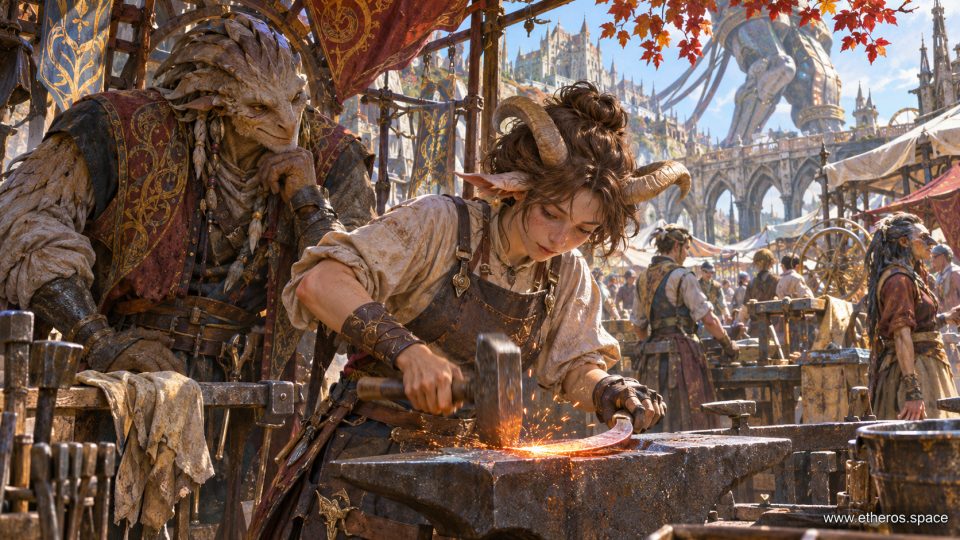
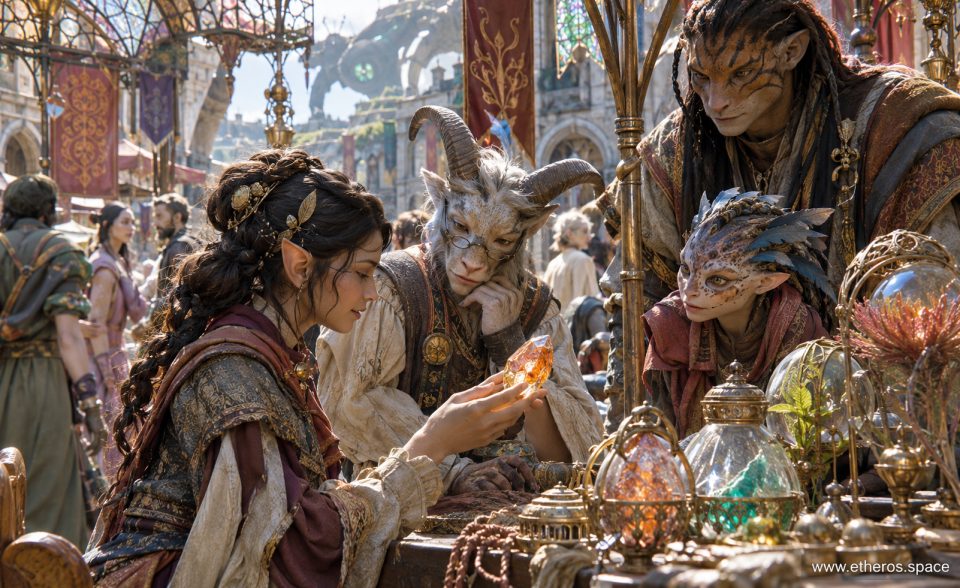
Erynn Ral bent close to the decorated cuff. Between its blue enamel petals was a narrow hinge, no wider than a seed, and a brass tongue meant to close without pinching the skin beneath it. Her fine brush trembled only when a cart knocked against the paving stones. She stopped, waited until the vibration passed, and drew the bright edge of the instrument across the hinge again. Gold was soft. Pride was harder.
A few steps behind her stood Orven, her horned uncle, his travel cloak powdered with pale road dust. He had been a stone-carrier before the years made his knees unwilling, and he still regarded any beautifully complicated object as a problem that somebody else would one day have to fix. A medallion rested at his chest. He touched his chin instead of the cuff. That was how Erynn knew he was worried.
Tallis, Orven’s grandson, leaned his elbows on the table with his cheeks in his hands. He had watched the craftswoman at work for almost the whole morning. He was young enough to be impressed by every gold curl and old enough to notice the silences between the adults.
"Will it close?" he asked.
"Not yet," said Erynn. "It opens beautifully. That is not the same thing."
The cuff had belonged to Tallis’s mother. When she returned from a season repairing the elevated road, the family had planned to meet her at the central arches and give it back. She had left it behind with a bent clasp, insisting that there were more important things to carry up a mountain. Orven had kept it wrapped in cloth. Tallis had remembered it every day.
Erynn could have soldered the hinge shut and made it shine. Nobody passing the stall would have noticed. But a clasp locked forever was no clasp at all: the metal had to yield, spring back, and bear a little movement without breaking. She had cut a replacement leaf from thin salvage brass and seated it inside the ornament. Now she needed to discover whether the new tongue would survive the pressure of an ordinary wrist.
Outside the awning the city went about its work. A traveler in a green mantle crossed the open street. An older resident carried a basket of flowers toward the stair. A pack beast waited beside a covered vehicle and flicked its ears at the traffic. Above them, carved stone and iron spans carried people from one quarter to the next. The enormous ribbed form against the far mountain was partly lost among masonry and haze; from this table, nobody could tell whether it was an ancient living load-bearer or a great fixed structure built in its image. Neither possibility had anything to do with this repair, and the goldsmith did not look up to settle it.
Erynn turned the cuff upside down. She placed a sliver of cloth where a wrist would be, pressed the latch with the flat of her thumb, and listened. There was a click: small, dry, imperfect. Tallis sat upright. Orven did not move.
She released the pressure. The brass tongue slipped free of its notch.
"Then it failed," Tallis whispered.
"It told us where it failed," Erynn answered. "That is useful."
She unscrewed the tiny pivot, shaved its shoulder with a sharp file, then worked a smear of lamp-wax into the contact. She checked the metal for burrs that could catch on fur or cloth. This time the hinge closed softly, flexed when she tugged it, and opened again when she pressed the hidden catch. Nothing in the sound was grand. It was simply correct.
Orven reached for the cuff but stopped short of taking it. On the road crews he had spent half a life trusting pins, knots, and straps to hold other people’s weight. He knew that attention was not the same as fussiness. He knew, too, how much of love was made of repairs no one would ever praise.
"Would she wear it?" he asked.
Erynn looked at the enamel beneath the light. A scratch crossed one of the blue flowers. She could polish it away, but the scar had been there before the clasp broke. She left it. "She already did," she said. "And she will know it is hers."
The city sounded different when Tallis laughed. Not quieter: the wagons still rolled, the hawkers still shouted, and somewhere under the arches a bell rang for the noon shift. But his laughter made one small place in that noise feel finished. Erynn wrapped the cuff in its old cloth rather than in new silk, and Orven paid the agreed sum without bargaining.
The three of them stayed beneath the awning for a moment longer. There was no spectacle to watch, no giant to salute, no promise that the returning road crew would arrive on time. Only a working hinge, warm brass in a child’s hands, and the ordinary good fortune of an object ready to be used again.