Eleven Minutes for the Night Shift — The Courtyard of Uncounted Hours

Story
Eleven Minutes for the Night Shift — The Courtyard of Uncounted Hours
At the eastern stair of Orren's Collegium, the city changed shifts under a sky the color of polished copper. Autumn leaves drifted down from the trees rooted between stone galleries, caught in the drafts made by a hundred passing feet. Nobody paused for the little table under the arch except those who already knew why it was there.
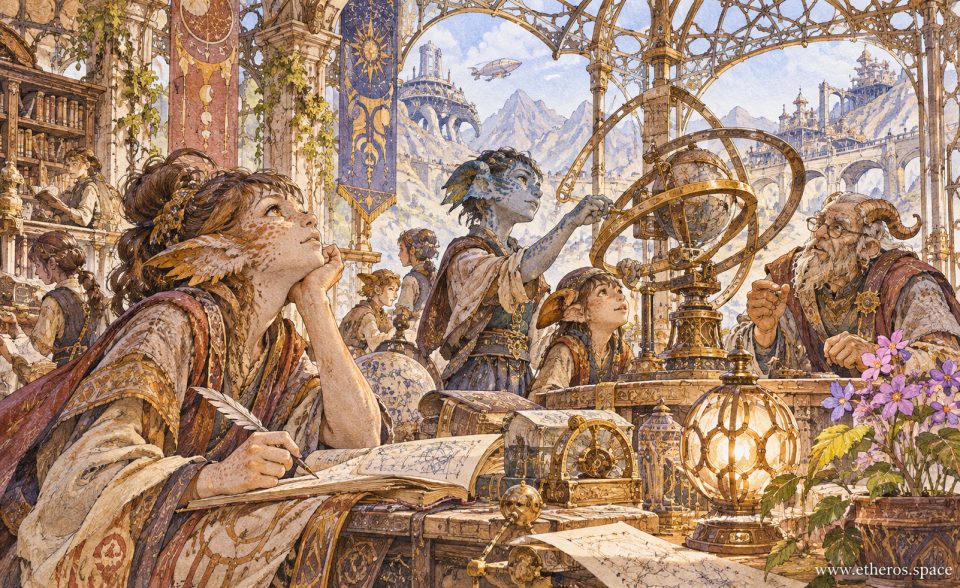
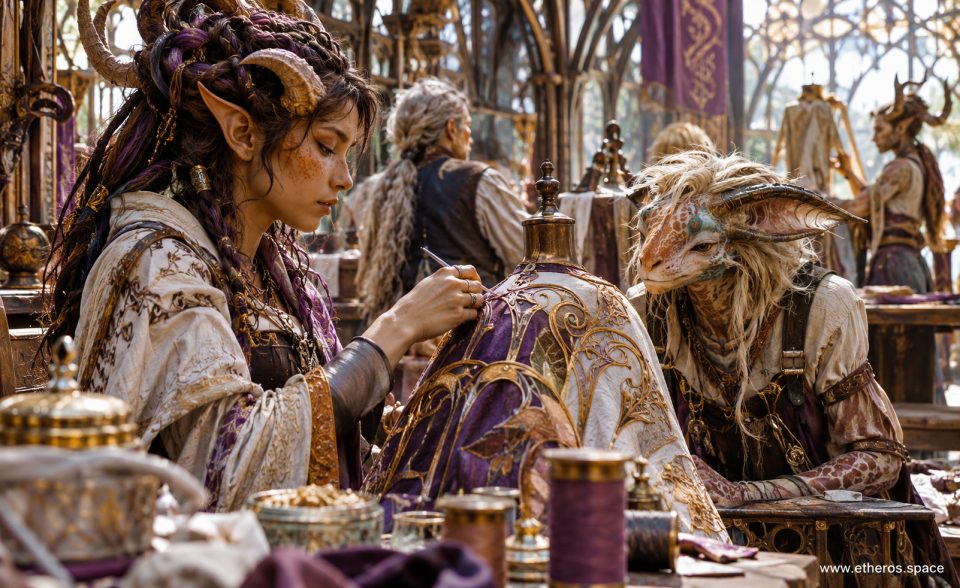
A young scribe named Sira sat with a parchment spread beneath her hand. She wrote carefully, her head bent so low that a curl of dark hair brushed the page. To one side stood an old horned examiner, Orris Venn, whose spectacles slipped every time he leaned toward the brass calculations. On the other, a spotted, sharp-eared mechanic called Tev balanced on the edge of the apparatus and adjusted a nested circle of metal. Their instruments were not connected to the city's bells. They were there to prove the bells wrong.
For seven days, workers leaving the western furnace houses had claimed that the evening signal sounded eleven minutes early. Eleven minutes is a small thing until a shift is paid by its final chime. The counting office dismissed the complaints as fatigue. Supervisors blamed the smoke. The official chronometer, they insisted, had not once stopped.
Then Tev's aunt brought home half a week's pay and a blistered wrist, and the question ceased to be an abstract argument over gears.
The three investigators had borrowed two old portable orreries, a mechanical angular frame, and the surviving municipal charts from the year of the broken tower. An orrery could not directly tell them what happened in a furnace house. It could, however, carry the geometry of the sun across a measured circle. If its axes were set correctly and the chart's fixed marks were trustworthy, they could compare celestial time against the bell records without relying on the counting office's machine.
Sira copied the measurements as Tev slowly turned the outer ring. Behind them the stairs filled and emptied. Two porters argued good-naturedly about an overloaded cart. A courier hurried past with a letter under one arm. A child on the upper landing chased a fallen leaf until a caretaker called them back. The city did not stop to watch a calculation being made on its behalf.
Orris studied a faint red line on the parchment. His fingers had grown unsteady, but he had once designed the carriage that kept the old tower's long pendulum from twisting under wind load. There had been a retrofit twelve years earlier, after a tremor cracked the original tower footing. The new bell drive was lighter, cleverer, and connected to the workshop district by a chain of flexible mechanical signal tendons. He had admired the engineering at the time.
'Look at this,' he said. 'It isn't losing time in one stroke. It is losing a little each time the western bell takes a load.'
Tev stopped the ring. The youngest of the three had been taught that even living metal had fatigue limits. In Etheros, some of the city's apparatus contained cultivated tensile fibers: strong and self-repairing within certain ranges, but vulnerable when strained faster than they could recover. The western signal tendon ran through a warmer district than its designers had allowed for. The mechanism contracted under heat, caught on a guide, and released its stored tension too quickly when the evening shift bell began to pull.
Each day, the apparent signal arrived earlier than the true count.
The figure in Sira's margin came to eleven minutes.
She placed her pencil down. Her brother worked the same furnaces as Tev's aunt. She thought of his boots drying outside their door, his supper cooling on the stove, the way his hands sometimes shook too badly to unfasten the straps of his work coat. Eleven minutes each night was not merely lost wages; it was eleven minutes of heat and exertion unrecorded as labor.
'Will they believe us?' Tev asked.
Orris looked beyond the table at the people ascending the broad steps, each carrying some unremarked burden of their own. 'A clock is a public promise,' he said. 'If they won't believe us, they will have to explain the promise.'
They made three clean copies of the result. Sira would deliver one to the counting office. Tev would bring another to the furnace workers' mutual hall. Orris would submit the third to the guild of signal-keepers, with the corresponding mechanical fault and a repair procedure: isolate the hot conduit, move its load guide into the cooler arch cavity, and calibrate the drive from both ends before restoring it to service.
The work itself would take most of a night. The pay correction might take weeks.
As the light mellowed, Tev tightened the last brass screw and folded the measuring arms. Sira blew dry the final line of ink. Orris stood with a quiet grunt, his knees protesting the long afternoon. Nobody cheered. Nobody declared an extraordinary discovery. A vendor across the steps began to pack away her wares; the last students slipped toward supper.
They had not changed the stars. They had found the minutes that belonged to somebody else.
And on the following night, when the western furnace workers heard their bell at the proper hour, they would know the difference even if the rest of the city did not.