The Bread That Went Around the Table
Story
The Bread That Went Around the Table
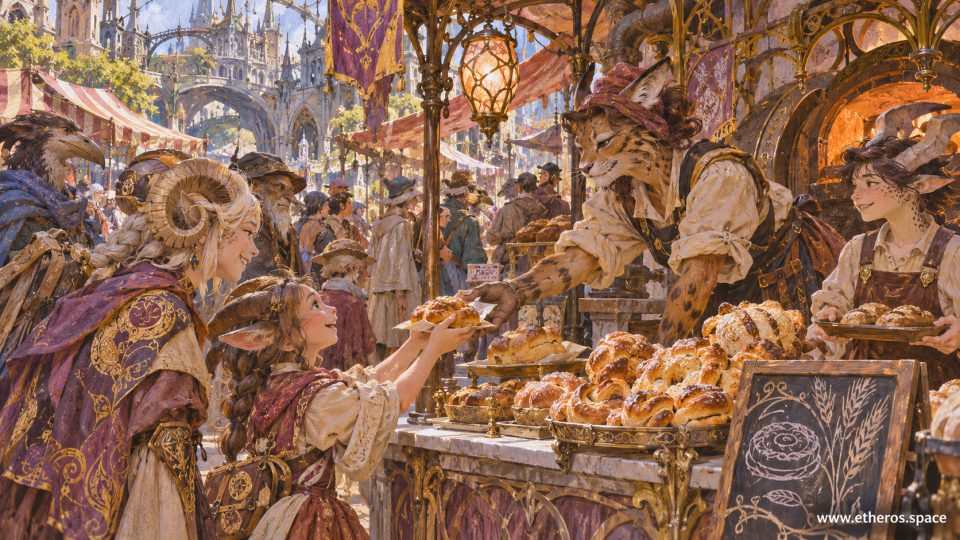
The first batch of evening bread came out of the copper oven just as the sun reached the upper bridges of Vellacourt. Light poured past the striped market awnings, caught the brass trays, and turned the flour dust gold. In the packed public arcade, no one could hear the bells from the western clocktower. They knew the hour instead by the smell.
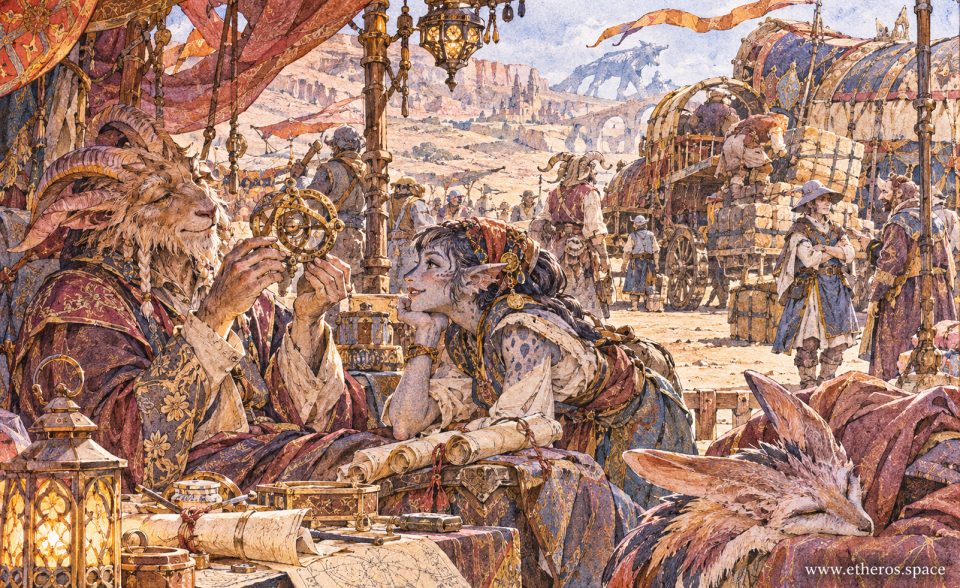
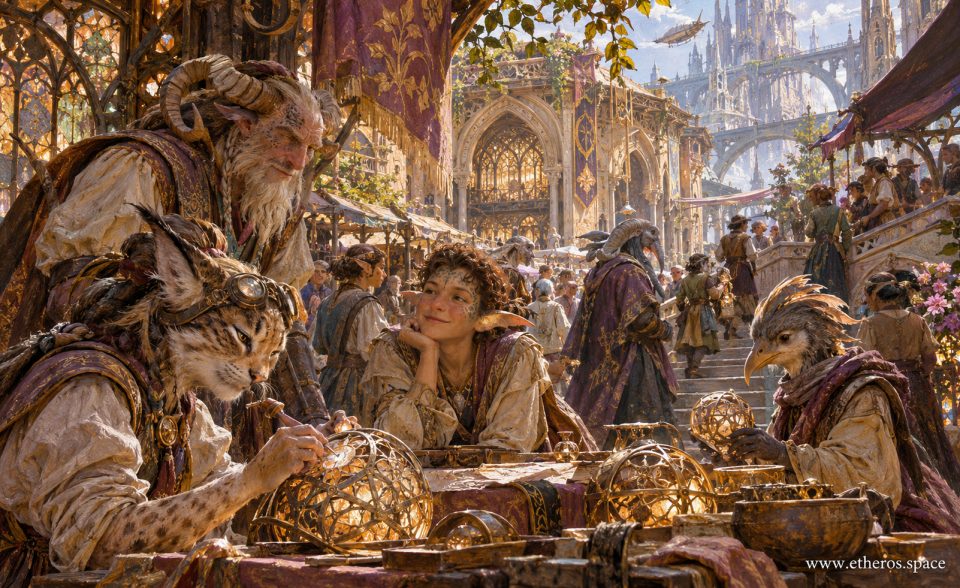
At the threshold of his stall, the spotted lynx-kin baker Rhaun leaned across the pastry counter with a warm braided roll balanced on a square of paper. A small long-eared child, Miri, lifted both hands to receive it. Her smile was directed at the food, and Rhaun's attention was on keeping the crust from slipping. At the child's shoulder stood her grandmother, Eshai, an elderly ram-horned woman in a violet cloak. On the other side of the counter the young baker's assistant, Tellen, held another tray of fresh rolls ready for the next customer.
Around them the market went about its business. An avian traveler, face partly shadowed by the canopy, threaded through the crowd at the far left. Porters moved beneath ribbed Gothic arches. Merchants checked supplies, families bargained over dinner, and the old bakery furnace glowed behind Rhaun's shoulder. Above the square, suspended bridges carried the city's workers back toward their homes. Nothing in that ordinary scene announced what Rhaun had decided before dawn.
That morning, the cooperative grain tally had come up short. A burst coupling in the communal mill had spoiled several sacks with grit from the grinding wheels. Mechanics could replace the coupling; they could not return the flour. The bakery still had enough for the next three batches, but only if the rolls were made smaller and the richer sweet dough was reserved for the following day.
Rhaun hated making the rolls smaller. In his own childhood the bakers of the eastern district had been expected to measure hunger by the width of a customer's purse. He had promised himself his shop would never do that. Yet promises were not grain. The oven needed a steady supply of furnace-gas from its living fermenter, the fermenter needed spent dough and fuel, and the district's bread ledger had to balance at night.
Eshai arrived with Miri just before closing. Her daughter worked the late shift maintaining the suspended roadway joints above the avenue; Eshai had only a few copper weights left, and Miri had been counting the buns through the shop window. Eshai asked for one roll to split between them. She said it cheerfully, as though splitting a single roll were a family tradition rather than a necessity.
Rhaun had known her long enough to recognize that kind of cheer.
He slid the hot roll forward. Miri reached for it, her small fingers held well away from the steam, and then looked up at him, surprised by the weight. It was one of the full-sized braided loaves, buttered and glazed, left from the early batch. She began to ask whether he had made a mistake.
"It is the second bell's bread," Rhaun told her. "That is the bread we share before the lamps are lit."
He had invented the phrase that very morning.
Tellen glanced at the day's ledger. The numbers did not become less difficult because a kind sentence had been spoken. Rhaun knew that, too. He turned the register toward his assistant and marked the roll against the bakery's own afternoon meal. He would eat the smaller dough ends later. There was no disappearing cost, no miraculous new supply: simply a choice about who would carry it.
Eshai understood immediately. She did not thank him loudly, which he appreciated. Instead she asked Miri to hold the bread with both hands, and the child did so with the solemn care usually given to a precious instrument. For a moment the chatter of the crowd seemed distant from their little space beside the glowing stove.
Then Miri noticed the tray in Tellen's hands.
"Could we take one to the bridge-watchers?" she asked. "They cannot come down until the lamps are working."
Rhaun looked toward the high spans, where the last workers moved like dots against the pale stone. The bridge-watchers had been checking a worn load-bearing joint all afternoon. Without them the heavy service carts would have crossed the damaged section after dark. Their work was part of the same city that brought grain to the mill and people to the market. Its cost belonged somewhere in the accounts as well.
He asked Tellen to set aside three plain rolls, not the expensive glazed ones. Eshai offered two copper weights, and this time he accepted them. Tellen entered the amount as a shared street delivery, with the cooperative covering the balance from the day's collection of flour scraps. The rolls would travel up in the next inspection lift. No new grain had appeared, but a plan had replaced an act of impulse.
By evening, the first batch had sold out. Rhaun watched Tellen sweep the crumbs into a jar for the fermenter and bank the oven's heat for the morning. Across the square, the sun caught the gold threads in the high awnings. Miri and Eshai disappeared among travelers and laborers, carrying their parcel carefully between them.
Rhaun reopened the ledger. In the margin beside the damaged-mill entry he wrote a note for the cooperative: *Tomorrow, post the bread-share beside the prices, where everyone can see it.* Below that he added a second line: *Send the bridge crew's flour allocation directly to the bakery, not through the toll house.*
He did not know whether anyone would approve either suggestion. A city as complicated as Vellacourt was never repaired by a single good gesture. But its people had to begin somewhere. And as the ovens cooled and the market lights took over from the sun, a small girl carried the warmth of a fresh roll through the crowd, unaware that for one evening she had helped make a better system imaginable.