The Wing That Would Not Fold — Midday at Lantern Market
Story
The Wing That Would Not Fold — Midday at Lantern Market
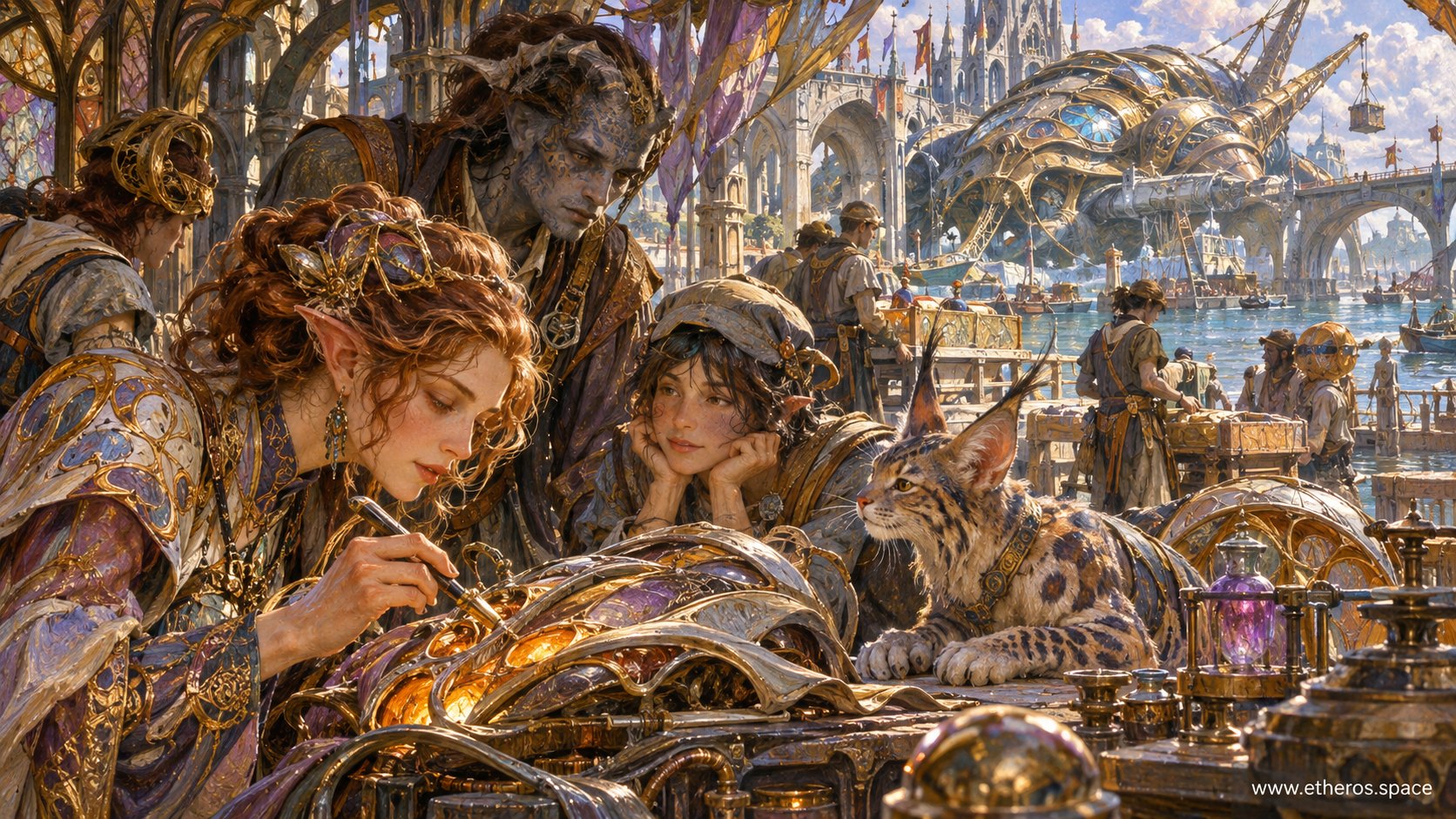
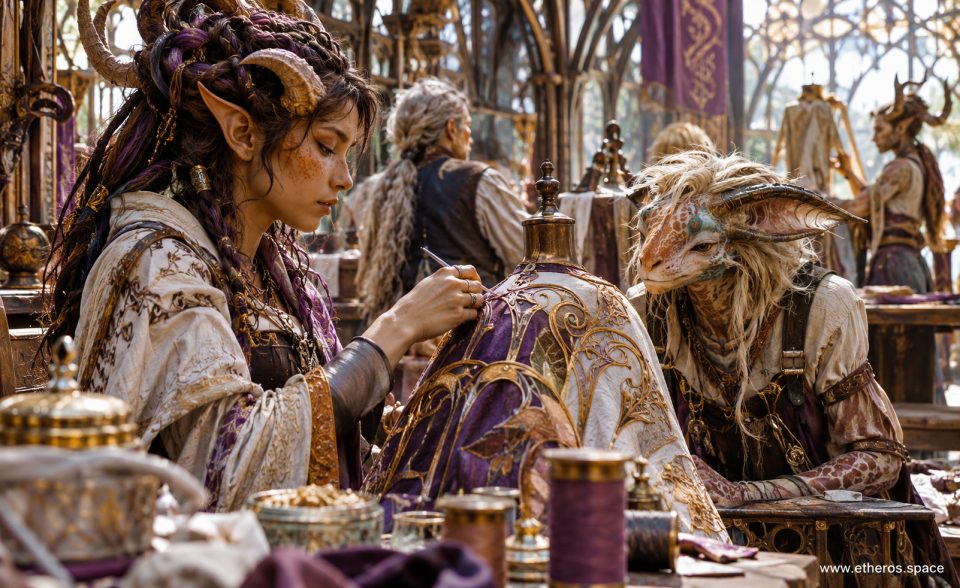
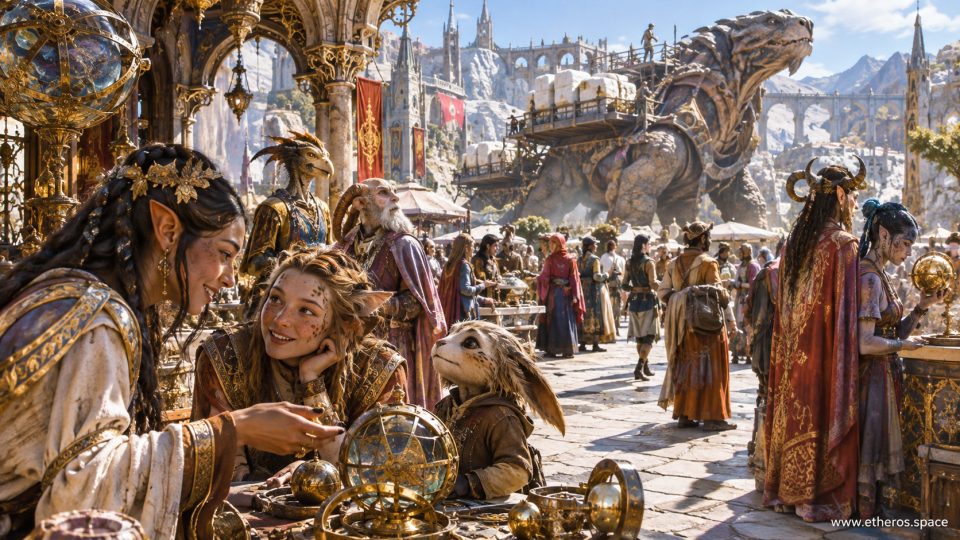
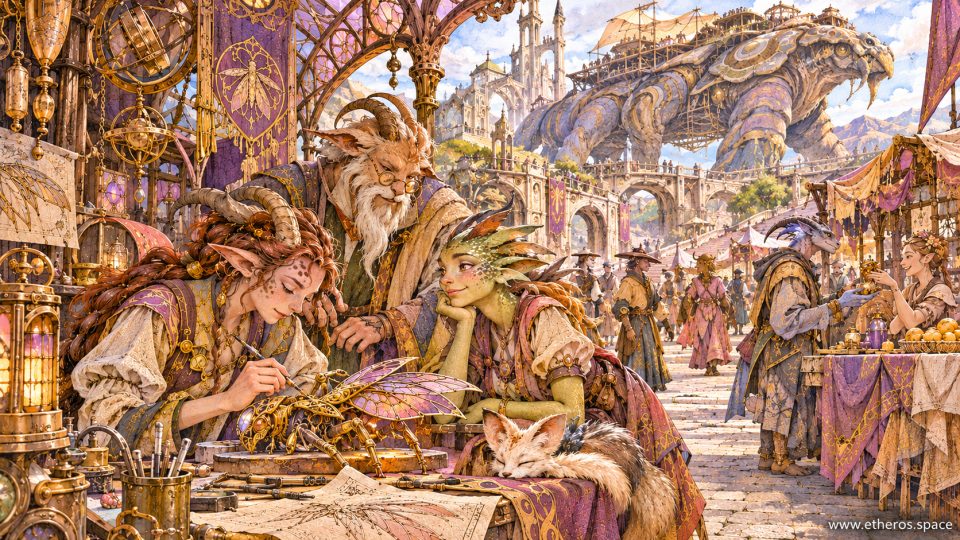
In the dry hill-city of Lantern Market, beneath arched ironwork, violet pennants, and the long shadow of a planet-born carrier, Seya Aur repaired small things. Her worktable was wedged between an instrument seller and a stall of bright orchard fruit. Anyone passing could see the hand tools, the gold-veined diagrams, and the little glasswing laid open on a low wooden stand.
That morning it had returned from the western terraces with its lavender wings shuddering. Its body of curved brass ribs was whole, its glasslike membranes uncracked, and its delicate jointed feet still gripped the stand. Yet whenever Seya rotated the drive axle, the left wing opened sharply, trembled, and would not fold all the way home.
The glasswings were the district's modest messengers. They carried sealed seed reports, notices from cooperatives, and specimens too light to justify sending a vehicle. Their flight was never free: a wound spring supplied motion; each articulated joint transferred load; a flexible biological filament at the wing root absorbed the small shock at every reversal. Once that filament failed, the remaining gears would grind themselves thin.
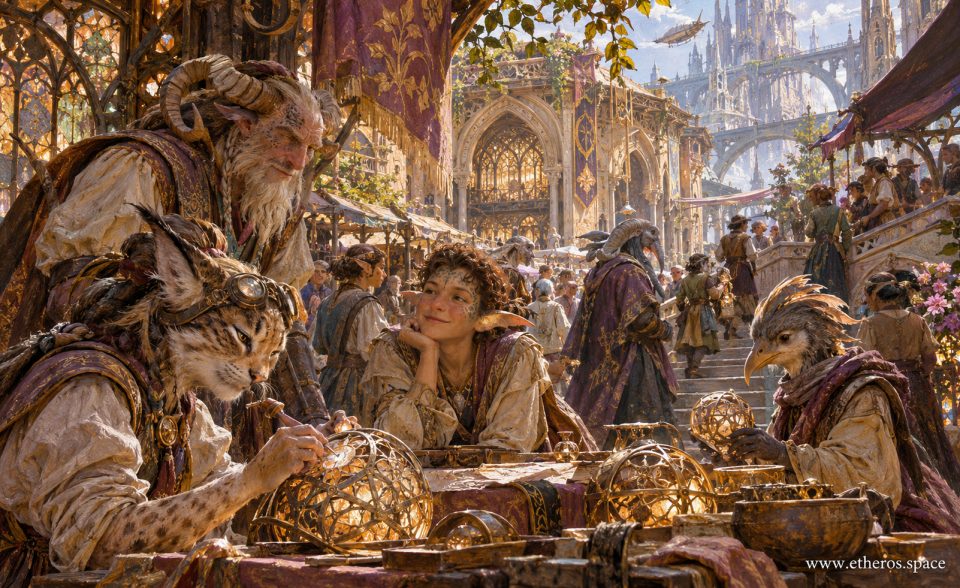
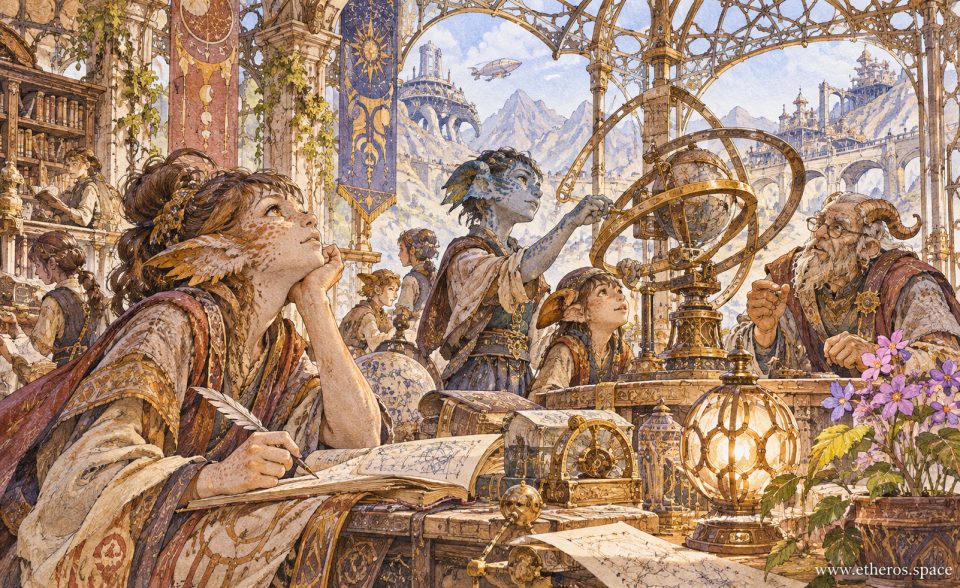
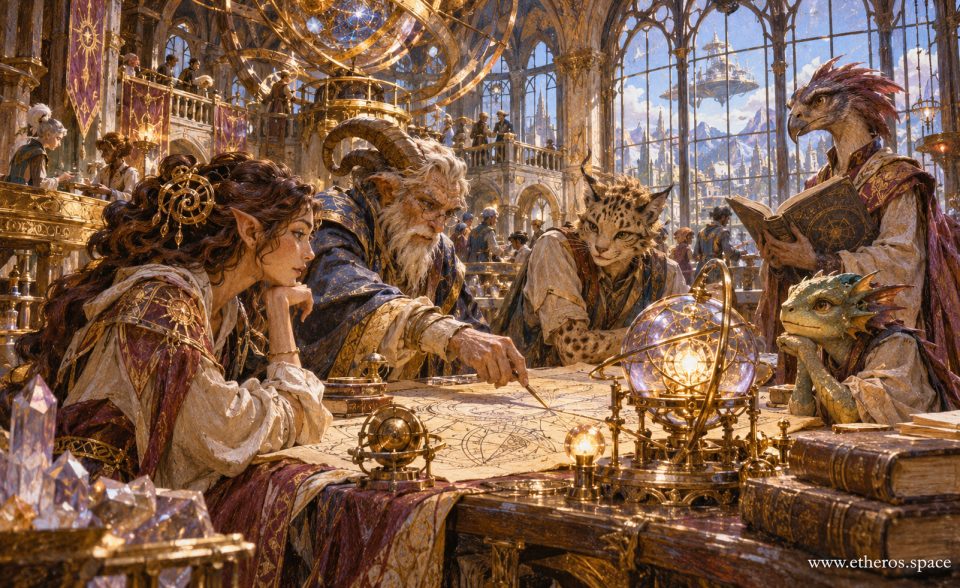
Nelu, a young green-scaled naturalist, rested her chin in her hand and watched the operation. Master Brann stood behind Seya, his horned head bent toward the mechanism, white beard brushing his collar. They had repaired larger machines together, but both knew that a hand-sized failure could still have consequences beyond the workbench. Tikka, the small cream-colored fox who had appointed himself workshop guardian, slept on the purple cloth beside the open drawings.
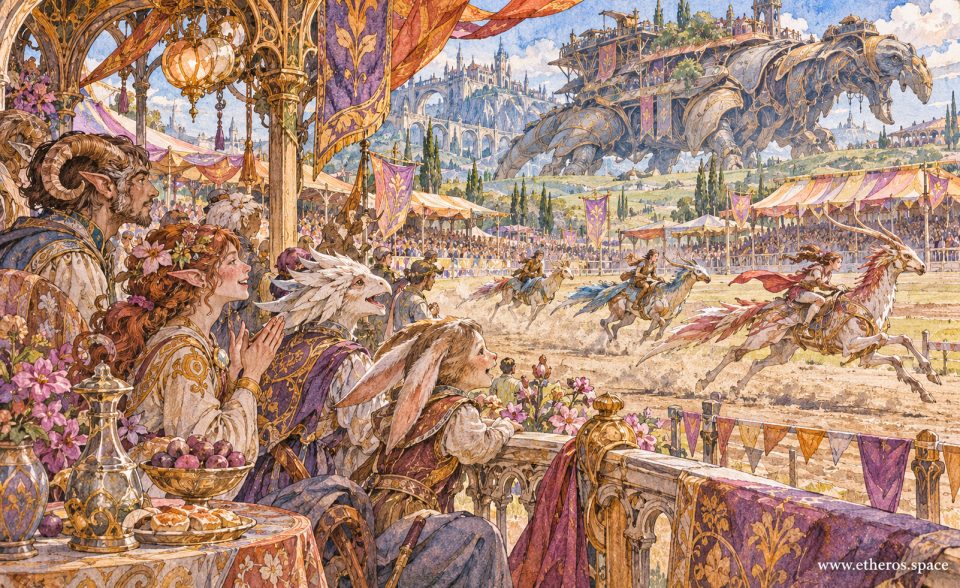
Behind them the market continued. Travelers crossed beneath Gothic arches, a blue-gray horned customer bought fruit, and a passing worker in a broad-brimmed hat ducked around the crowd. High above the street, a colossal armored bearer moved behind the bridges. It carried inhabited scaffolds across its back and stepped deliberately among the terraces, its load borne through massive articulated limbs into the old mountain roads. Its work belonged to the city's maintenance economy, not to a parade.
Seya tried the wing again. At the instant when it should have folded, she felt the axle push against her fingertip. She unfastened the small gold cover and found a replacement insert, rigid as a sliver of porcelain. Someone had installed it in place of the yielding filament specified in the older plans.
Brann frowned. 'It opens well enough,' he said. 'Until it has to return.'
'Like a door with no hinge,' Nelu replied.
Seya smiled but did not reach for a new glasswing. Several merchants had suggested replacing the whole creature, as if the city had limitless metal, pigments, and stored energy. Instead she opened a worn field notebook. Between drawings of stems and moth wings, a former craftswoman had left a formula for preserving silk-like fibers shed by a local six-legged moth. A small coil of the material remained in the cupboard.
They divided the work. Nelu recorded the old joint geometry and the direction of each moving force. Brann stabilized the body and counted the turns remaining in the spring. Seya teased the old insert free, shaped the flexible fibers into a narrow band, and fixed them between the wing spar and the rotating socket. She did not make the spring stronger. She gave the force somewhere safe to go.
The first test was silent. Gold gears turned; the purple panes lifted and caught the light; the new band stretched as the wing opened, then eased the moving assembly back without a jolt. On the second test the creature made a small, steady ticking sound. On the third, the left and right wings folded together.
Tikka raised one ear and went back to sleep.
Nelu began writing the repair in the ledger, assigning the credit to Seya as custom demanded. Seya stopped her and pointed to the entry with the old material formula. 'Write the name of whoever discovered the fiber. Then yours, for finding its purpose again.'
Brann considered the passing crowd. 'And yours?' he asked.
'Mine can go beside the hours worked.'
No bell rang. The giant bearer continued its measured labor above the city, the merchants continued arguing over prices, and someone down the lane laughed as a basket toppled harmlessly into a pile of folded cloth. But before afternoon, a glasswing would carry a packet of seeds to a neighborhood that needed them. Its restored joint would last not because the city had added more power, but because three people had remembered that a living system must know how to yield.
When Seya finally set the little messenger upright, the wings folded neatly against its back. Nelu reached to touch one lavender pane, then withdrew her hand so the machine could rest. There was still a day of work ahead, and that was precisely the comfort of it.