The Wind Has Room for Everyone — Race Day at Serevan Heights
Story
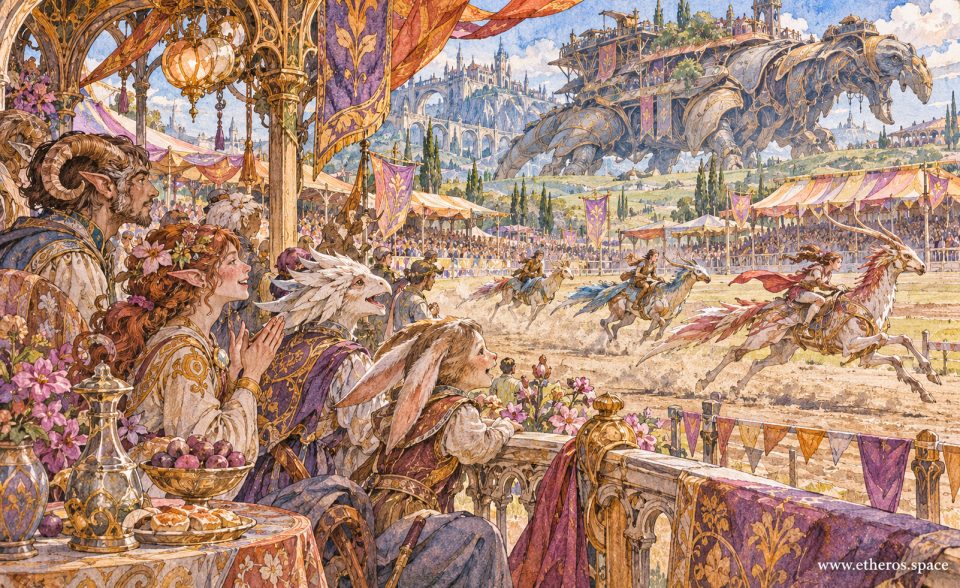
On the dry terraces of Serevan Heights, the festival had begun with the sound of hooves rather than bells. The whole city seemed to have come out beneath the amber awnings: stonecutters still in their work aprons, merchants with sugared fruit, elders wrapped against the upland wind, and children who had been awake since before sunrise. Ribbons lifted from the railings. Dust hung over the oval course like a second, softer horizon.
From a decorated balcony, Peli could see nearly everything. Peli was small, long-eared, and in possession of an enormous opinion about how races ought to be run. The child pressed both hands against the carved balustrade and felt the vibration of the approaching mounts before their feathered crests appeared past the bend.
"They're late," Peli announced.
"They are exactly where their legs say they should be," replied Hadrin, the horned man seated beside the fruit bowl. He had once supervised the long-distance messenger stables, where haste was measured in missed suppers and strained tendons. These days he repaired harness buckles for whatever a family could spare. "The race doesn't begin when the impatient people want it to."
Iva, whose copper hair had escaped its flowered comb, laughed and applauded. Beside her, Senn, a pale-feathered, sharp-faced visitor from the high grasslands, leaned forward with the fierce concentration of someone who had been raised among running animals. All three were watching different things: Peli the speed, Iva the riders, Senn the movement of the mounts' shoulders.
Three racers swept into view. The nearest mount was bright with red and cream plumage, its long limbs stretching ahead of a streamer of dust; a blue-crested runner followed toward the center of the track; another pressed hard beyond it. Their riders balanced low over fitted saddles, each shift of weight answering the rhythm beneath. No clever ornament could carry them across the course. The animals did that, with breath and muscle and judgment.
The crowd rose. Peli bounced so hard that the balcony's brass flower fixtures trembled.
"The red one is going to win!" the child cried.
"Perhaps," said Senn. "Look at the inside hind foot."
Peli squinted. At first there was only dust, and the dizzying impression of wings that were not wings at all but long feathered ridges streaming with motion. Then the child noticed it: the leading mount shortened one stride on the turn. Its rider loosened the rein a fraction. The animal found its footing and lengthened again.
There was no stumble, no dramatic rescue. There was only an exchange of trust so small most of the audience never saw it.
Hadrin had recognized the mount. Her stable name was Vesh, though he had known her earlier as a restless yearling that refused to cross iron grates. Last cold season she had been withdrawn from the courier circuit after a tendon injury. Her handlers had kept her on the slow walking roads, waiting until she chose to run without protecting the leg. Today's event was her first full public course since then. The history belonged to this family's telling; nothing in the spectacle itself could prove it.
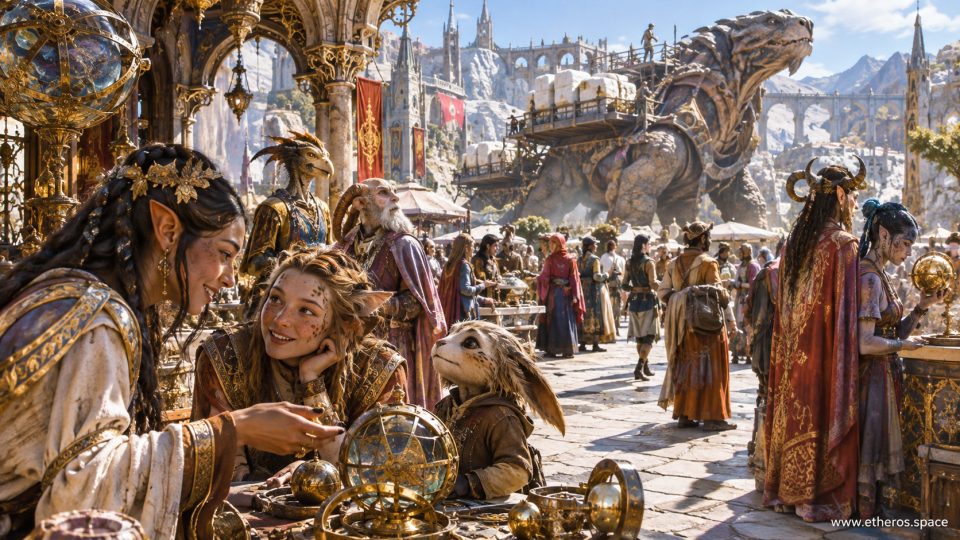
Beyond the far grandstands, a great biomechanical bearer moved across the upland ridge. Its enormous jointed legs took the load of terraces, planted roofs, and the workers traveling upon its back. Each foot found stone; each arch of its carrying frame passed the weight toward living struts and armored limbs. It followed its own service road, distant from the race. Nobody had summoned it to entertain the spectators. It was carrying a neighborhood's new shade gardens toward the exposed southern roofs, because the people there had nowhere else to grow them.
Peli watched the huge worker for a moment. "Why doesn't that one race?"
"Because," Hadrin said, "it has somewhere important to arrive without being first."
The runners passed the terrace in a rush of warm air. Iva's applause mixed with the clatter of cups; Senn gave a short approving whistle; the crowd's voices became too many to count. Peli gripped the railing, feeling their joy travel through the stone in pulses.
The leading rider looked ahead, the red-crested mount gathered herself, and the finish remained outside the balcony's view. For one suspended instant there was no victor, only three creatures running with everything they had, their partners listening, and a city remembering to cheer for the effort as loudly as for the outcome.
Hadrin took a piece of fruit from the table and offered half to Peli. He did not say who would win. Some lessons, he knew, arrived more honestly on their own feet.