The Feather That Kept Its Name
Story
The Feather That Kept Its Name
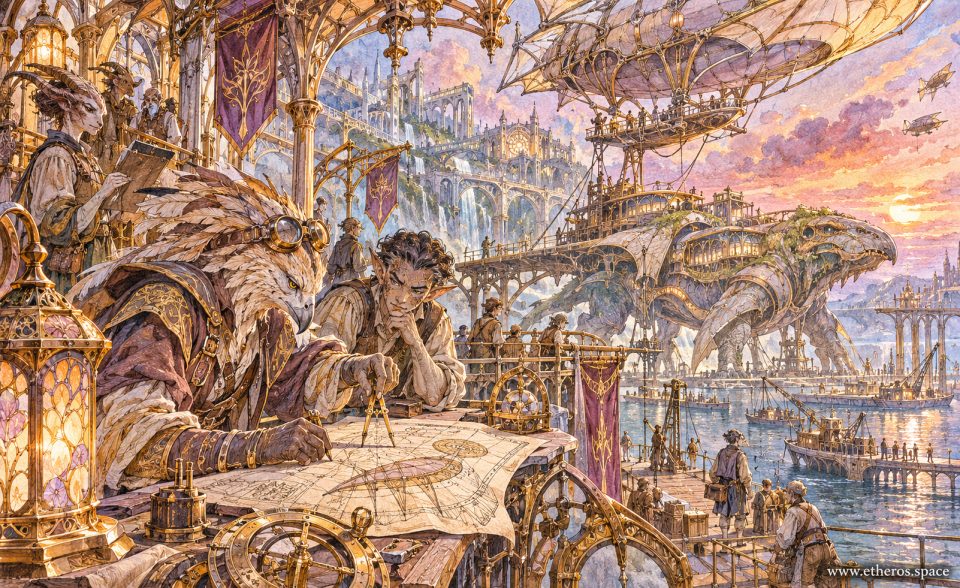
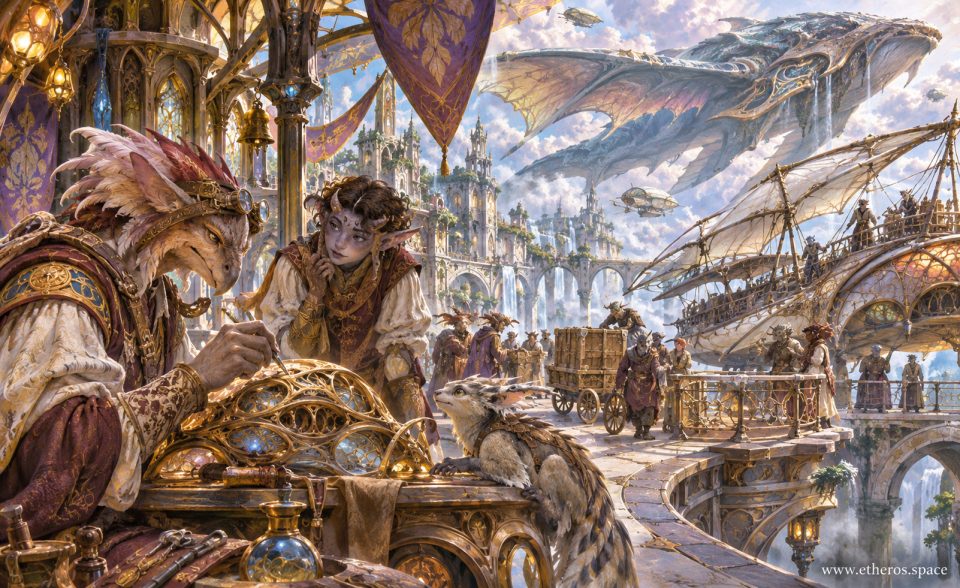
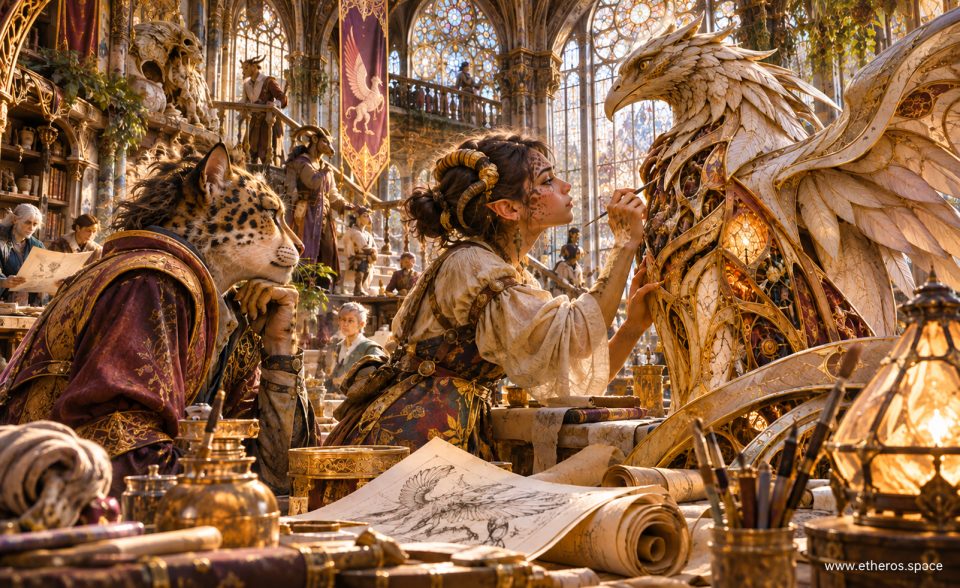
By midday the atrium of the Keralis Artificers' Hall was warm enough to wake the brass sap in its carved columns. Light passed through the high stained-glass windows and broke into fragments across paper plans, gilded jars and the enormous white-feathered figure that stood beside the workbench. On the mezzanine, apprentices went between shelves and balconies, their footsteps barely audible under the clicking of measuring tools.
Illyra Venn held a narrow brush so still that even the tiny gold bells hanging from her horn-rings did not stir. Before her rose the chest of a griffin-shaped living machine, its pale feather plates overlapping flexible ribs of gold. Deep inside, between the ribs, an amber chamber glowed. The machine's head was turned toward her; whether it had turned deliberately, or because of the angle of its repaired neck, no one in the hall could say.
At the left of the bench sat Sareth Qor, the old spotted cat-kin master whose signature appeared on a hundred celebrated designs and, lately, on almost none. He rested his chin on his hand. He watched Illyra work, not the diagram open before them. Several other craftworkers—some pale-haired, some horned, some too far away to distinguish—consulted plans and carried equipment in the light beyond the table.
The great griffin was called Aster. Long before the hall became famous for ceremonial mechanisms, Aster had spent thirty-seven seasons bearing messages through the high passes. Its feathered wings were made to flex under changing wind loads. A living sensor web beneath their metal roots found the pressure gradients that ordinary instruments could not. The amber chamber supplied heat and electrical energy; return conductors fed the wing muscles, while the hollow bronze spine carried the strain back into the leg supports. Aster was not made to float by ornament alone. Every graceful curve had once had a duty.
Then the passes acquired new routes and the council wrote Aster off as a relic. Its heart was not broken. The problem was smaller and crueler: a rigid decorative plate, added during a public restoration, had trapped the breathing seam of its breast. Each time the core warmed, the plate pressed against a nerve-like conductor until the wing briefly lost its own position. The mechanics called it an inconvenient flutter. Aster had stopped opening its right wing at all.
Illyra's task appeared simple: replace the rigid plate with a flexible one. Her first design copied the old ornament exactly. Sareth had returned it with a single penciled line: 'Whose movement does this pattern serve?'
Now she was doing something that would not look quite so symmetrical. Using a fine tool she separated the gold filigree at the chest and painted a conductive resin into the newly exposed channel. It would carry the core's minute pressure signals without forcing the plates to remain motionless. The new joint left a visible gap beneath the wing feathers. The gap was deliberate; a functioning body needed room to change shape.
Sareth considered her work, then nodded toward the drawing of an idealized griffin on the table. 'It is beautiful there,' he said, 'because the paper never asks it to breathe.'
Illyra almost smiled. She was aware of being watched. Aster had been the guild's emblem for longer than she had been alive, and no one wanted to be the apprentice who changed its famous silhouette. Her mother had carried supplies on the old pass road and had seen Aster above the snow on more than one winter night. The machine had been a useful neighbor before it became a picture on ceremonial banners. That history mattered more to Illyra than perfect symmetry.
She opened the regulator no wider than a hair. Warmth traveled from the amber reservoir into the braided conductors. A faint click answered from inside the collar; then another, farther down the wing. The pale feathers trembled. Across the hall a few heads turned, but the apprentices did not crowd the bench. Everyone knew that living mechanisms required quiet when they found an unfamiliar balance.
For an instant the right wing drew inward. Illyra thought she had damaged it. The amber light softened; the chest plates separated by the width of her smallest finger, letting the core expand without pressure. Only then did the wing rise, slow and controlled, as though the machine were remembering a motion that belonged to it.
Sareth looked away first. It was not indifference. Forty years ago he had designed the decorative plate himself, believing he had improved a plain working body. The council had praised the embellishment, and he had accepted the praise. He had never asked why Aster became so still afterward.
'It will not match the old drawing,' Illyra whispered.
'No,' Sareth said. 'It will match Aster.'
The hall's midday bell sounded overhead. On the balcony the apprentices resumed their journeys, carrying ink and shaped metal to other tables. Illyra set down her instrument and wrote the repair into the register: not restoration to original appearance, but restoration of safe motion. She added the load path, temperature range, conductor response and the name of the apprentice responsible. In a city whose machines were treated as a species of neighbor, those details were a form of respect.
Aster did not fly that day. There were still load trials, balance checks, and people to convince. But its right wing remained open in the stained-glass sunlight. The feathers were not perfectly even. Under their roots, something alive was moving again.
And when the visitors later asked why a gap remained in the most celebrated work of the Keralis Hall, the younger apprentices knew how to answer: it was not an unfinished decoration. It was the space a living being needed to breathe.