The Warmth Beneath the Fault
Story
The Warmth Beneath the Fault
The tremor arrived during the second nursery watch, when most of the young were sleeping and the geothermal wheel had settled into its ordinary amber hum.
A seam opened across the oldest basalt column. Dust loosened from the vault ribs. Every cradle in the lower ward shivered. The children did not know that the stone overhead was older than the city, or that the warm air passing over their nests had traveled through a loop of metal and living membrane many chambers deep. They knew only that the floor was moving beneath them.
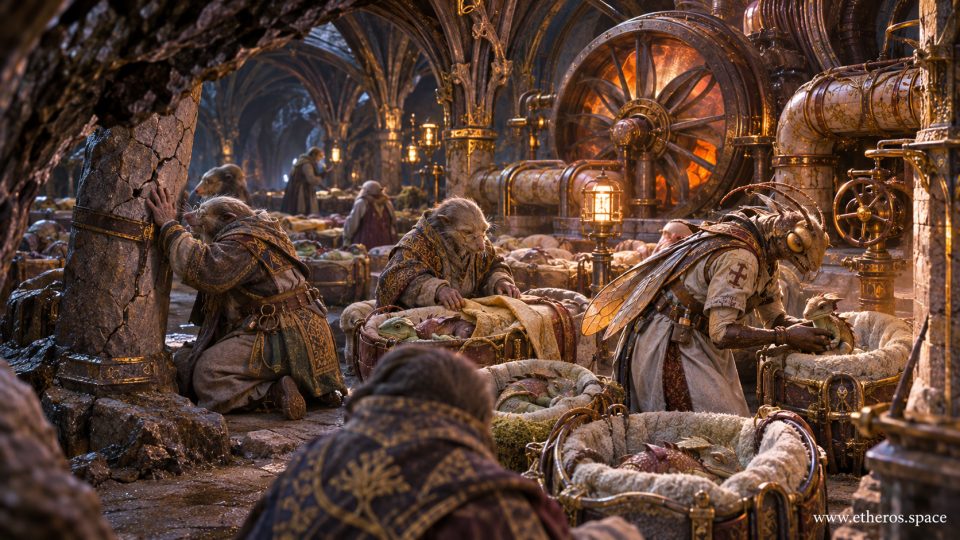
Old Brenn was the first to reach the cracked pillar. He was a broad-shouldered burrow-kin, gray at the muzzle, with hands made rough by forty years of masonry repair. He pressed his weight against the stone while his fellow workers cleared the nearest cots. It was an instinctive gesture, not a serious method of holding up an underground roof; the load belonged to the braced ribs and the bedrock. But his palm told him how the fault was shifting, and whether the crack had opened farther.
"Not the whole arch," he called. "Only the facing. Move the nests out of its fall line."
Beyond him, the great bronze wheel continued to turn. It belonged to the ward's heat-exchange system, not to any celestial engine: deep geothermal warmth entered a sealed primary circuit; a secondary circuit moved tempered air along the nursery floor. Its valves were fitted with supple, cultivated membranes that tightened when the pressure changed. The machine was a form of Etheros life, grafted into crafted pipework, and it could respond to strain—though not always quickly enough.
At the center of the room, Senna bent over a moss-lined basket, pulling a thick gold blanket around a small newly hatched creature. The infant's pale face rested between fragments of its broken shell. A second hatchling, green-scaled and wide-eyed, looked up from the nest beside it. Their breathing stayed fast. Senna counted each rise of the small chests rather than the seconds on the brass clock. She had been midwife here long enough to know that warmth alone was not care: a frightened hatchling needed quiet, clear air, room to stretch, and another living being close enough to answer it.
The nursery's winged medic, Ori, knelt beside a raised cradle on the right. The fine wings folded behind their back so they would not brush the bedding or snag the copper valves. In one hand they steadied a bright-eyed youngster; with the other they tested the nest's heated rim. The child's claws pressed against their fingers and did not let go.
"Too hot at the outer edge," Ori said.
Senna glanced up. The wheel was spinning, yet the air had grown uneven. That meant the tremor had pinched a return duct and left a pocket of hot air trapped near the last row of cradles. Increasing the furnace draft would only worsen it. They needed to bypass the damaged branch and move the smallest infants toward the inner aisle, away from both the crack and the over-warmed line.
A cloaked porter crouched in the low foreground, half hidden behind a rock spur, waiting for Senna's signal. Others worked deeper in the dim nave, carrying bedding from one nest to another and setting aside broken shell so that no one would slip. Nobody stood still for a portrait. Their eyes followed cradles, valves, and the people beside them.
Brenn withdrew his hand from the pillar, checked the crack once more, and called to the valve keeper behind the wheel. A handwheel turned. For several uneasy breaths the turbine's low pulse faltered. Then the membrane shutters found their new position, diverting the heated flow through a service channel that had not been used since the winter of the long ashfall.
The lantern beside Senna brightened as the circulation stabilized. The smallest hatchling gave a startled chirp. Ori answered with a noise too low to be a word, a rough old nursery song learned long before they joined the ward. Other infants stirred, and one by one the rapid breaths slowed.
The tremor left its mark. The cracked stone would have to be pinned and faced before the upper passage could reopen. The damaged duct would need a new flexible joint, grown from living tissue and fitted to the old bronze sleeve. There would be records to write, supplies to ration, and another watch before dawn. None of the caregivers mistook a temporary recovery for a finished repair.
But at that moment, under the branching Gothic vaults, the ward continued to breathe. Amber light traveled across blankets, tiny shells, work-worn hands, and the rough floor. The children lay safe within a system held together not by one heroic machine, but by many beings who knew where its forces and its warmth truly went.
Far above them, the sleeping streets of Etheros felt only a slight aftershock. No one there heard the small green hatchling, finally at ease, make its first contented sound.