The Width of a Doorway
Story
THE WIDTH OF A DOORWAY
In Brackenrise, the high houses leaned toward one another without touching. Their upper corridors carried lamps, bootsteps, household gossip, and the smell of suppers through a network of stone ribs whose living tendons tightened almost imperceptibly when the wind came off the eastern roofs. Nobody noticed those small movements until a mason began marking the walls.
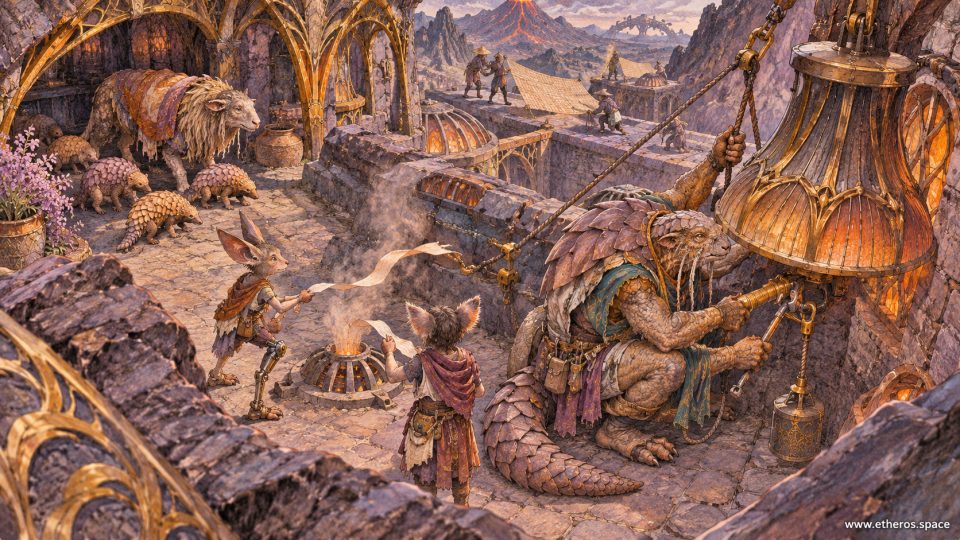
Orrun noticed. He had spent sixty-seven winters in the same building and had acquired the shell, the stooped gait, and the unsentimental patience of a creature who had outlasted four generations of landlords. From his landing he could see narrow towers beyond the pointed window. On the day the upper-floor inspection notices arrived, he put his keys in his fist and sat on the stairs, where he could hear the house settling.
An inspection was not an eviction. The distinction mattered, the district officer had said. Repairs to a load-bearing root-rib demanded that the two rooms nearest the western wall be emptied for ten nights. No landlord could charge rent during the closure. The law was quite clear. What it could not provide was a place for every family to sleep while stonecutters exposed the damaged anchorage, nor did it say whether the rooms would be affordable when the repairs were finished.
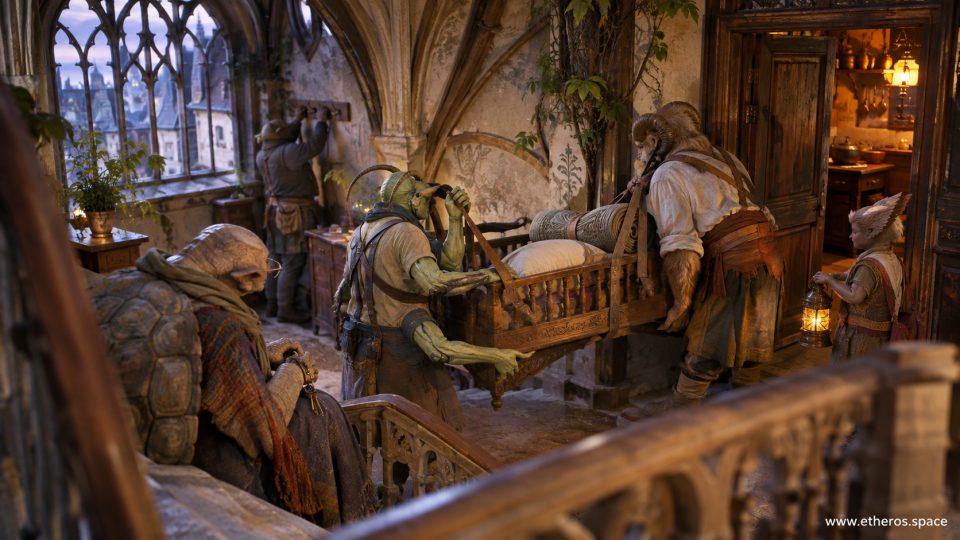
Orrun's upstairs neighbors, Braska and Tesh, had volunteered the largest room of their small apartment. Before sunset the landing was filled with bundles. Braska, a broad-shouldered ram-horned carrier who earned his wages shifting stone, threaded cloth slings around an old carved cradle. At the other end Tesh, a long-limbed green-scaled mender, took the strap in one hand and caught a loose rail with another. The cradle had been empty for years. It was not light. Inside lay two thick pillows, a rolled coverlet and a quilt patched with more different hands than Orrun could name.
'Angle the near corner first,' Braska said. 'The far post will catch the jamb.'
'If we angle it that way, the hinge catches the blanket,' Tesh answered.
Neither was wrong. Braska had the strength; Tesh could see the geometry. They paused, lowered the weight a finger's breadth onto its padded supports, and tried again. The cradle rose between them with the slow, awkward dignity of anything that has survived long enough to be loved.
Ili, Braska's feather-crowned child, held a lantern beside the kitchen door. She had been ordered to keep clear of the lifting straps and took the instruction seriously. Nevertheless she moved the light when Tesh asked, illuminating a lip of carved wood that had nearly struck the doorway. Warmth came from the kitchen beyond; someone had left a pot on the shelf, and a bench had already been cleared. The small practical signs of welcome were more useful than a speech.
Near the window, another neighbor was fastening a temporary handhold where the old stair rail met the wall. He did not look around for thanks. In a house with so many different backs, hands, wings, horns and knees, a single height of railing had never served everyone. The adjustment would remain after the repairs. Nobody had formally approved it yet.
Orrun turned the keys over in his palm. The larger one opened the room he was leaving; the narrow one opened the shared storeroom where everyone deposited winter boots. He had been offered three alternatives: a municipal bed far across the city, a temporary berth in a warehouse dormitory, or a neighbor's room where the stairs and cooking smells were familiar. All three were called accommodation on the registry. Only one allowed him to hear Ili practicing her whistle in the mornings.
'You needn't carry that,' Braska called when he saw the keys.
'I know,' Orrun said. But he held them harder.
The cradle's carved headboard passed the jamb with an inch to spare. The straps were slackened before the wood met the floor, and Tesh checked the little legs in case a joint had loosened. Ili lifted her lantern so that Orrun could see the quilt. He recognized a crooked blue seam sewn by his daughter when she was young enough to dislike straight lines. She had since made a home in another district. Keeping the old cradle had never been an argument against change; it had been a way of remembering that people arrive before a house knows it has room.
Braska sat back on his heels. 'Ten nights,' he said, not as a promise, but as the length of time written on the notice.
'Ten, if the wall agrees,' Tesh replied. He knew enough about the living root-ribs to distrust anyone who promised a repair before opening the stone.
Orrun looked at the darkening rooftops. Somewhere in Brackenrise, tenants were arguing over rent and engineers over safety. Both arguments deserved to be heard. A damaged support could kill a family; a repair paid for by removing the poorest families could hollow out a neighborhood just as surely. In this landing, for one evening, four people were making a third possibility with their arms, their patience and a lantern.
He put the narrow storeroom key in Ili's hand and kept the larger one. 'We will count the nights together,' he told her.
Below them, the house answered with a faint, almost musical contraction of its buried ribs. It was only the evening cooling, Tesh would later explain. Orrun liked that explanation. A building did not have to be a prophet to be alive, and a shared doorway did not have to settle a city's housing laws to make one frightened resident feel welcome tonight.