The Rule That Could Bend
Story
THE RULE THAT COULD BEND
The rings of Luth Vale had been rolled for so many generations that the stone held two polished tracks where all other paths remained rough. At sunset the lamps woke one by one beneath the crooked trees, and neighbors who spent their days in scattered upland farms began arriving at the little arena with baskets, stools, tired feet, and opinions.
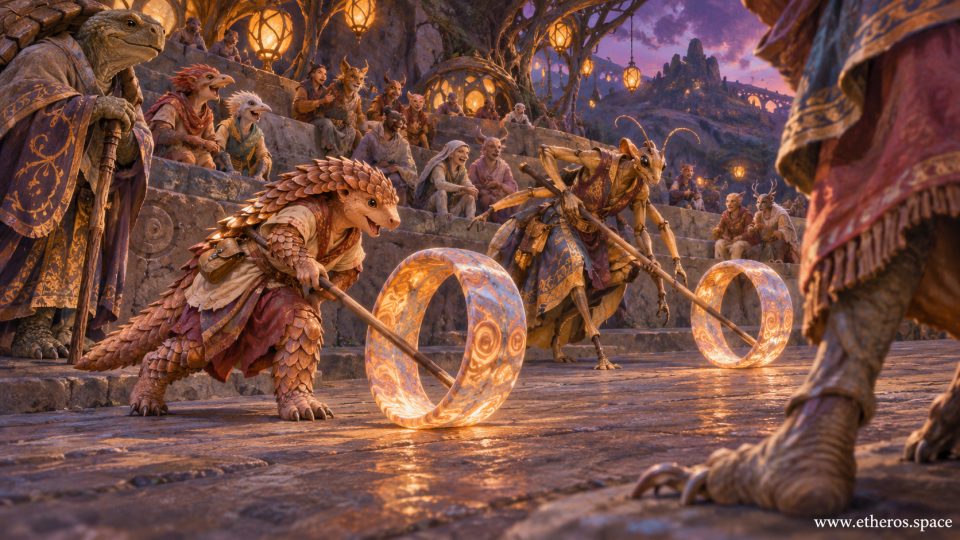
Amiq had never entered the hollow before the lamps were lit. The young scale-backed runner stood near the lower curve in a layered ochre tunic, holding a long guiding staff across both hands. Beyond the staff a large, amber-patterned ring rested upon its rim. It looked delicate when still, but the grown glass-reed from which it had been bent had the resilience of a sprung root. Its golden glow came from colonies of tiny symbiotic organisms sealed beneath the translucent sheath. Light was the ring's ornament; motion still depended on a good push.
Opposite, Keseth checked the binding around a second ring. The tall antennaed competitor had entered these games for eleven seasons. Their many-jointed limbs made the steering staff look like an extension of their body. Children in the terraces always assumed Keseth would win. Keseth found this more burdensome than flattering.
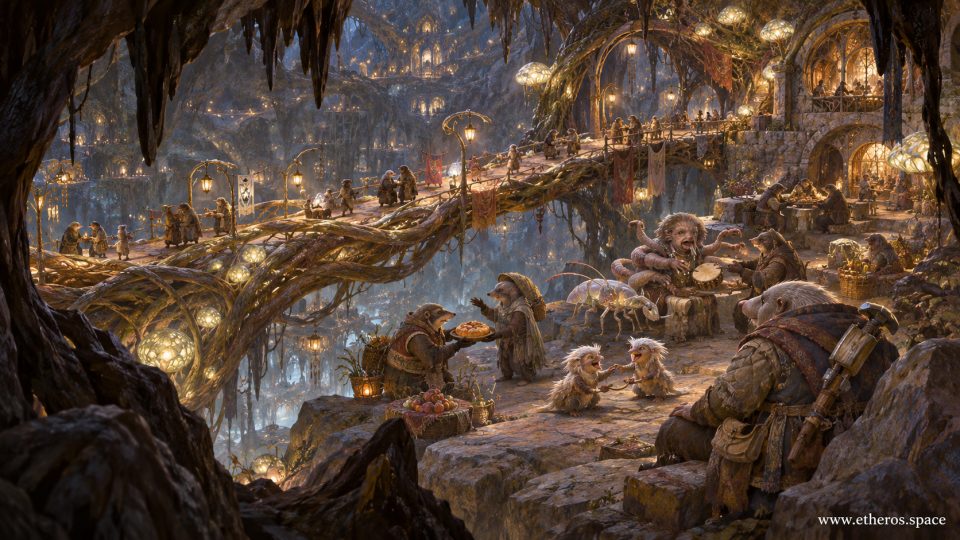
Above them old Sarruk leaned on a knotted cane. The referee's shell had weathered to the color of sandstone, and the embroidered cloth over it had been repaired many times. All around Sarruk spectators occupied a semicircle of uneven stone steps: horned walkers, feathered neighbors, small furred children and larger travelers with folded claws or tails carefully arranged so that others could sit. Some laughed already. Others had come merely to watch the lanterns.
The game was simple in description. Two rings, two guides, one oval circuit. A runner must keep the ring upright with a pole and bring it around the markers without striking a spectator or another runner. The ring could not be lifted over a difficult section. No one was to interfere with another's steering, and no competitor could cross the inner line merely to shorten the course.
Until this year there had been one more rule: the staff was to be handled from a standing two-footed posture.
Amiq had four strong ground-contact limbs. They could rise briefly to use both forelimbs, but the posture pulled uncomfortably against the plates of their back. On the practice path they had been fast, inventive and perfectly safe. At the formal games the old rule would have disqualified their natural gait. Amiq's aunt had asked the council whether a runner should be judged by the position of their legs or by the fairness of the race.
The question had seemed small to those who had always run upright, and enormous to those who could not.
Keseth had argued against changing the rule on the day of a contest. They were not unkind. They had trained through winter storms, measuring how the pole touched the ring when the stone tilted, and worried that a sudden change might reward an unfamiliar technique without giving everyone time to learn its limits. A few spectators agreed. Others pointed out that the existing rule had been written by people whose bodies were nearly alike. The discussion occupied more council hours than anyone expected.
Now Sarruk tapped the cane against the lowest step. The crowd fell almost quiet.
"The tracks remain the same," the elder announced. "The rings remain the same. No one may carry, throw, or obstruct them. But how you keep your feet beneath you is your own affair. This is a trial rule. We will examine it after the games."
There was cheering, and there was a little worried murmuring. Both were allowed. No new rule was sacred simply because it was new.
The signal sounded. Amiq pressed the staff against the near rim and sent the patterned ring forward. Keseth matched the motion with a precise sweeping stroke. Two luminous circles began rolling along the worn stone, amber reflections flashing beneath their arcs. Dust rose from their lower edges, and the crowd leaned inward before remembering that leaning did not make anyone faster.
Amiq ran low, close to the ground, using the rear limbs for propulsion and the forelimbs for quick corrections. Keseth balanced high and light, adjusting the guiding pole between several delicate hands. Both ways worked. Neither looked easy.
At the first turn Amiq's ring wobbled. A child in the terraces gasped. Keseth, a stride ahead, heard the sound and almost turned; the effort of not looking back made the next stretch dangerous in its own way. Amiq caught the spinning rim with a diagonal stroke, recovered, and continued without leaving the track.
Sarruk's hand tightened on the cane. It was a clean correction. The old elder had seen the same maneuver in practice and had been frightened of it because it was unfamiliar. From the stands now it looked less like a threat and more like skill.
The second turn brought them almost level. Keseth's ring ran close to the outside stones. Amiq took the shorter lawful curve. Neither could see how the other looked from the spectators' point of view. Each could only feel the ring's resistance through the staff and decide whether to push harder or let it settle.
At the finish the two hoops passed the lantern post so near together that no one was certain which had crossed first. A cheer became a dispute, then laughter, and finally a demand for witnesses. Sarruk asked two stewards at opposite ends of the line to say what they had actually seen. Their accounts differed.
"Then we have two finishers," the elder said, "and an unfinished question."
Keseth knelt to steady the ring. Amiq lowered their own staff and, after a moment's hesitation, offered a foreclaw. Keseth took it with a thin articulated hand. The crowd cheered more loudly for that exchange than it had for the finish.
No shortage was solved, no old prejudice vanished, and the council still had to measure whether the changed rules made collisions more likely. Tomorrow the stone would be swept, the lanterns checked and the rings returned to their racks. A few spectators would continue to argue over the finish for weeks.
But on the lowest terrace a small child with six unevenly placed feet had begun practicing the motion of a guiding staff, and no one told them to stand differently.
In Luth Vale the games belonged to the people who kept coming back to play. That evening, for a little while, the circle was wide enough for one more way of moving through the world.