The Seam That Would Not Disappear
Story
THE SEAM THAT WOULD NOT DISAPPEAR
In the upper galleries of Sarvareth, cloth was once measured by the number of mornings it took to weave. Now the broad timber loom at the back of the atelier could produce a ceremonial length before the sun had cleared the distant chalk mountains.
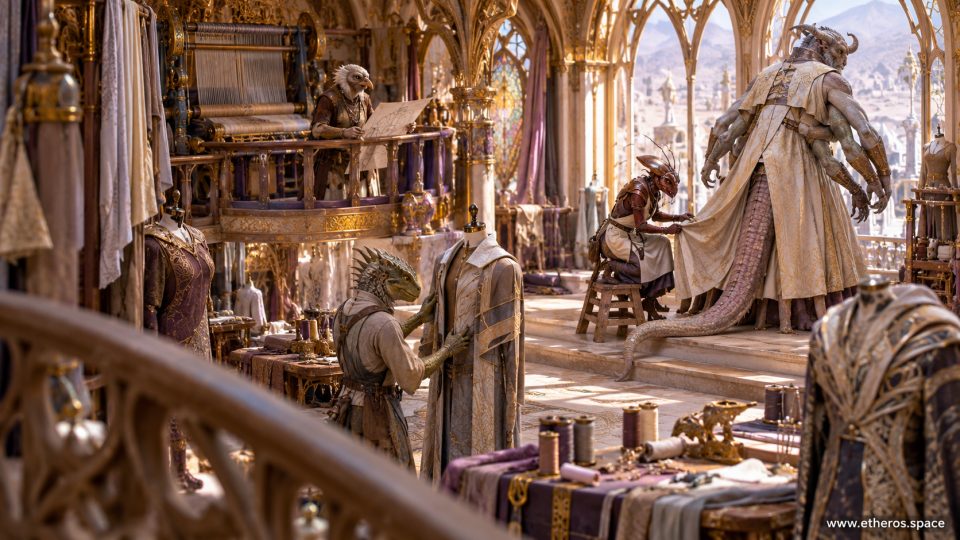
Avrel had overseen both ways of working. The feather-crested master stood at the raised pattern desk, a curling sheet of measurements braced against its wooden rail. Below her, bright panels of cream, russet and violet hung between carved columns. The loom's rollers were quiet for the afternoon, though the day's new fabric still draped from the upper beam. In the foreground, spools and fine needles lay ready beside the unfinished coats.
The new machine was not a villain. It gave families with modest means access to cloth that only wealthy houses could once afford, and it spared apprentices weeks of repetitive strain. But the district's purchasers had begun speaking as if a garment were finished when it left the rollers.
At the far end of the sunlit room stood Ader, whose broad horned head, several working arms and long scaled tail made that claim difficult to defend. He wore a pale gold outer robe over his old work clothes. Senvek, the narrow, antennaed fitter, sat on a wooden stool and held the trailing hem away from the tail's rough plates. The fabric pulled at one shoulder whenever Ader raised his lowest arm.
Ader did not complain. He had spent his adult life inspecting the stone galleries along the upper roads. He knew a tight joint when he felt one, and he knew that forcing it would make damage appear somewhere else. This garment was intended for a civic procession honoring the crews who kept the mountain crossings sound. He had agreed to wear it because his daughter had helped embroider one of its borders.
"If I lower all my arms, it fits beautifully," he told Senvek.
"You will need them to greet people," Senvek replied.
"And to keep my balance on the steps."
Near a mannequin, Hura, the short green-scaled pattern-maker, smoothed a second coat over a narrow dummy form. Its front panels were perfectly matched. Yet Hura could see where the machine's elegant repeating motif would fall directly across a living creature's bending joint. She marked that place with a small length of dark thread.
The atelier had received an offer from the council: an order large enough to keep the looms occupied for three seasons, provided each finished garment used the new universal cutting plan and required no more than one fitting. The council's accountant said the savings could fund clothing for twice as many residents. Avrel had no reason to doubt the arithmetic. She doubted the word universal.
Senvek asked Ader to take a measured step. One heavy foot landed on stone; his tail followed, sliding gently across the hem. The cloth caught at a lower scale. Senvek released two stitches before they could tear, then opened the side panel to reveal a hidden pleat.
The movement became easy. The robe lost none of its dignity, but the alteration demanded a length of work the new contract did not count.
Avrel descended from the pattern desk. She examined the loosened threads, then the fit at Ader's upper shoulders. Instead of telling Senvek to pull the cloth tighter, she asked Hura for the ordinary work ledger and the measurements of every species that had ordered garments that season.
The pattern-maker brought a stack of tablets. The records showed something that the council's tally had hidden. A cloth length could be made in a fraction of the former time, but the most intricate bodies still needed an experienced hand. Some customers returned repeatedly because their garments chafed, restricted a wing or trapped a tail. A few gave up and wore the ill-fitting clothes anyway.
"Then the machine has made weaving faster," Hura said, "but not necessarily clothing."
"Nor has it made the old work useless," said Avrel. "It has made the unseen part harder to charge for."
He turned slightly so that Senvek could place a second pleat below his shoulder. Sunlight slid across the carved gold on the balcony, then fell through the long windows to the stone floor. Across the hall, Hura continued adjusting the mannequin's coat with a look of concentration that was neither nostalgia nor defeat.
Avrel decided to present the council with a second set of figures: the cloth saved by efficient weaving, the labor still required for safe fitting, and a proposal for paid apprenticeships in species-specific pattern work. She would also offer a simpler line of garments that truly needed little adjustment. The council might reject the added expense. Some weavers might resent another round of training. Customers might choose the cheaper clothes even when they knew the difference.
None of those questions could be settled by a single fitting.
Senvek tied off the new seam and asked Ader to raise his arms again. This time the robe moved with him. Ader took one step, then another. His long tail passed beneath the cloth without catching. He looked toward the mountains beyond the arched windows and breathed as though he had only now noticed how carefully he had been standing.
From the balcony Avrel could see the machine, the waiting cloth, the old mannequins and the four working lives arranged around them. She left the ledger open beside her pattern sheet.
The loom would start again in the morning. Before it did, she wanted the purchasers to understand that a length of cloth was not yet a promise made to a body.