At Hearthside, the Sound Between Breaths
20261106T132451715464Z_066percent.png

Story
At Hearthside, the Sound Between Breaths
Arel Ravine, on the morning side of primordial Etheros
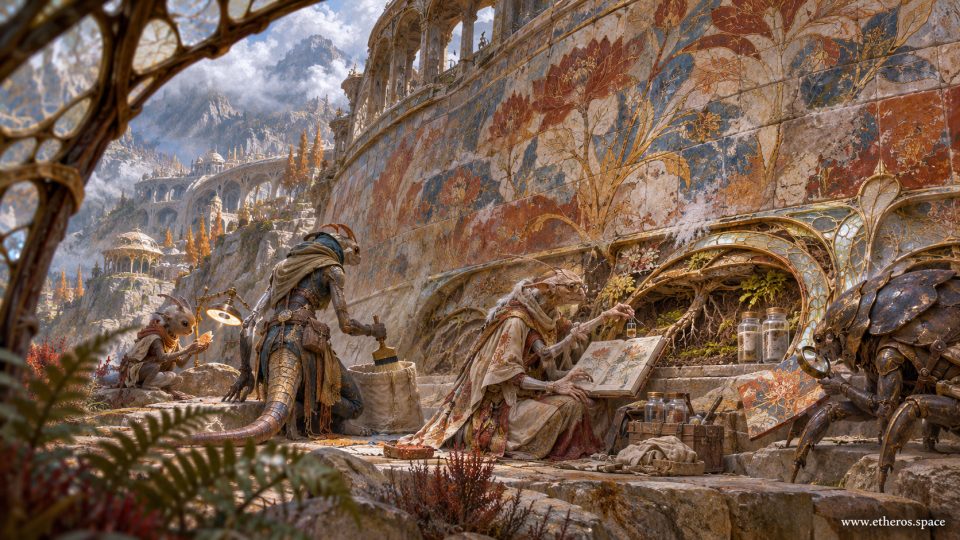
The mountain path was pale with morning mist, but inside the Root House the hearth had burned since the second watch. Brass-colored ducts carried its warmth along the ceiling, their ribs grown around older timbers rather than nailed over them. Rowa, the owl-faced keeper of the house, stirred a dark pot with one hand while she listened to the patient breathing on the floor.
Arvek had not slept. He was too large for any bed the household could afford, and the cushions under his six heavy, furred-and-armored limbs had been made from old winter cloaks. His great back was protected by overlapping copper-dark plates. He had carried stone up this ravine for most of his long life, building the foundations beneath other people's homes. Now the effort of crossing the kitchen exhausted him. He disliked the sound he made when he tried to laugh: a breath caught somewhere beneath the plates, followed by silence.
Beside him knelt Nemm, a small green-scaled healer with four working arms. One held a lattice-woven listening horn against the broad shoulder where the living plates met soft tissue. Another steadied its weight, and the others felt for a rhythm in the elder's pulse. There were no glowing words inside the horn and no oracle hidden in its ceramic throat. It amplified a vibration that a practiced ear might distinguish from ordinary fatigue. Might: that was the word Nemm kept using.
Across the rug, Ilir waited with a folded russet blanket. The young shell-backed creature had offered it three times, and three times Arvek had said he was already warm. At the fourth offer he let it rest across his nearer forelimb. Ilir sat down without celebrating the victory.
'Your left breathing chamber is slower than the right,' Nemm said. 'That I can hear. I cannot yet tell whether the cause is an old crack, a temporary swelling, or the way your armor has changed with age.'
Arvek turned his broad face toward the window. Two early travelers walked along the ridge under the lavender mountains. 'So the clever horn does not know,' he said.
'No,' Nemm answered. 'It knows enough to ask a better question.'
That was harder to accept than a promised cure. For years the settlements had argued about the listening horns. Some healers said they prevented needless cutting into living shells. Others warned that a beautiful resonance could disguise a dangerous injury, particularly when a tool calibrated to one lineage was used on another. Nemm's teacher had died repeating a warning: never let the clarity of a sound become certainty about its meaning.
Rowa brought a little broth, not as medicine but because it was breakfast. Arvek could taste it without moving. They agreed to let the household rest, to record the changes in his breath over the coming watches and to send word to a specialist of his own kind across the pass. If his breathing worsened, they would not wait for her return. Nothing in this plan was miraculous. That made it useful.
Then Nemm took out a sheet of thin, root-pulp paper. The local healers were assembling an atlas of resonance patterns, hoping to recognize troubles in people whose bodies had once been considered too unusual to study. The atlas might spare future patients an invasive examination. But each pattern could also tell neighbors who was ill, who could no longer work, who might owe money for care. Even a small village could turn a kindness into a ledger.
'I would like to keep only the shape of the sound,' Nemm said. 'Not your name, not the house, not the day. You may refuse, and your treatment will not change.'
Arvek studied the horn's copper throat and the young keeper's green hands. 'You may keep it when I have heard it myself,' he decided. 'And Ilir may decide later whether to lend anyone the sound of their own body.'
Nemm accepted the condition without bargaining. Rowa set aside a spoon so Ilir could learn the old rhythm by tapping lightly on the rim of the bowl. The child was terrible at it. For the first time that morning Arvek laughed, quietly and without trying to conceal the catch in his chest.
Outside, the travelers on the ridge continued toward the next village, carrying news that would arrive late, misunderstood or both. Inside the Root House, no one claimed to have solved what ailed Arvek. They had done a smaller thing: listened without pretending that listening was possession, and made room for another morning.