The Name the Sky Could Not Keep
Story
The old ring could no longer follow the stars. No one had gathered on the ridge to make it follow them again.
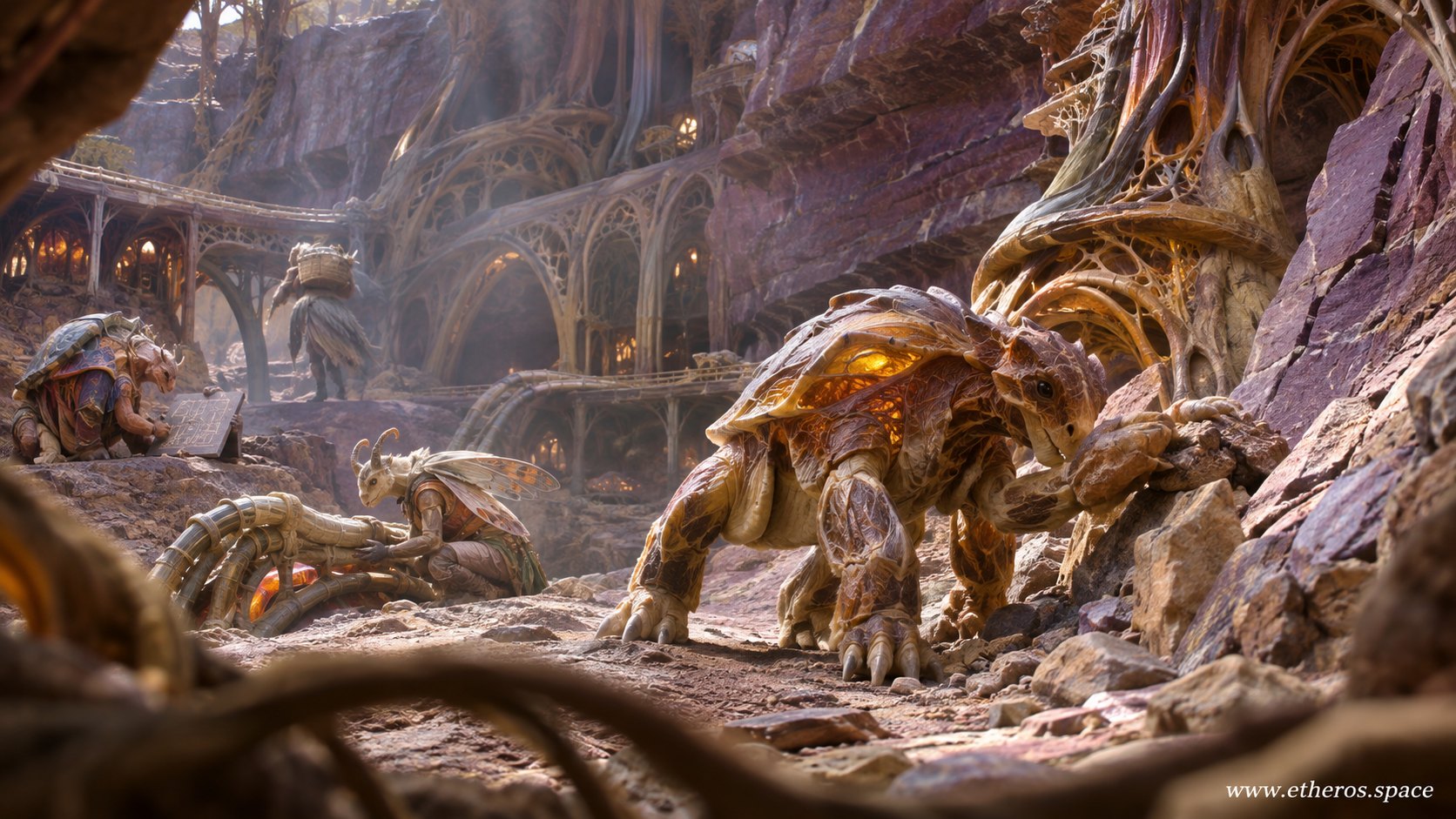
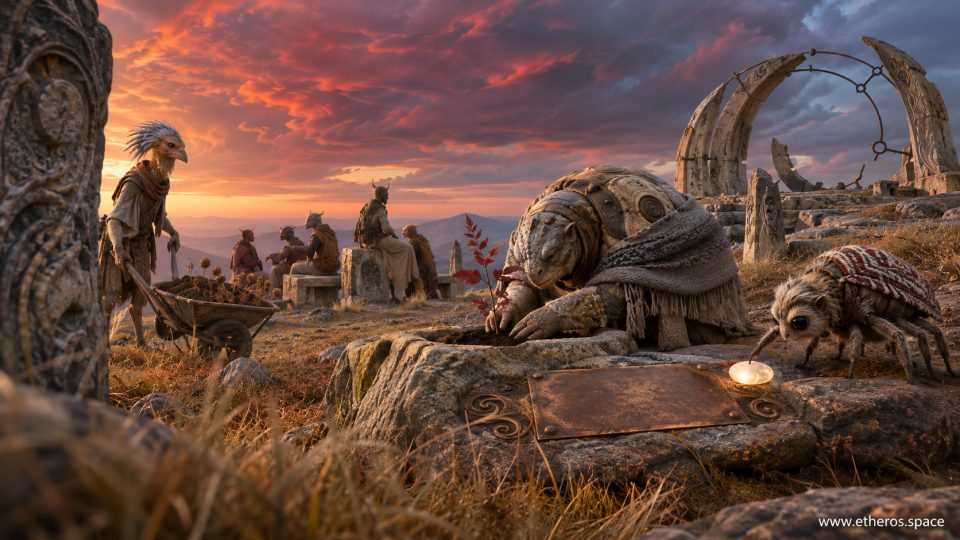
There were seven grown folk in sight when the western clouds turned the color of hot copper, and one creature not yet old enough to count the seasons by the lines on its shell. Above them the split arms of the sky-ring still rose from Tharu's limestone crest, their curved braces open where the missing span had once turned. Grass had rooted in its footing. In all the years the arch had watched the sky, nobody had thought to ask what should grow where its shadow ended.
Avek arrived with a barrow of hill soil and a narrow spade. The feather-crested groundskeeper set the wheel into the hollow between two stones and leaned on the handles without speaking. Beside the low stone bed, his oldest friend Senn remained crouched over a sapling with five red leaves. Senn's back was broad and plated, and the woven mantle across it had been patched so often that none of the cloth remembered its first color. One large, careful hand made space around the root. The other steadied its stem against the evening wind.
The sapling was not a gift from a distant prince or a rare relic carried from some vanished realm. It came from the dry slope below the ridge, where this species of tree survived by spreading its roots through cracks in the rock. Senn had chosen it because it would need ordinary tending. For once in his long life he wished to care for something that could not be kept alive by an ingenious device.
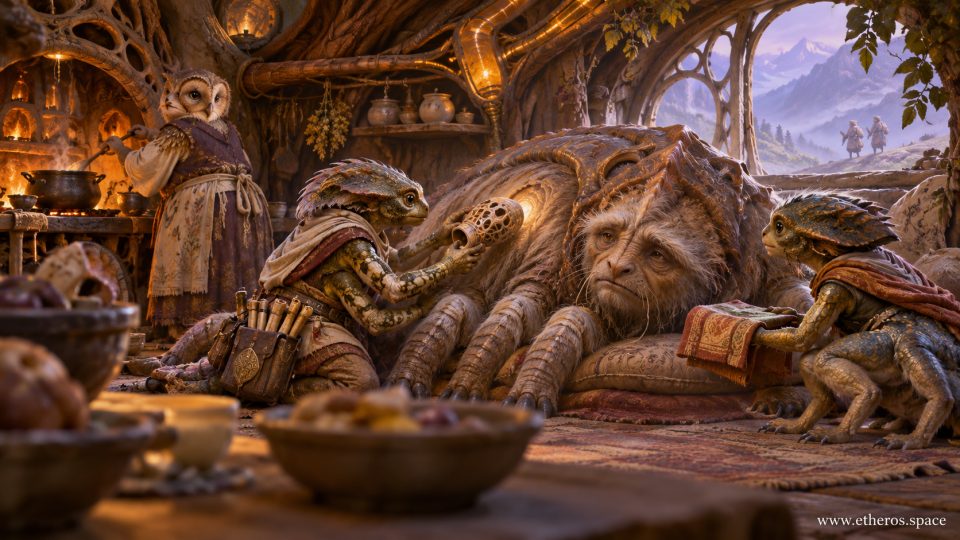
On a flat ledge to his right, little Orrik leaned close to a small amber lamp. The child's downy fur rose between the plates of a knitted head covering; six fine limbs sought purchase among the pebbles. The lamp was a warm seedlight in a clear shell, powered by its own slowly ripening pith. Orrik had brought it for the ceremony but now guarded it from the breeze as if its light were the last thing holding the whole ridge together.
'Will the arch remember?' the child asked.
Senn did not look up. 'Stone remembers weight. The people who lived beneath it remember different things.'
Their missing friend, Enael, had kept the ring's alignment for forty-six long turnings of Etheros's remote seasons. Every night she could stand, she climbed the western steps and noted the slow procession of distant lights through the open circle. When the support bearings fractured, the council ordered the mechanism stopped: a new ring would cost more than the outlying communities could spare, and an unstable old ring could injure the very watchers it had served. Enael agreed with the order. She died before the apprentices finished copying her observations onto bark scrolls. None of the mourners believed that her death was caused by the broken machine, yet all felt the silence that followed it.
On the lower rise several neighbors sat facing the horizon. One was a traveler who had crossed the ridge because Enael's sky counts once helped caravans judge the change between the dusty and the bitter seasons. Another had opposed the ring's repairs even when repairs were possible; she had argued that the same materials should strengthen roofs in the lower settlement. She still believed it. The two sat near enough to share the view without pretending they shared a conclusion.
Below Orrik lay a bronze nameplate bolted to the stone. The plate remained empty. When it had been commissioned, the council asked whether Enael's name should appear on it. Her former assistant wanted the letters carved so that future children would know who had worked here. Senn remembered Enael's objections to monuments made in anyone's honor. She had spent years reminding visitors that the sky belonged neither to the observers nor to those who paid them. The council, unable to settle the argument, left the plate blank until the next public gathering.
Avek tipped the last of the soil beside the sapling. He knew the arguments better than most: his mother had walked the long road to the observatory before the ring's bearings failed. She had once been refused a place as an apprentice because the available stairs were too steep for her legs. Enael had finally found a lower route, but only after the woman had already spent five seasons carrying other people's notes up the hill. If the council chose to build another instrument, Avek said, it must also build the way to reach it.
Senn pressed the soil around the roots. No bell rang. The mourners did not stand in formation. A worker rested by a wheelbarrow, a child held a light, two elders argued quietly about the cost of steps, and the last saffron light crossed the mountain backs.
'Perhaps,' said Orrik, 'we can write what she found instead of just her name.'
Senn turned toward the little creature. It was not a promise, and it did not settle which names belonged on a public stone. But by the time the first cool star appeared above the fractured arch, three of the elders had agreed to bring copies of Enael's last charts to the next gathering. Avek offered to measure a new accessible path. Someone else offered to tend the red-leaf tree on the nights when Senn could no longer climb to it.
The sky-ring would remain silent for the season. In the dark above it, the stars continued their slow and indifferent passages. On the ridge below, a different kind of observation began: who came to water the sapling, who learned the old measurements, who stayed to ask why a ladder had ever been the only way to the sky.